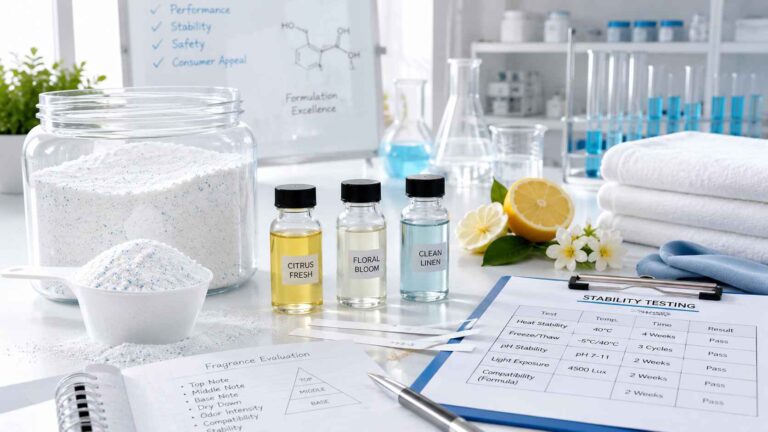
Perfume maceration is real, but the online mythology surrounding it is not. Here is what controlled resting can improve, what it cannot repair, and how professional buyers should test perfume oil before approving a batch.
But whether that change counts as improvement depends on the carrier, headspace, oxygen exposure, raw-material profile, storage temperature, packaging system, and whether anyone recorded a proper baseline before the bottle disappeared into a dark cupboard for six weeks.
Without a control, what exactly are we proving?
My blunt answer is this: perfume oil maceration matters as a controlled production and evaluation step, but it is not a miracle treatment for weak fragrance.
It can help a freshly compounded oil smell more integrated. It can expose haze, sediment, color drift, carrier incompatibility, and rough transitions between notes. It gives formulators time to see whether a sample is genuinely stable or merely attractive on the day it was mixed.
But perfume maceration cannot rescue a thin formula, replace fixatives, repair oxidized citrus materials, correct an unsuitable carrier, or guarantee longer wear.
That is the hard truth.
The Industry Uses “Maceration” Far Too Loosely
Online fragrance discussions tend to use maceration, maturation, resting, and aging as though they describe the same process.
They do not.
In stricter professional usage, maturation usually describes the resting of the fragrance concentrate after its aromatic materials have been compounded. Maceration often refers to the later rest after that concentrate has been diluted in ethanol. A finished oil-based perfume contains no ethanol stage, so what sellers call perfume oil maceration is more accurately described as maturation, equilibration, or controlled resting.
The terminology varies between fragrance houses. The chemistry does not care what marketing calls it.
In an April 2026 investigation, Allure interviewed perfumers and an International Flavors & Fragrances technical manager. The experts described maturation as a controlled two-to-three-week period during which raw fragrance oils are allowed to integrate. Maceration followed after dilution in alcohol, allowing aromatic materials to dissolve, distribute, and reach a more stable equilibrium.
That distinction matters for oil perfume.
A carrier such as jojoba oil, fractionated coconut oil, dipropylene glycol, isopropyl myristate, or a mixed ester system does not behave like ethanol. It changes diffusion, evaporation, skin feel, clarity, and the apparent balance between top, heart, and base notes.
Our guide to oil-based perfume versus alcohol-based perfume explains the commercial consequence: oil normally produces a softer, closer scent profile, while ethanol creates faster lift and wider projection.
So when someone says a perfume oil “needs six weeks to become stronger,” I become skeptical.
Stronger by what measurement?
Table of Contents
What Perfume Oil Resting Actually Changes
A freshly mixed perfume oil is not necessarily chemically unfinished. It is, however, often sensory and physically unsettled.
Several things can happen during a controlled rest.
Aromatic materials distribute through the carrier
Heavy materials, crystalline ingredients, resinoids, musks, vanillic materials, and viscous naturals may require time and adequate mixing to distribute fully through a carrier.
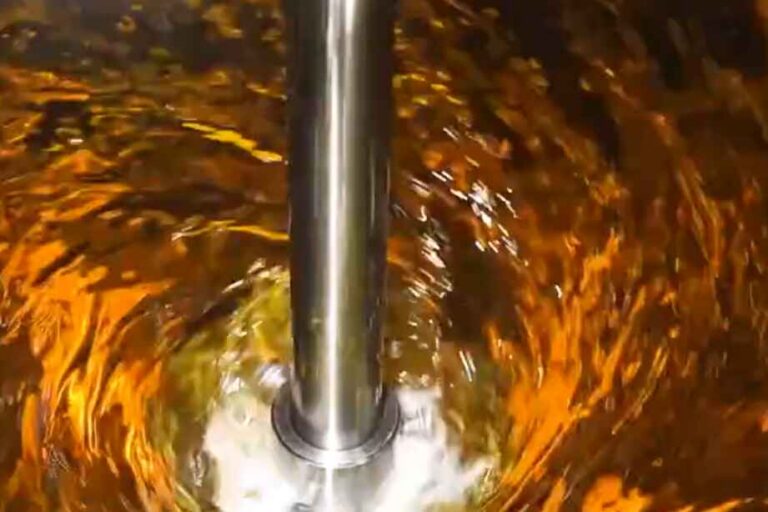
The first sample drawn from a tank may not represent the final bulk blend if the system was poorly mixed. Resting does not replace proper agitation, but it can reveal whether the mixture remains homogeneous after that agitation stops.
The scent may become easier to evaluate
Freshly compounded accords sometimes smell disjointed. A sharp citrus opening may sit awkwardly above a dense amber base. A powerful woody material may dominate the first evaluation. Trace materials may be difficult to read.
After several days, the same composition can appear rounder and more coherent.
I said appear deliberately.
The materials have not formed a mystical new perfume molecule. Their distribution, solubility, evaporation pattern, and sensory balance may simply be easier to judge after the blend has settled.
Insolubility and precipitation have time to show themselves
This is where resting earns its production value.
A bottle that looks clear at T0 can develop haze after 72 hours. Crystals may appear at lower temperatures. A natural extract may throw sediment. A resin-heavy accord may separate. The carrier may react badly with a rollerball gasket or plastic component.
Those are not romantic transformations. They are warning signs.
The site’s existing guide to perfume maceration timelines and evaluation checkpoints offers working ranges for concentrates, fine fragrance, surfactant products, candles, and diffusers. Those ranges are useful starting points, but they should never replace observations from the actual formula.
Oxidation may begin changing the fragrance
Here is where “more time is better” falls apart.
Limonene has the molecular formula C10H16. Linalool is C10H18O. Both are common fragrance materials, and both can oxidize when exposed to air. Heat, ultraviolet light, repeated bottle opening, excessive headspace, and unstable raw materials can accelerate that process.
Oxidation can flatten citrus notes, alter odor character, deepen color, and create hydroperoxides associated with contact allergy.
A multicenter clinical study published through the U.S. National Library of Medicine found positive reactions to oxidized R-(+)-limonene ranging from 0.3% to 6.5% across four dermatitis clinics. Among limonene-allergic subjects, approximately 60% reacted to the limonene hydroperoxide fraction during testing.
Those figures apply to tested dermatitis patients, not the general public. Still, the lesson is uncomfortable: oxidation is not automatically beneficial fragrance aging.
Sometimes the perfume is not maturing.
It is degrading.
Perfume Maceration, Maturation, and Aging Compared
Process
What It Usually Means
Typical Stage
What It May Improve
Main Risk
Maturation
Resting the compounded fragrance concentrate before final dilution or application
After aromatic materials are blended
Accord integration, sensory evaluation, detection of sediment or instability
Oxidation, unnecessary delay, loss of volatile character
Maceration
Resting fragrance concentrate after dilution, traditionally in ethanol
Before filtration and filling of EDP, EDT, or parfum
A consumer leaving a finished bottle in a drawer is not repeating the manufacturer’s controlled maceration process. The perfume has already been diluted, filtered, filled, shipped, exposed to temperature changes, and opened.
That is aging.
And aging is unpredictable.
Darker Perfume Does Not Automatically Mean Better Perfume
Color change is persuasive because consumers can see it.
That does not make it evidence of improved quality.
Vanillin, C8H8O3, is famous for darkening in finished products. Vanilla-rich fragrances can shift from pale gold to amber, brown, or nearly black over time. Certain naturals, resins, balsams, and color-sensitive aroma chemicals behave similarly.
The 2026 Allure investigation used Kayali Vanilla 28 as a prominent example. Social media users treated the darker bottles as stronger and more desirable, yet principal perfumer Gabriela Chelariu explained that the color shift came from the natural behavior of vanillin and other reactive materials. A darker color did not automatically prove better performance.
I agree with the skeptical reading.
Color is data. It is not a quality score.
A darker perfume oil may smell richer because volatile top notes have faded and the base now feels louder. That is a change in balance, not necessarily an increase in fragrance strength or longevity.
And sometimes darker oil means oxidation, an unstable carrier, heat exposure, or packaging interaction.
Would you approve a bulk batch from color alone?
Of course not.
The Real Evidence Problem Behind Fragrance Aging Claims
Most online perfume maceration tests would fail a basic laboratory review.
The user smells a fragrance on Day 1. Then again on Day 30. They know which sample is older. They remember what they expect to happen. They may apply a different amount, test under different weather conditions, or compare skin performance after becoming more familiar with the scent.
That is not a controlled comparison.
It is expectation dressed as evidence.
A better test requires:
A retained T0 sample
Identical bottles and fill levels
Controlled storage temperature
Comparable headspace
Fixed application quantity
Coded or blinded samples
Blotter readings at the same intervals
Skin evaluation on more than one person
Written observations for opening, heart, dry-down, color, clarity, and irritation
A predefined acceptance standard
The 2024 systematic review indexed by PubMed on fragrance sensitization examined 84 eligible original studies. Among European dermatitis patients, reported sensitization prevalence was 6.81% for Fragrance Mix I and 3.64% for Fragrance Mix II.
Again, these were dermatitis populations, not random consumers. But the figures demolish the idea that perfume aging is purely an aesthetic hobby with no technical or safety dimension.
Accord integration, skin performance, packaging interaction and color shift
Often sufficient for simpler perfume oils
Day 28
Resin, oud, amber, musk and natural-heavy development
Compare against Day 14; continue only if change remains meaningful
Day 42
Stability plateau, oxidation signs and final sensory approval
Stop waiting if no measurable improvement remains
Long-term stability
Heat, light, cold, packaging and normal storage controls
Required for commercial confidence, not replaced by maceration
For a simple, stable perfume oil, seven to fourteen days may be enough to make a sound evaluation.
For resinous amber, oud, balsamic, musk-heavy, or natural-rich compositions, two to six weeks may reveal useful changes. But “may” is doing important work in that sentence.
Citrus-heavy perfume oils deserve extra caution. Their sparkle can decline while the heavier base appears stronger. A tester may call that improvement even though part of the original structure has disappeared.
The best maceration time is therefore not the longest time.
It is the point at which the formula reaches an acceptable, repeatable plateau.
How to Macerate Perfume Oil Without Damaging It
Start with clean equipment and a documented formula.
Mix the concentrate and carrier thoroughly. Do not expect time to compensate for poor blending. Fill the sample into compatible glass or validated production packaging, leaving as little unnecessary headspace as practical.
Seal it.
Store the sample away from direct sunlight at a stable, moderate temperature. Do not put it on a radiator. Do not leave it in a hot car. Do not repeatedly freeze and thaw it because a social media video promised “molecular activation.”
And stop removing the cap every day.
Every opening changes headspace and oxygen exposure while allowing volatile materials to escape. If you need multiple evaluation points, prepare multiple coded samples at T0 rather than repeatedly disturbing one bottle.
I would also hold a separate retained control under normal conditions. For serious development, another sample should undergo controlled stress testing.
This is where quality management in fragrance oil production becomes more important than perfume folklore. A manufacturer should be able to trace the formula version, raw-material lots, mixing record, storage conditions, evaluation dates, packaging type, and release decision.
Otherwise, “macerated for 30 days” tells the buyer almost nothing.
What Perfume Maceration Can Fix—and What It Cannot
Controlled perfume oil maceration can help:
Settle bubbles and suspended material
Reveal haze, crystals, sediment, or separation
Improve the reliability of sensory evaluation
Allow difficult materials to distribute through the carrier
Expose packaging incompatibility before filling
Reduce premature formula modifications
Establish a repeatable production hold time
It cannot:
Replace proper fixative selection
Make low-quality raw materials premium
Correct an unbalanced fragrance structure
Reverse oxidation
Remove an irritating material
Repair a rancid carrier oil
Guarantee stronger projection
Guarantee longer skin wear
Replace IFRA review, safety assessment, or stability testing
This distinction saves money.
I would rather delay approval for a properly designed 14-day checkpoint than wait 90 days for a bad formula to become an older bad formula.
For buyers developing a commercial scent, the custom fragrance development process from brief to bulk production is the stronger model. It treats resting as one control point inside a larger system covering the brief, formula, base, documentation, application testing, pilot production, and retained standards.
That is manufacturing.
Everything else is hope.
Why Maceration Records Now Matter to Commercial Brands
Perfume oil resting time is not explicitly prescribed as one universal legal number. Regulators do not tell every brand to rest every fragrance for 30 days.
They do, however, expect safe and properly controlled products.
The FDA’s current MoCRA guidance states that the responsible person must ensure and maintain records supporting adequate safety substantiation for cosmetic products. The law does not prescribe one mandatory test for every formula, but “we let it sit and it smelled better” is not persuasive safety documentation.
The European Union has moved further on fragrance-allergen disclosure. Commission Regulation (EU) 2023/1545 maintained the existing 24 individually labelled fragrance allergens and identified 56 additional allergens for disclosure requirements.
The regulation applies thresholds of:
0.001% in leave-on cosmetics
0.01% in rinse-off cosmetics
Non-compliant products covered by the transition provisions may be placed on the EU market until July 31, 2026, and made available until July 31, 2028.
This matters to maceration because air oxidation can transform some fragrance substances into recognized allergens. Time is not legally neutral when time changes the chemical profile.
An IFRA certificate for fragrance oil remains an important part of the document pack, but it does not prove that a particular carrier, bottle, storage condition, concentration, or finished batch will remain stable.
I want the IFRA certificate.
I also want the COA, SDS, allergen declaration, formula version, batch code, retained sample, packaging test, and written release criteria.
Perfume is emotional. Approval should not be.
FAQs
What is perfume oil maceration?
Perfume oil maceration is the controlled resting period after aromatic materials are blended with a carrier oil, allowing the mixture to reach a more stable sensory and physical state before evaluation, filtration, filling, or release; in strict technical language, many professionals would call this maturation or equilibration rather than maceration.
During that period, formulators monitor odor, color, clarity, sediment, separation, viscosity, packaging interaction, and dry-down behavior. It should be treated as a documented production hold, not passive waiting.
Does perfume maceration make fragrance last longer?
Perfume maceration can improve perceived smoothness and consistency, but it does not automatically increase molecular longevity or turn a weak formula into a strong one; longer wear depends mainly on the volatility profile, concentration, carrier, skin interaction, application amount, and the proportion of substantive heart and base materials.
A rested fragrance may seem stronger because sharp top notes have softened or faded, making amber, musk, wood, vanilla, or resin notes more noticeable. That shift should not be confused with a measured increase in total longevity.
How long should perfume oil macerate?
The best perfume oil resting time is usually the shortest controlled period after which odor, color, clarity, and dry-down readings stop changing meaningfully, with 7–14 days serving as a sensible first checkpoint and 2–6 weeks reserved for heavier resinous, amber, oud, or natural-rich compositions that still show measurable evolution.
Commercial release should also depend on stability and packaging data. A pleasant Day 14 smell does not prove that the formula will survive six months in a warehouse or a hot shipping container.
How do you macerate perfume oil correctly?
To macerate perfume oil, mix the formula completely, transfer it into clean low-headspace glass or compatible production packaging, seal it, store it in a dark location at a stable moderate temperature, and compare retained samples at fixed intervals without repeatedly opening, heating, freezing, or shaking the batch.
Record T0, 72-hour, 7-day, 14-day, and later observations. Use identical blotters, application quantities, and evaluation times whenever possible.
Can perfume oil go bad while macerating?
Perfume oil can deteriorate during an extended resting period when oxygen, heat, ultraviolet light, contaminated equipment, reactive packaging, or an unstable carrier accelerates oxidation, hydrolysis, discoloration, rancidity, or precipitation, so any sour, metallic, paint-like, stale-citrus, or irritating change should be treated as a failure rather than proof of successful aging.
Stop using any perfume that causes new redness, itching, burning, or other irritation. A darker color alone does not establish spoilage, but odor deterioration and physical instability require investigation.
What is the best maceration time for perfume oil?
The best maceration time for perfume oil is a formula-specific hold period validated through repeated sensory and physical measurements, rather than a fixed number copied from another brand, because carrier type, aromatic composition, natural-material content, oxygen exposure, packaging, temperature, and the intended customer experience all influence when the blend reaches stability.
Set checkpoints before testing begins. Stop when the data plateaus. Waiting longer without a defined reason is inventory delay, not craftsmanship.
Stop Waiting Blindly—Test the Batch
Do not approve perfume oil because it has been sitting for 30 days.
Approve it because the formula remains clear, consistent, recognizable, compliant, traceable, compatible with its packaging, and stable against an agreed retained standard.
Start with a controlled sample. Record T0. Evaluate at 72 hours, Day 7, Day 14, and Day 28 when the formula justifies it. Test the actual carrier and final bottle. Reject unexplained drift.
And when you brief a supplier, send the information that matters: intended application, carrier system, fragrance concentration, target market, packaging material, benchmark scent, allergen requirements, cost target, order quantity, and launch date.
For a production-ready project rather than another scented experiment, submit those details through the OEM/ODM perfume oil development service and request a documented sampling, resting, evaluation, and batch-approval plan.
Our team of 20+ senior perfumers leverages a vast library of 40,000+ formulas to deliver expert customization and scent replication with up to 98% accuracy. As premier perfume oil manufacturers, we bring your most complex fragrance concepts to life with precision.
Industry-Leading Speed
We empower your business with industry-leading speed. Samples are ready in just 1-3 days, mass production takes only 3-7 days, and our low 5kg MOQ allows you to test the market quickly and without risk, solidifying our role as agile fragrance oil suppliers.
Certified Quality & System Assurance
Our quality is built on trust and technology. We are fully certified with IFRA, ISO, GMP, and Halal, and our advanced ERP system guarantees complete traceability and batch-to-batch consistency, making us your reliable perfume raw materials supplier.