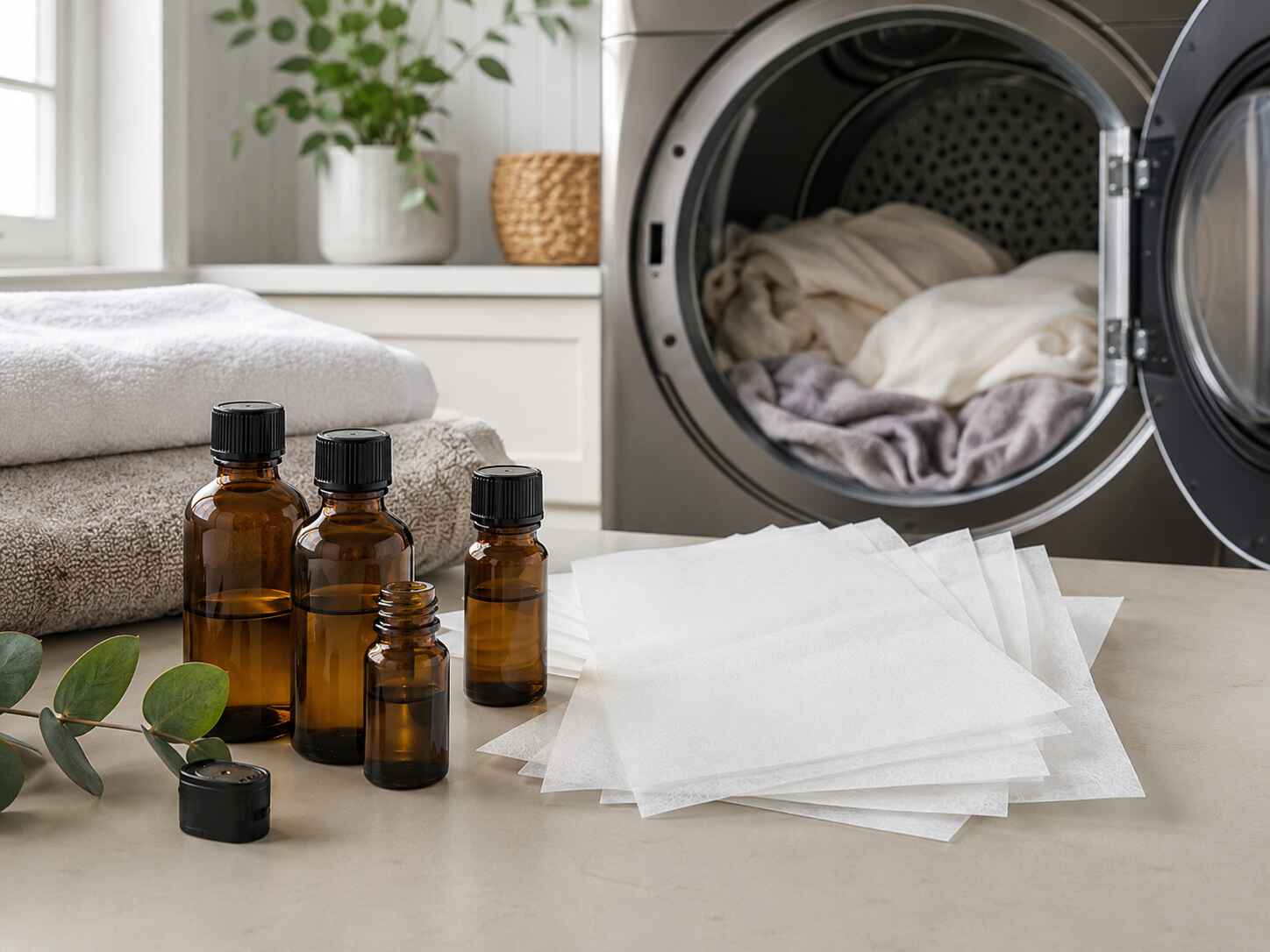
The best fragrance oil for dryer sheets is not simply the strongest or highest-flash-point option. This guide explains how manufacturers should evaluate heated scent release, substrate compatibility, fabric residue, allergen data, documentation, and batch consistency before approving bulk production.
But fragrance oil for dryer sheets operates inside a heated transfer system where the sheet substrate, softening coating, dryer cycle, fabric type, airflow, fragrance volatility, storage conditions, and consumer sensitivity all affect the final result.
Why do buyers still approve it on a paper blotter?
I would reject any fragrance selected solely because it smells “fresh,” has a high flash point, or performs well in candles. A dryer sheet is neither a perfume strip nor a wax product. It is a coated substrate expected to release functional ingredients during heated tumbling while leaving a controlled scent—not greasy spotting, harsh vapor, or a waxy fragrance overload—on clothing.
The hard truth is that the best fragrance oil for dryer sheets is rarely the loudest one in the sample box. It is the formula that survives manufacturing, storage, heat, transfer, cooling, folding, and several days in a wardrobe without turning thin, sour, dusty, or irritating.
Dryer-Sheet Fragrance Is a Heat-and-Transfer System
A scented dryer sheet normally carries a coating that softens or becomes mobile during the drying cycle. The fragrance must remain compatible with that coating before use, release at the intended stage of the cycle, and deposit enough aroma on fabric to meet the product claim.
That is a very different job from fragrance oil for laundry detergent. Detergent fragrance has to survive water, surfactants, dilution, rinsing, and possibly enzymes or alkaline builders. Dryer-sheet fragrance encounters a dry substrate, a coating system, elevated temperature, tumbling, airflow, and direct contact with heated textiles.
Start With the Finished Product, Not the Perfume Pyramid
A useful supplier brief should identify:
Sheet material and dimensions
Coating composition
Fragrance addition point
Target fragrance loading
Expected dryer cycle and temperature profile
Target fabrics, such as cotton, polyester, towels, or mixed loads
Intended markets and regulatory requirements
Packaging format and expected shelf life
Desired scent immediately after drying, after 24 hours, and after storage
Restricted-material, allergen, or environmental criteria
A weak brief says, “We need a long-lasting clean linen fragrance.”
A usable brief says:
Nonwoven dryer sheet with a cationic softening coating, North American and EU launch, six-month packaged stability target, moderate hot-cycle bloom, low residue on black polyester, soft musk and white-floral profile, restrained citrus top note, Category 12 documentation, SDS, COA, and allergen disclosure required.
That changes the supplier conversation. Immediately.
Seven Checks That Separate Dryer-Safe Fragrance Oil From Expensive Trouble
1. Confirm the Correct IFRA Product Category
Dryer sheets and fabric-softener sheets are listed under IFRA Category 12 in the published IFRA 51st Amendment guidance. They are not classified in the same category as liquid fabric softeners, which the guidance places in Category 10A.
Ask for an IFRA Certificate of Conformity covering:
The exact fragrance code
Category 12
The applicable amendment
The maximum permitted fragrance concentration
The certificate date and revision
Any restrictions relevant to the formula
Do not accept “our factory is IFRA certified” as a substitute. That phrase tells you almost nothing about the particular oil being placed in your dryer-sheet coating.
As of July 2026, IFRA’s consultation on the proposed 52nd Amendment had closed, while the published Standards library still listed the 51st Amendment materials. Buyers should therefore ask suppliers to identify the exact amendment used and update documentation when the next amendment becomes effective.
A high flash point can matter for handling, storage, transport, factory risk assessment, and the behavior of the concentrated oil, but it does not prove that the finished dryer sheet will produce a pleasant heated aroma, low emissions, good fabric retention, or acceptable consumer exposure.
So what does it prove?
Under ASTM D56, flash point measures a sample’s tendency to form a flammable mixture with air under controlled laboratory conditions. It is not a fragrance-performance test.
The supplier’s Safety Data Sheet should provide flash point, evaporation-related properties, flammability information, decomposition temperature when available, and handling guidance. OSHA places these physical and chemical properties in SDS Section 9.
My purchasing rule is blunt: reject oils with missing or ambiguous flash-point data, but never select an oil merely because its flash point is higher than a competitor’s.
3. Test Hot Release and Cold-Fabric Retention Separately
The fragrance coming from an operating dryer is not the same fragrance consumers smell on a folded T-shirt two hours later.
Highly volatile top notes can produce a dramatic hot burst and then disappear. Heavy base notes can survive but create a dense, oily, or stale impression on fabric. A balanced dryer-safe fragrance oil needs controlled diffusion across several stages:
Scent inside the unopened package
Scent on the unused sheet
Hot fragrance during drying
Scent on fabric 30 minutes after cooling
Scent after 24 hours
Scent after three to seven days of storage
Use at least three pilot loadings: 0.5×, 1.0×, and 1.5× the proposed commercial target. These are comparative levels, not universal percentages. The lowest loading that meets the sensory target without residue or compliance problems is usually the smarter commercial choice.
For heat, cold, light, and packaging stress methods, use the site’s fragrance stability testing guide as a starting framework, then adapt the conditions to the real dryer-sheet coating and packaging system.
4. Test the Fragrance Inside the Actual Coating
Blotters lie badly.
A fragrance may smell polished in a glass vial yet soften the coating excessively, separate during manufacturing, migrate into the wrapper, stain the sheet, bleed onto fabric, attack printing, or produce an unpleasant fatty note when heated with the softening system.
What is the sample really worth without the base?
The pilot must use the commercial substrate and coating, not a supplier’s neutral test base. Evaluate:
Coating uniformity
Oil migration
Sheet-to-sheet blocking
Wrapper staining
Fragrance loss through packaging
Discoloration
Black-fabric spotting
Towel absorbency effects
Dryer-drum residue
Odor changes after accelerated storage
Fragrance oil for dryer balls should also be treated as a separate application. Wool, plastic, and other reusable ball materials interact differently with liquid fragrance, and consumer dosing may be uncontrolled. A fragrance suitable for a pre-dosed dryer sheet is not automatically suitable for direct application to a dryer ball.
5. Examine the Allergen Profile, Including Essential Oils
Natural means natural. Not harmless.
A 2020 analysis published in Dermatitis reviewed 65 top-selling textile-care products, including eight dryer sheets. Fragrances and essential oils were identified among the leading potential allergens in 75% of the dryer sheets examined. The study evaluated ingredient disclosures, not confirmed consumer reactions, but the result is still a strong reason to demand proper allergen data.
Another study inventoried 1,447 detergent products across 131 households and found widespread use of fragrance allergens, with limonene and linalool appearing frequently on labels. Both materials are common in essential oils as well as constructed fragrances.
This is why the “essential oils for dryer sheets versus synthetic fragrance” debate is usually too simplistic. Citrus oil may contain limonene. Lavender oil may contain linalool. Lemongrass can be rich in citral. Rose-type naturals may introduce geraniol or citronellol. Oxidation, concentration, purity, storage, and the finished exposure pattern matter more than a romantic origin story.
6. Screen Emissions Without Turning the Article Into Scare Marketing
A widely cited EPA-indexed dryer-vent study sampled two residential dryer vents under three conditions: no fragranced products, fragranced detergent, and fragranced detergent plus a dryer sheet. Researchers detected more than 25 volatile organic compounds, including seven compounds classified as hazardous air pollutants.
That finding deserves attention. It also deserves context.
The study involved two residential sites and measured chemical emissions; it did not establish that normal dryer-sheet use causes cancer or another disease. Presence is not the same as clinical risk, and a small emissions study cannot settle population-level health outcomes.
But ignoring the result would be equally unserious. It supports:
Thermal headspace testing
Ingredient review
Lower-emission formulation work
Ventilation-aware product instructions
Sensory panels that reject harsh or irritating hot-cycle profiles
Extra caution for products marketed to sensitive households
The University of Washington’s report on the research also noted that dryer-vent emissions were largely unmonitored, reinforcing the need for suppliers and finished-product manufacturers to conduct their own responsible screening.
For brands pursuing a stronger environmental or human-health position, the EPA Safer Choice criteria assess fragrance ingredients alongside other formulation components. EPA states that fragrances can be used in certified products when they meet its fragrance criteria; it also maintains a separate fragrance-free label.
7. Demand Batch Evidence, Not Supplier Poetry
A beautiful sample has no commercial value when the next 500-kilogram batch smells different.
Before approval, request:
IFRA Certificate of Conformity
Current SDS
Certificate of Analysis
Allergen declaration
Restricted-substances declaration where required
Recommended storage conditions
Shelf-life statement
Batch identification system
Color, density, and refractive-index specifications
Retained-sample policy
Change-notification procedure
For a dryer-sheet program, I would also request a reference sample from the approved fragrance batch and compare each incoming lot against it using both analytical QC and blinded sensory evaluation.
Dryer-Sheet Fragrance Oil Comparison Table
Selection factor
What a strong candidate looks like
Rejection signal
Verification method
IFRA status
Exact formula documented for Category 12
Generic “IFRA approved” marketing claim
Review formula-specific certificate
Flash point
Reported with a recognized test method
Missing value, vague range, or no method
SDS Section 9 and laboratory report
Hot-cycle odor
Clean bloom without sharp solvent or burnt notes
Harsh, thin, smoky, or overpowering release
Pilot dryer test using actual sheet
Cooled-fabric scent
Balanced scent after 30 minutes and 24 hours
Strong dryer-room odor but weak fabric retention
Blinded fabric panel
Coating compatibility
Uniform coating with no migration or separation
Oil bleed, blocking, wrapper staining
Accelerated coated-sheet storage
Fabric appearance
No visible spotting on light or dark textiles
Greasy marks or discoloration
Cotton/polyester test loads
Allergen profile
Complete disclosure aligned with target markets
“Natural” claim used instead of data
Allergen statement and formula review
Batch consistency
Defined specifications and retained standards
Approval based only on smell
COA, GC fingerprint, sensory comparison
Packaging stability
Controlled scent loss and no film interaction
Swollen wrapper, staining, fading scent
Filled-pack heat and shelf testing
Commercial efficiency
Lowest dose meeting the performance target
More oil used to hide weak substantivity
Three-level dosage study
Which Fragrance Families Usually Work Best?
There is no universal best fragrance oil for dryer sheets, but some fragrance structures are easier to control than others.
Clean Musks and Soft Woods
Clean musk, pale woods, and subtle amber materials can support fabric retention without requiring an aggressive top-note load. They often work well as the structural base of “fresh linen,” “cotton,” “hotel bedding,” and “cashmere” concepts.
But dosage discipline matters. Too much musk can make towels smell stale, cosmetic, or oddly warm after storage.
White Florals and Muguet-Style Accords
Soft jasmine, orange blossom, peony, violet, and muguet-style notes can create a recognizable cleanliness cue. I prefer transparent florals over dense, indolic floral compositions for mainstream dryer sheets because heated release exaggerates certain heavy facets.
Citrus and Aromatic Notes
Lemon, bergamot, mandarin, lavender, eucalyptus, mint, and green aromatics provide fast freshness. They also tend to expose weak formulation work.
Bright top notes can disappear during heated tumbling, oxidize during storage, or become sharp in the dryer exhaust. Build them over a more persistent floral, musk, or woody foundation rather than expecting citrus alone to carry a seven-day fabric claim.
Vanilla, Gourmand, and Dark Amber Notes
These profiles can work in premium or seasonal scented dryer sheets, but they require close discoloration and residue testing. Sweet, vanillic, balsamic, and resinous directions may become heavier under heat and can dominate enclosed linen storage.
The best fragrance oil for dryer sheets is not necessarily the scent consumers prefer on a perfume blotter. Ask them to smell treated fabric instead.
That is the sale.
A Practical Seven-Step Approval Protocol
Step 1: Freeze the Product Brief
Document the coating, substrate, target market, packaging, fragrance direction, benchmark, intended claims, target dose, and prohibited materials before requesting samples.
Step 2: Review Compliance Documents First
Remove any candidate that cannot supply Category 12 documentation, an SDS, a COA, and the required allergen information. Do not waste panel time on oils that procurement cannot legally or operationally approve.
Step 3: Prepare Three Loading Levels
Produce sheets at 0.5×, 1.0×, and 1.5× the proposed commercial fragrance load. Keep every other variable unchanged.
Step 4: Run Real Dryer Loads
Test small, medium, and full loads where practical. Include cotton towels, polyester sportswear, dark garments, and mixed fabrics. Record dryer program, load weight, cycle duration, ambient conditions, and sheet count.
Step 5: Evaluate at Multiple Time Points
Use coded samples and score:
Hot-cycle fragrance
Fabric scent after cooling
Scent after 24 hours
Scent after seven days
Off-notes
Perceived cleanliness
Intensity
Consumer acceptability
Do not let the perfumer explain the fragrance before the panel scores it. That biases the room.
Step 6: Check Residue and Material Effects
Inspect the sheet, fabrics, dryer drum, lint screen, wrapper, and coating. Photograph failures. Weighing or instrumental analysis can be added when the project requires stronger deposition data.
Step 7: Repeat With a Second Fragrance Batch
A single successful laboratory sample proves that one sample worked once. Repeat the pilot with another production or scale-up batch before locking the commercial specification.
For adjacent powder-laundry development, the site’s guide to fragrance oil for powder laundry detergent shows why base testing and batch consistency matter across the wider laundry category.
FAQs
What is the best fragrance oil for dryer sheets?
The best fragrance oil for dryer sheets is an application-tested Category 12 composition that remains stable in the sheet’s coating, releases cleanly during heated tumbling, leaves a controlled scent on cooled fabric, and arrives with an IFRA Certificate of Conformity, SDS, COA, and allergen disclosure for the intended market.
A balanced musk, floral, aromatic, or woody structure often performs better than an extremely volatile or excessively heavy perfume. Final selection should be based on treated-fabric testing, not the neat oil or blotter alone.
Is high flash point fragrance oil better for dryer sheets?
A high flash point fragrance oil is simply a neat liquid that requires a higher test temperature to create an ignitable vapor mixture under a defined method; it does not prove low VOC emissions, low allergen potential, thermal odor stability, coating compatibility, or finished dryer-sheet safety.
Flash point should be reviewed as part of factory handling and hazard assessment. It must be considered alongside vapor behavior, SDS data, thermal testing, IFRA limits, substrate compatibility, and finished-product performance.
Can essential oils be used in scented dryer sheets?
Essential oils can be used in dryer sheets only when the complete blend is assessed for Category 12 limits, oxidation, heat behavior, odor consistency, substrate compatibility, and allergen disclosure; “natural” origin does not remove compounds such as limonene, linalool, citral, geraniol, or their oxidation products from the risk review.
Essential-oil composition may also vary by species, origin, harvest, processing method, and storage. A standardized fragrance composition can sometimes provide more consistent commercial performance.
How much fragrance oil should be used in dryer sheets?
The correct fragrance-oil dosage for dryer sheets is the lowest loading that meets the agreed scent target after drying and storage without causing oil bleed, spotting, excessive residue, regulatory exceedance, or unstable release; determine it through three-level pilot testing rather than copying a universal percentage from another product.
Test 0.5×, 1.0×, and 1.5× the proposed target in the actual coating and substrate. Confirm the final concentration against the formula-specific IFRA limit and finished-product risk assessment.
Are dryer sheets classified as IFRA Category 12?
Dryer sheets and fabric-softener sheets are classified as IFRA Category 12 under the published 51st Amendment guidance, so the supplier’s conformity document should identify Category 12 and the permitted concentration for that exact fragrance formula instead of presenting a generic company-level compliance claim.
Liquid fabric softeners are listed differently. That distinction is one reason a fragrance approved for a rinse-cycle softener should not automatically be approved for a dryer sheet.
Can fragrance oil for dryer balls be used in dryer sheets?
Fragrance oil for dryer balls is not automatically suitable for dryer sheets because reusable wool or plastic balls, consumer-applied dosing, pre-coated disposable sheets, and commercial softening coatings create different absorption, release, contact, and exposure conditions that must be tested separately before the same fragrance formula is approved for both formats.
Ask the supplier to confirm both applications explicitly. Then run separate stability, material-compatibility, thermal-release, and fabric-residue tests.
Your Next Steps: Approve the System, Not Just the Smell
Send your fragrance supplier a technical brief containing the dryer-sheet substrate, coating composition, target market, dryer program, fabric mix, scent benchmark, packaging, proposed loading, shelf-life target, allergen requirements, and required documents.
Then request three fragrance variants and test each at three loadings.
Do not ask, “Which one smells strongest?”
Ask which formula remains consistent after coating, storage, heated tumbling, cooling, folding, and wardrobe storage—and which supplier can prove it with Category 12 documentation, stable batches, and repeatable production.
That is how to choose fragrance oil for dryer sheets without letting a ten-second blotter decision become a six-month product failure.
Our team of 20+ senior perfumers leverages a vast library of 40,000+ formulas to deliver expert customization and scent replication with up to 98% accuracy. As premier perfume oil manufacturers, we bring your most complex fragrance concepts to life with precision.
Industry-Leading Speed
We empower your business with industry-leading speed. Samples are ready in just 1-3 days, mass production takes only 3-7 days, and our low 5kg MOQ allows you to test the market quickly and without risk, solidifying our role as agile fragrance oil suppliers.
Certified Quality & System Assurance
Our quality is built on trust and technology. We are fully certified with IFRA, ISO, GMP, and Halal, and our advanced ERP system guarantees complete traceability and batch-to-batch consistency, making us your reliable perfume raw materials supplier.