Quality Management in Fragrance Oil Production: Critical Process Controls
Most fragrance oil failures start long before the blend tank. I break down the control points that separate disciplined manufacturers from factories that keep shipping expensive surprises.
Fragrance Oil Quality Control starts where most suppliers get lazy
Pretty samples sell.
But fragrance oil quality control has almost nothing to do with whether a blotter smells expensive at T0, and almost everything to do with whether the same formula still smells right after heat, light, oxygen, freight vibration, surfactants, ethanol, PET contact, and three months of boring storage that nobody on the sales team wants to talk about. Why do so many factories still pretend otherwise?
I’ll say it plainly: the market is not forgiving sloppy execution anymore. On April 14, 2026, Reuters reported that Givaudan’s Fragrance & Beauty division grew 5.9% in Q1, above the 4.1% analyst estimate, driven by perfumery plus personal and home care demand. That tells me one thing. Volume is there. Weak process discipline is the bottleneck, not demand. According to Reuters on Givaudan’s Q1 2026 fragrance growth, this category is still moving, which means bad batches get exposed faster, not slower.
And the legal pressure got heavier too. The FDA says under MoCRA safety substantiation that the responsible person must ensure cosmetic safety and maintain records supporting that substantiation, while the EU’s Regulation (EU) 2023/1545 tightened fragrance allergen labeling by requiring individual labeling above 0.001% in leave-on products and 0.01% in rinse-off products. That is not a paperwork footnote. That is process-control pressure, straight into the plant.
So here is my hard truth. Quality control in fragrance oil production is not a lab-side courtesy; it is a management system that starts with raw-material qualification, gets enforced through batch coding and retained standards, and only works when the commercial team stops treating reformulation risk like somebody else’s problem. The site already has a useful process cluster on fragrance oil manufacturing techniques, common issues in fragrance oil production, and cosmetics and detergent regulations relevant to fragrance oils. Read those in that order and the pattern becomes obvious fast.
Table of Contents
The fragrance oil manufacturing process controls that actually matter
Incoming raw materials are the first courtroom
Garbage enters.
And once a weak citrus fraction, oxidized floral material, mislabeled solvent, or off-spec fixative gets into the system, every downstream control becomes more expensive because now you are not preventing failure, you are chasing it with more blending, more masking, more testing, and more internal fiction about how the batch is “probably fine.” Why gamble that early?
My view is unfashionable but right: incoming inspection is where adult manufacturers separate themselves from scented gamblers. I want supplier approval, lot identity, organoleptic comparison against a retained standard, and physical markers that actually help detect drift. If the supplier cannot support that with real documentation, the right move is not optimism. It is rejection. That is also why the site’s piece on fragrance oil safety documentation matters more than most trend articles, because SDS, COA, and IFRA paperwork tell you different things and lazy teams keep mixing them up.
Batch coding beats perfume poetry
Codes matter more.
A fragrance formula can smell luxurious and still be operationally reckless if the plant cannot tie that drum, lot, weighing sheet, retained sample, and release decision back to one traceable record set, because when a customer complaint lands 47 days later, memory is useless and vibes are worse. Why do buyers still accept vague batch histories?
This is where batch consistency testing for fragrance oils stops sounding boring and starts protecting margin. I want version control on the formula, controlled weighing, calibrated scales, operator sign-off, and retained samples that survive long enough to settle arguments. If a plant flashes “ISO 9001 fragrance oil manufacturing” on the website but cannot reconstruct a batch in one hour, I do not care what the certificate says. Paper does not rescue a bad traceability system. The same site cluster reinforces that point in common issues in fragrance oil production and fragrance oil safety documentation.
Stability is where fragrance fantasies die
Test it harder.
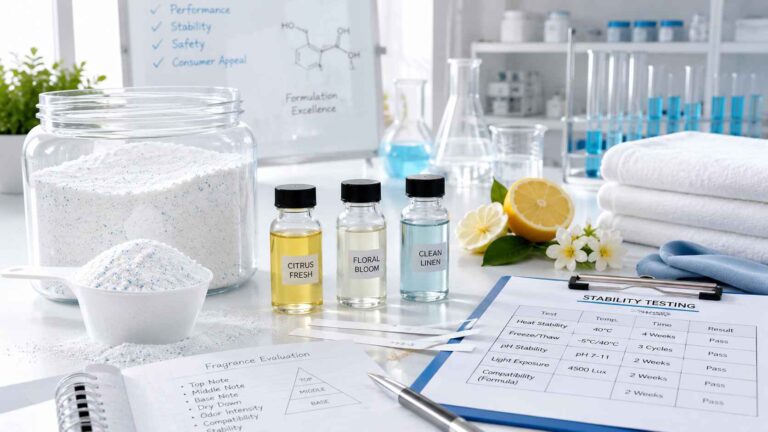
Most teams still ask whether the fragrance smells good, when the adult question is whether it stays recognizable at 25°C, under heat stress, under light, in alcohol, in surfactants, in oxidizing cleaners, or in the actual bottle the brand will ship, because neat-oil beauty and finished-product performance are not the same job at all. Why keep pretending a cap sniff predicts market behavior?
That is why I treat testing diffusion and throw in formulations as part of quality management, not just application development. And in home-care or air-care work, I would pair it with application of fragrance oils in home cleaning products because cleaners, sprays, candles, and diffusers expose the lie faster than fine fragrance does. Purdue researchers reported in 2025 that fragranced chemical products can rapidly fill indoor air with nanoscale particles small enough to get deep into the lungs. So no, stronger is not automatically better. Smarter is better. The Purdue indoor-air findings should have killed the old “just boost the load” reflex by now.
IFRA compliance in fragrance oil production is not a magic shield
People get this wrong.
IFRA is useful, serious, and necessary in professional sourcing, but it is not the same thing as legal compliance in every market, and it definitely is not proof that your batch will remain stable, clear, or commercially safe in your exact formula, pack, and use condition once real manufacturing begins. Why do so many suppliers still pitch it like a universal pardon?
IFRA itself says its standards are a globally recognized risk-management system, voluntary in nature, and separate from the national or local regulations companies still must follow. I agree with that framing. It is disciplined. It is also the opposite of the lazy sales pitch. So when people ask me how to ensure fragrance oil quality, I tell them the answer is layered: IFRA certificate, right category mapping, COA tied to the lot, SDS for hazards and transport, and real stability work in the finished system. Anything less is wishful thinking wearing a lab coat. See IFRA Standards and the site’s own regulations article.
The control table I trust more than a sales deck
I like ugly tables.
Because a disciplined table forces a supplier to answer specific questions, while a pretty brochure lets them hide behind adjectives, and in fragrance oil manufacturing process controls, adjectives are where bad batches go to avoid prosecution. Why not make the supplier show their work?
Control Point
What must be checked
What smart buyers ask for
What fails when this is skipped
Commercial damage
Raw-material intake
Supplier approval, lot identity, odor match, physical markers, contamination risk
The best practices for fragrance oil quality management are boring on purpose: qualify inputs, lock revisions, stress the formula in reality, then refuse to release anything you cannot defend on paper and in retained samples. That is not glamorous. It is profitable. And given MoCRA’s recordkeeping pressure plus the EU allergen-labeling thresholds now sitting over cosmetic products, I think that boring discipline is exactly what grown-up buyers should demand.
Where the money really leaks out
Small drift hurts.
But batch drift is never just a sensory problem, because once odor moves, the hit spreads into label review, customer service, retailer trust, production scheduling, freight timing, and sometimes legal exposure, especially when a fragrance was already living close to an allergen threshold or transport limit that somebody treated as “probably okay.” Why do finance teams keep learning this last?
And here is the part the sales deck will never say out loud: most factories do not lose money on dramatic catastrophes. They lose it on a thousand medium-grade controls failures that trigger one extra test, one late shipment, one reformulation, one irritated buyer, and one procurement team that starts asking harder questions next quarter. In that sense, Fragrance Oil Quality Control is not a technical side conversation. It is margin defense. The site’s internal reading path on common issues in fragrance oil production, testing diffusion and throw in formulations, and fragrance oil safety documentation reflects that reality better than most supplier blogs do.
I’m also skeptical of the old “premium fragrance sells itself” myth. Demand is healthy, yes, but that only raises the penalty for operational sloppiness. When Reuters says Givaudan’s fragrance and beauty unit beat expectations in Q1 2026, I read that as a warning to smaller manufacturers: the market rewards reliable supply, not just pretty fragrance stories. So if your supplier still cannot explain their batch consistency testing for fragrance oils in plain language, keep walking.
FAQs
What is fragrance oil quality control?
Fragrance oil quality control is the batch-by-batch system of raw-material qualification, identity testing, in-process checks, stability screening, documentation review, and release approval that keeps a fragrance within agreed odor, safety, and regulatory limits before it hits filling lines, shipping cartons, or consumer skin. I think of it as the discipline that turns scent from a creative idea into a repeatable manufactured product.
How to ensure fragrance oil quality?
To ensure fragrance oil quality, manufacturers need a written control plan that verifies incoming materials, locks formula versions, calibrates weighing and mixing, checks odor and physical markers against a retained standard, confirms IFRA and safety paperwork, and stress-tests the formula in its real base and packaging. If one of those steps is missing, the system is not robust. It is just hopeful.
Is IFRA compliance enough?
IFRA compliance in fragrance oil production is a supplier declaration that a fragrance mixture aligns with IFRA use limits for a stated product category, but it is not a blanket legal shield, it does not replace local law, and it does not prove the batch will stay stable in your formula. I use IFRA as one gate, not the whole fence. Buyers still need SDS, COA, local regulatory review, and finished-product testing.
What documents should buyers demand from a fragrance oil supplier?
The minimum document pack for professional fragrance purchasing is an SDS, a lot-specific COA, an IFRA certificate matched to the right end use, and evidence of retained-sample or stability control, because paperwork without batch linkage is administration, not real quality assurance. I would also ask how fast the supplier can trace a complaint back to one batch. Slow answers usually mean weak systems.
Why does batch consistency testing for fragrance oils matter so much?
Batch consistency testing for fragrance oils is the practice of comparing each production lot against an approved standard for odor, appearance, and supporting physical or documentary markers so the formula that ships in April behaves like the one the customer approved in January. Without that discipline, “same fragrance name” becomes a marketing line, not a manufacturing fact.
Our team of 20+ senior perfumers leverages a vast library of 40,000+ formulas to deliver expert customization and scent replication with up to 98% accuracy. As premier perfume oil manufacturers, we bring your most complex fragrance concepts to life with precision.
Industry-Leading Speed
We empower your business with industry-leading speed. Samples are ready in just 1-3 days, mass production takes only 3-7 days, and our low 5kg MOQ allows you to test the market quickly and without risk, solidifying our role as agile fragrance oil suppliers.
Certified Quality & System Assurance
Our quality is built on trust and technology. We are fully certified with IFRA, ISO, GMP, and Halal, and our advanced ERP system guarantees complete traceability and batch-to-batch consistency, making us your reliable perfume raw materials supplier.