Citrus Top Notes: How to Assess Oxidation Risk in Bulk Perfume Oils
Citrus top notes can lose brightness long before a bulk perfume oil looks obviously damaged. This guide explains how oxygen, heat, light, headspace, packaging, and storage history affect limonene oxidation—and how buyers can build a defensible testing and release program.
A bulk perfume oil can still look clear, pour normally, and pass a casual cap sniff while its most volatile citrus materials are already shifting, peroxide formation is rising, and the bright opening approved during sampling is becoming flatter, harsher, or strangely peel-like. So why do buyers keep treating oxidation as something they will smell immediately?
I would never release a limonene-heavy bulk lot from an opening sniff alone. That test is fast, cheap, familiar—and dangerously incomplete.
Perfume oil oxidation is a chemical and commercial stability problem. Oxygen exposure can alter vulnerable fragrance materials, particularly unsaturated terpenes used in lemon, orange, lime, bergamot, grapefruit, mandarin, and aromatic accords. The result may be top-note loss, color drift, new off-notes, inconsistent performance, higher sensitization risk, or a finished perfume that no longer matches its approved standard.
The hard truth is simple: citrus freshness is easy to sell and expensive to preserve.
Why Citrus Top Notes Carry Higher Oxidation Risk
Many citrus effects depend on volatile terpenes and aldehydes. One of the most commercially important is limonene, a monoterpene with the molecular formula C₁₀H₁₆. Its identifiers include CAS 5989-27-5 for d-limonene and CAS 138-86-3 for the racemic material covered by the IFRA specification. PubChem identifies limonene as C₁₀H₁₆, while the official IFRA document lists the relevant limonene CAS numbers.
Fresh limonene is not the whole problem. What concerns formulators is what can happen after repeated contact with air.
As limonene oxidizes, it can form hydroperoxides and other secondary products. The 2022 RIFM safety assessment distinguishes the parent material from its oxidation products: unoxidized limonene was not considered a skin-sensitization concern under the reviewed evidence, while autoxidation products would be expected to act as contact allergens.
That distinction matters commercially. A certificate describing the original formula does not prove that a partly used drum remains chemically identical after months of warm storage, repeated opening, uncontrolled headspace, or transfer through unsuitable equipment.
Oxidation is not just evaporation
Buyers often use “top-note loss” as a catch-all explanation. That is sloppy.
Evaporation means volatile materials are physically leaving the system. Oxidation means oxygen is chemically changing susceptible materials. Both may weaken a citrus opening, but the corrective actions are different.
Adding more citrus material may temporarily compensate for evaporation. It does not reverse oxidation. Worse, adding fresh limonene to an aging, poorly controlled lot may simply hide the problem during evaluation while leaving the underlying peroxide trend untouched.
And maceration will not repair it. The site’s guide to perfume oil maceration and controlled maturation correctly separates useful maturation from oxidation, rancidity, poor raw materials, and failed stability control.
Table of Contents
The Human Evidence Buyers Should Not Ignore
Oxidation risk is not an abstract laboratory argument. Several clinical investigations have reported reactions to oxidized limonene or its hydroperoxides in dermatitis patients.
A 2014 multicentre UK audit found that testing oxidized forms captured 97.0%—411 of 422—of the reported positive reactions to the tested limonene and linalool materials. The researchers concluded that testing only the nonoxidized terpenes was less useful in that clinical setting.
A separate study consecutively patch-tested 821 dermatitis patients. Positive reactions were reported in 9.4% of patients for limonene hydroperoxides and 11.7% for linalool hydroperoxides; 4.6% reacted to both. These numbers apply to a selected clinical population, not the general public, but they are substantial enough to make careless bulk-storage practices indefensible.
Then there is the case-report evidence. A published report described a 57-year-old man who developed recurring pigmented contact dermatitis after using a roll-on antiperspirant; the product reportedly became darker when left open for extended periods, and testing implicated limonene hydroperoxides. One case does not establish population-wide risk, but it shows why air exposure, visible change, and consumer complaints deserve investigation rather than dismissal.
My opinion is blunt: a supplier that discusses citrus quality only in terms of odor is discussing half the job.
The Five Variables That Drive Bulk Perfume Oil Oxidation
Oxygen and container headspace
Every opening event exchanges part of the container atmosphere. A nearly empty 25-kilogram drum has a very different oxygen-to-liquid relationship from a properly filled, sealed production container.
This is why “the drum was closed” is not an adequate storage record. I want to know:
When was it first opened?
How many times was it reopened?
How much headspace remained?
Was material transferred into smaller containers?
Was the closure gasket still compatible and intact?
Was an inert-gas system used under a validated procedure?
Do not top up an old container with a new lot merely to reduce headspace. That destroys lot separation, weakens traceability, and turns one questionable container into a mixed batch that is harder to investigate.
Heat and temperature cycling
Heat can increase reaction rates, but repeated temperature cycling creates its own operational problems. A drum moved between a hot loading area, an air-conditioned room, and a humid warehouse may experience expansion, contraction, condensation around closures, and repeated handling.
The correct storage temperature is the supplier’s validated range—not a temperature invented by a warehouse manager. Refrigeration is not automatically better. Some fragrance blends can become cloudy, precipitate, or separate at low temperatures, and repeated cold-to-warm cycling may complicate evaluation.
For a wider program covering heat, light, cold, and time, use a documented fragrance oil stability test plan rather than relying on one accelerated sample. Accelerated testing is a screening tool, not a substitute for real-time data.
Light exposure
Light can affect both fragrance chemistry and color. Clear glass may look premium in a presentation room, but it offers little help when a sample sits beside a sunlit laboratory window for three weeks.
Production materials should be evaluated in their real commercial packaging or in a justified protective container. Light-exposed challenge samples can be useful, but they should be compared with dark controls from the same lot.
No control, no conclusion.
Trace metals and processing equipment
Iron and copper contamination can promote unwanted reactions and color change in susceptible systems. Potential sources include pumps, transfer fittings, poorly maintained vessels, tools, water, pigments, botanical materials, and packaging components.
This is one reason an oxidation complaint cannot automatically be blamed on the fragrance formula. The fault may sit in the filling line, container closure, transfer hose, or finished-product base.
A professional fragrance oil quality-control system should connect incoming inspection, formula control, retained samples, equipment records, batch codes, and release data. Without that chain, every complaint becomes a debate instead of an investigation.
Formula composition
Not all “citrus fragrances” carry the same oxidation burden. One may depend heavily on expressed citrus oils and limonene-rich fractions. Another may use a more engineered structure with stabilized materials, lower terpene loading, citrus aldehydes, floral modifiers, woods, musks, or longer-lasting synthetic components.
The fragrance name tells you almost nothing about the chemical risk.
Ask for composition-relevant documentation, not a marketing description. A serious fragrance oil supplier qualification process should include the SDS, lot-specific COA, IFRA documentation, allergen declaration, shelf-life information, storage conditions, batch number, and technical discussion of the intended application.
How to Assess Perfume Oil Oxidation Before Bulk Release
I use a layered decision model. No single instrument, document, or nose should carry the entire release decision.
Step 1: Reconstruct the lot history
Start with the boring questions. They often solve the case faster than expensive analysis.
Record:
Manufacturing and filling dates
Formula version
Raw-material lot numbers
Antioxidant system, when disclosed
Original container type and fill volume
First-opened date
Number of withdrawals
Storage-temperature records
Light exposure
Transport excursions
Repacking or transfer history
Previous peroxide, GC, color, or sensory results
A supplier-stated shelf life means little when the container has been repeatedly opened and stored outside the specified range. Shelf life assumes defined conditions. Abuse changes the calculation.
Step 2: Establish a defensible T0 baseline
A retained reference is not “an old sample somewhere in the lab.” It should be a controlled sample tied to the approved lot or master standard.
At T0, I would normally consider:
Blind sensory comparison
Appearance and clarity
Instrumental or standardized color
Density and refractive index, where relevant
Peroxide value for suitable limonene-rich materials
GC-FID or GC-MS fingerprint
Photographic record under controlled lighting
Container, closure, and headspace details
Density and refractive index are useful identity and consistency checks, but they are weak oxidation detectors on their own. A perfume oil can remain inside those physical limits while its top-note balance changes materially.
Step 3: Split the study into controlled conditions
Do not repeatedly test from one container. Every opening alters the experiment.
Prepare separate, clearly coded samples for each condition and time point. A practical development program may include:
Controlled ambient storage in darkness
Elevated-temperature storage
Defined light exposure
A protected reference
A headspace or oxygen challenge
Real commercial packaging
The finished perfume base at the intended dosage
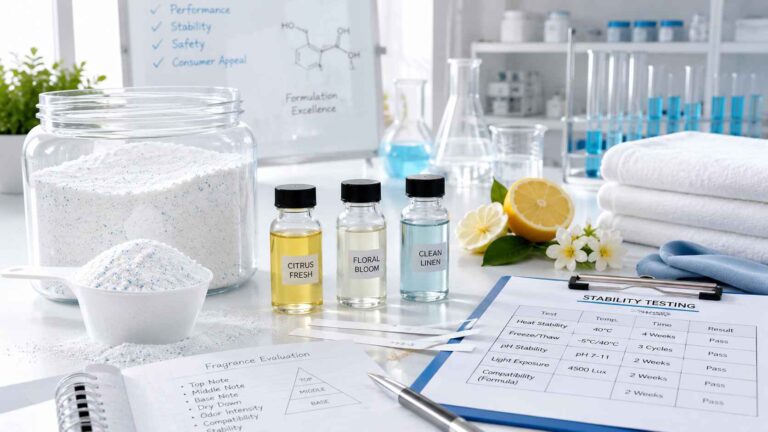
Time points might include T0, two weeks, four weeks, eight weeks, and longer real-time intervals, but those intervals are project choices—not universal legal standards.
One peroxide result is a photograph. A series is a film.
The same principle applies to GC markers, sensory ratings, and color. A result still inside an internal specification may deserve investigation when it is moving sharply toward the limit.
For example, a peroxide value that rises consistently across T0, week two, and week four is more informative than one result obtained just before shipment. Likewise, a gradual decline in limonene peak area paired with new oxidation-related peaks deserves attention even when the sample still smells acceptable to an untrained evaluator.
Step 5: Test the finished application
Neat oil stability does not prove finished-product stability.
Ethanol, water, pH, surfactants, preservatives, dyes, botanical extracts, packaging, spray hardware, and oxygen permeability can change how a fragrance behaves. Fine fragrance should be assessed at the actual EDP, EDT, extrait, body-mist, or oil-perfume concentration intended for sale.
Real behavior in alcohol, oil, surfactant systems, and packaging
Every possible market condition
Required before commercial approval
Retained-sample comparison
Whether the complaint batch differs from the approved reference
Root cause without supporting records
Essential for complaint defense
Here is the mistake I keep seeing: teams run GC, find no dramatic disappearance, and declare victory.
But a citrus opening is a balance of highly odor-active materials. A modest analytical shift can still create a noticeable sensory change, while a substantial chemical change in a less odor-active component may be harder to smell. Instrumental and sensory data must be interpreted together.
A Practical Bulk Oxidation Risk Score
The following scorecard is an operational screening tool, not an IFRA method, statutory test, or universal release specification.
Risk factor
0 points
1 point
2 points
Citrus-terpene dependence
Low or documented stabilized structure
Moderate citrus loading
High limonene or expressed citrus-oil dependence
Container status
Unopened, sealed, traceable
Opened once or twice with records
Frequently opened or opening history unknown
Headspace
Low and controlled
Moderate
High or undocumented
Temperature history
Stable, recorded, within specification
Minor controlled excursion
Warm storage, cycling, or missing records
Light exposure
Protected
Brief controlled exposure
Prolonged or unknown exposure
Antioxidant information
Documented and formulation-appropriate
Partly documented
Unknown or unsupported
Analytical baseline
Complete retained data
Partial baseline
No reliable T0 reference
Packaging compatibility
Validated
Preliminary test only
Untested or changed packaging
Suggested interpretation:
0–4 points: Lower screening risk; routine release testing may be appropriate.
10–16 points: High risk; quarantine the lot pending a documented investigation.
These bands are deliberately conservative. A single serious deviation—such as an unexplained off-note, failed peroxide specification, broken seal, or major GC shift—can justify quarantine regardless of the total score.
The IFRA Limonene Specification Is a Floor, Not a Complete Program
The official IFRA Standard for limonene says oxidation products, particularly hydroperoxides, have been demonstrated to be potent sensitizers. It recommends keeping hydroperoxide levels as low as practical and cites 0.1% BHT or α-tocopherol as examples that have shown effectiveness. It also specifies a peroxide value below 20 mmol/L for covered limonene materials, measured using the IFRA analytical method.
Read that carefully.
The 20 mmol/L figure is not a universal acceptance limit for every complex perfume oil, finished cosmetic, or alcoholic fragrance. It is part of the IFRA ingredient specification for limonene and natural products containing substantial amounts of it. Matrix suitability, product category, local law, finished-product exposure, and supplier specifications still matter.
And do not add 0.1% BHT blindly because a PDF mentioned it. Antioxidant selection can affect odor, color, claims, regulatory documentation, downstream formulations, and customer requirements. It should be made by a competent formulator and validated in the actual system.
More antioxidant is not automatically more protection. It can become a new formulation problem.
Best Storage for Citrus Perfume Oils
The best storage system reduces oxygen, heat, light, contamination, and uncontrolled handling while preserving lot traceability.
Keep containers tightly closed
Use compatible closures and inspect seals, threads, liners, gaskets, and valves. “Closed” does not mean airtight when the liner is degraded or the cap has been cross-threaded.
Reduce uncontrolled headspace
After repeated withdrawals, consider transferring the remaining oil into a smaller compatible container under an approved SOP. Do not make casual transfers with open funnels, dirty utensils, or unverified plastics.
For valuable, highly oxygen-sensitive materials, an inert-gas blanket may be justified. It still needs validated equipment, trained operators, safe handling, and written controls.
Store at a stable supplier-approved temperature
Avoid warehouse heat, direct sunlight, radiators, hot container walls, and repeated temperature swings. Do not freeze or refrigerate a perfume oil unless the supplier has confirmed that the formula and packaging tolerate it.
Protect the lot from light
Opaque or suitably protective containers are usually preferable for bulk storage. If clear sample bottles are required for visual inspection, keep the protected master reference separate.
Record every opening
The label should show more than the lot number. Add first-opened date, withdrawal record, remaining volume, storage location, and next review or retest date.
Use FEFO, not optimism
First-expire-first-out is better than discovering a forgotten citrus lot behind newer inventory. Retest decisions should reflect storage history, container condition, analytical trends, and intended use—not the purchasing team’s desire to avoid a write-off.
EU Regulation Makes Oxidation a Compliance Issue
The European Union has explicitly recognized that some fragrance substances can become known contact allergens through air oxidation or bioactivation.
Commission Regulation (EU) 2023/1545 states that fragrance substances acting as prehaptens or prohaptens should be treated as equivalent to fragrance allergens when they transform into known contact allergens. The regulation also identified 56 additional fragrance allergens for individual labelling and retained disclosure thresholds of 0.001% in leave-on products and 0.01% in rinse-off products.
The same regulation estimates that 1–9% of the EU population may be allergic to fragrance allergens. That range concerns fragrance allergy generally, not limonene oxidation alone, but it explains why regulators do not view allergen disclosure as a niche issue.
For relevant transition provisions, non-compliant products may be placed on the EU market only until 31 July 2026 and made available only until 31 July 2028. Companies should verify how each provision applies to their formula and supply chain rather than assuming every product receives identical treatment.
This is where procurement teams get caught. They collect an allergen declaration when the oil is approved, then ignore storage history and formula changes for the next two years.
Documentation must be maintained. It is not a ceremonial file generated once and forgotten.
Release, Retest, or Reject?
I would release a citrus-rich bulk perfume oil only when five questions have defensible answers:
Does it match the approved retained reference in a blind sensory assessment?
Are peroxide results acceptable under the applicable material, supplier, and regulatory specifications?
Does the chromatographic fingerprint remain within justified limits?
Has the finished application passed the intended stability and packaging program?
Can the supplier and buyer reconstruct the lot’s complete handling history?
Retest when data are incomplete but the lot remains traceable and no major failure is evident.
Reject or quarantine when there is an unexplained harsh note, obvious top-note collapse, failed peroxide criterion, significant analytical drift, visible change without explanation, damaged packaging, missing identity records, or uncontrolled storage history.
Do not blend away a failed lot. That is not correction. It is dilution of evidence.
FAQs
What is perfume oil oxidation?
Perfume oil oxidation is the chemical reaction that occurs when oxygen changes susceptible fragrance ingredients, particularly unsaturated terpenes such as limonene, producing compounds that may alter odor, color, stability, and sensitization potential. It differs from simple evaporation because the fragrance molecules are chemically transformed rather than merely lost from the container.
Early oxidation may present as reduced citrus sparkle, a stale peel effect, sharper solvent-like notes, yellowing, or changing peroxide results. Some batches show analytical movement before an obvious sensory failure appears.
How do you test oxidation in bulk perfume oils?
Bulk perfume oil oxidation is assessed by combining storage-history review, blind sensory comparison, peroxide-value testing where appropriate, chromatographic fingerprinting, color measurement, retained-sample comparison, and finished-product stability testing. No single method provides a complete answer, so release decisions should rely on converging evidence from chemical, sensory, physical, and traceability records.
For limonene-heavy formulas, peroxide trends and GC changes deserve particular attention. The sample should also be tested in its intended alcohol, oil, cosmetic, or household-product base.
What peroxide value is acceptable for citrus perfume oil?
An acceptable peroxide value is a validated limit tied to the specific raw material, fragrance matrix, supplier specification, analytical method, product type, and governing regulation; IFRA’s limonene ingredient standard specifies less than 20 mmol/L for covered limonene-rich materials, but that number should not be applied blindly to every complex perfume oil or finished product.
A buyer should confirm which method was used, whether the matrix was suitable, and whether the result represents a raw material, fragrance compound, or ready-for-use cosmetic.
How long is the shelf life of citrus fragrance oil?
Citrus fragrance oil shelf life is the documented period during which an unopened or controlled container is expected to remain within agreed sensory, physical, chemical, and regulatory specifications under stated storage conditions. It is not one universal number because formula composition, antioxidant strategy, packaging, temperature, oxygen exposure, and handling history differ substantially.
After opening, the remaining life may change. The open date, headspace, withdrawal frequency, storage record, and analytical trend should guide the next retest decision.
What is the best storage for citrus perfume oils?
The best storage for citrus perfume oils is a cool, stable, dark, and controlled environment using compatible tightly sealed containers, minimal headspace, documented opening dates, clean transfer procedures, and first-expire-first-out inventory management. The exact temperature and packaging requirements should follow validated supplier guidance rather than a generic warehouse rule.
Where justified, smaller containers or a controlled inert-gas system can reduce oxygen exposure. Each measure must preserve batch identity and avoid introducing contamination.
Can antioxidants stop limonene oxidation completely?
Antioxidants are formulation tools that can slow oxidative reactions in suitable limonene-rich materials, but they do not make a fragrance permanently stable, reverse existing oxidation, excuse poor storage, or replace peroxide monitoring and finished-product testing. Their effectiveness depends on concentration, chemical compatibility, oxygen exposure, light, temperature, packaging, and the composition of the complete fragrance.
IFRA cites 0.1% BHT or α-tocopherol as effective examples in its limonene specification, but any antioxidant system should be selected and validated by a qualified formulator.
Build an Oxidation-Controlled Citrus Fragrance Program
Do not ask a supplier only whether a citrus oil “smells fresh.”
Send the application, target market, fragrance dosage, package, expected annual volume, shipping route, storage conditions, and required launch date. Then request a lot-specific COA, SDS, IFRA certificate, allergen declaration, storage specification, retained-sample policy, peroxide-control approach, stability data, and written bulk-release criteria.
For a citrus perfume oil project, request three samples from the same proposed formula:
A protected reference
A sample for accelerated testing
A sample in the real finished-product base and commercial packaging
Compare them at defined intervals. Record everything. Reject vague answers.
To develop or source a citrus fragrance with documented bulk-production controls, contact the I’SCENT fragrance development team with your application, market, dosage, packaging, testing requirements, and target volume. Ask specifically how limonene-rich materials, peroxide risk, retained samples, and opened-container storage will be managed before you approve the bulk order.
Our team of 20+ senior perfumers leverages a vast library of 40,000+ formulas to deliver expert customization and scent replication with up to 98% accuracy. As premier perfume oil manufacturers, we bring your most complex fragrance concepts to life with precision.
Industry-Leading Speed
We empower your business with industry-leading speed. Samples are ready in just 1-3 days, mass production takes only 3-7 days, and our low 5kg MOQ allows you to test the market quickly and without risk, solidifying our role as agile fragrance oil suppliers.
Certified Quality & System Assurance
Our quality is built on trust and technology. We are fully certified with IFRA, ISO, GMP, and Halal, and our advanced ERP system guarantees complete traceability and batch-to-batch consistency, making us your reliable perfume raw materials supplier.