How to Choose Fragrance Oil for Powder Laundry Detergent
Choosing a laundry detergent fragrance requires more than approving a pleasant scent on a blotter. This guide explains how detergent manufacturers should evaluate fragrance stability, powder compatibility, fabric retention, encapsulation, compliance documents, and commercial performance before placing a bulk order.
A fragrance that smells clean, bright, and expensive on a paper blotter can become flat, sour, dusty, discolored, or almost undetectable after it is mixed with alkaline builders, oxidizing agents, enzymes, fillers, and surfactants, then stored in a hot warehouse for several months.
So why do purchasing teams still approve laundry detergent fragrance oil from a ten-second blotter test?
Choosing the right fragrance oil for powder laundry detergent is a technical purchasing decision, not a beauty contest. The formula must survive the dry powder, remain stable during storage, release properly in wash water, cover the detergent base odor, and leave a controlled scent on fabric after rinsing and drying.
My working rule is simple: never approve a powder detergent fragrance until it has survived the actual commercial base.
Table of Contents
Powder Laundry Detergent Is a Hostile Fragrance Environment
Powder detergent may look chemically inactive, but it is not a neutral fragrance carrier.
A typical formula may contain sodium carbonate, written as Na₂CO₃, alkaline silicates, anionic surfactants, zeolites, enzymes, fluorescent whitening agents, sodium percarbonate, and moisture-sensitive processing aids. Sodium percarbonate, often represented as 2Na₂CO₃·3H₂O₂, can release hydrogen peroxide when dissolved.
That combination creates several risks:
Volatile top notes may evaporate during blending, packing, storage, or washing.
Oxidation-sensitive materials may develop metallic, oily, sour, or stale odors.
Liquid perfume may create localized wet spots, agglomeration, or caking.
Colored fragrance ingredients may yellow or darken a white detergent powder.
The detergent base odor may overpower a weak fragrance.
Heat and humidity may change both scent intensity and powder flow.
A fragrance that smells strong in the box may disappear after rinsing.
This is why a competent detergent fragrance manufacturer should ask about the complete base before recommending a formula. “Fresh floral” is not a technical brief. Neither is “make it last longer.”
Fragrance encapsulation can protect volatile compounds and regulate their release, but scientific reviews also point out that capsule performance depends on shell material, particle size, storage conditions, detergent exposure, and release mechanism. It is a delivery technology, not a magic repair for a poor fragrance formula.
Define the Finished Product Before Selecting the Scent
The fastest way to waste three sampling rounds is to request fragrance samples before defining the detergent.
Before sending a brief, establish the following conditions.
Detergent Composition
Tell the fragrance supplier whether the powder contains:
Oxygen bleach or sodium percarbonate
Enzymes such as protease, amylase, lipase, or cellulase
High levels of sodium carbonate or sodium silicate
Zeolite, sodium sulfate, STPP, citrate, or other builders
Optical brighteners
Soap, linear alkylbenzene sulfonate, or nonionic surfactants
Colored speckles or perfume carrier granules
Do not hide the base formula and expect an accurate recommendation. A supplier does not always need every commercial percentage, but it does need to understand the chemical stress points.
Consumer and Market Position
A low-cost hand-wash powder sold in tropical markets should not automatically use the same perfume architecture as a concentrated machine-wash detergent sold in Northern Europe.
State:
Target country
Hand-wash or machine-wash use
Mass-market, mid-market, or premium positioning
Expected fragrance dosage
Preferred scent family
Target shelf life
Packaging type
Storage and distribution climate
Regulatory documentation required
Cost target per kilogram of finished detergent
A structured fragrance development brief prevents vague revisions such as “make it fresher” or “make it stronger.” Those comments sound useful. Usually, they are not.
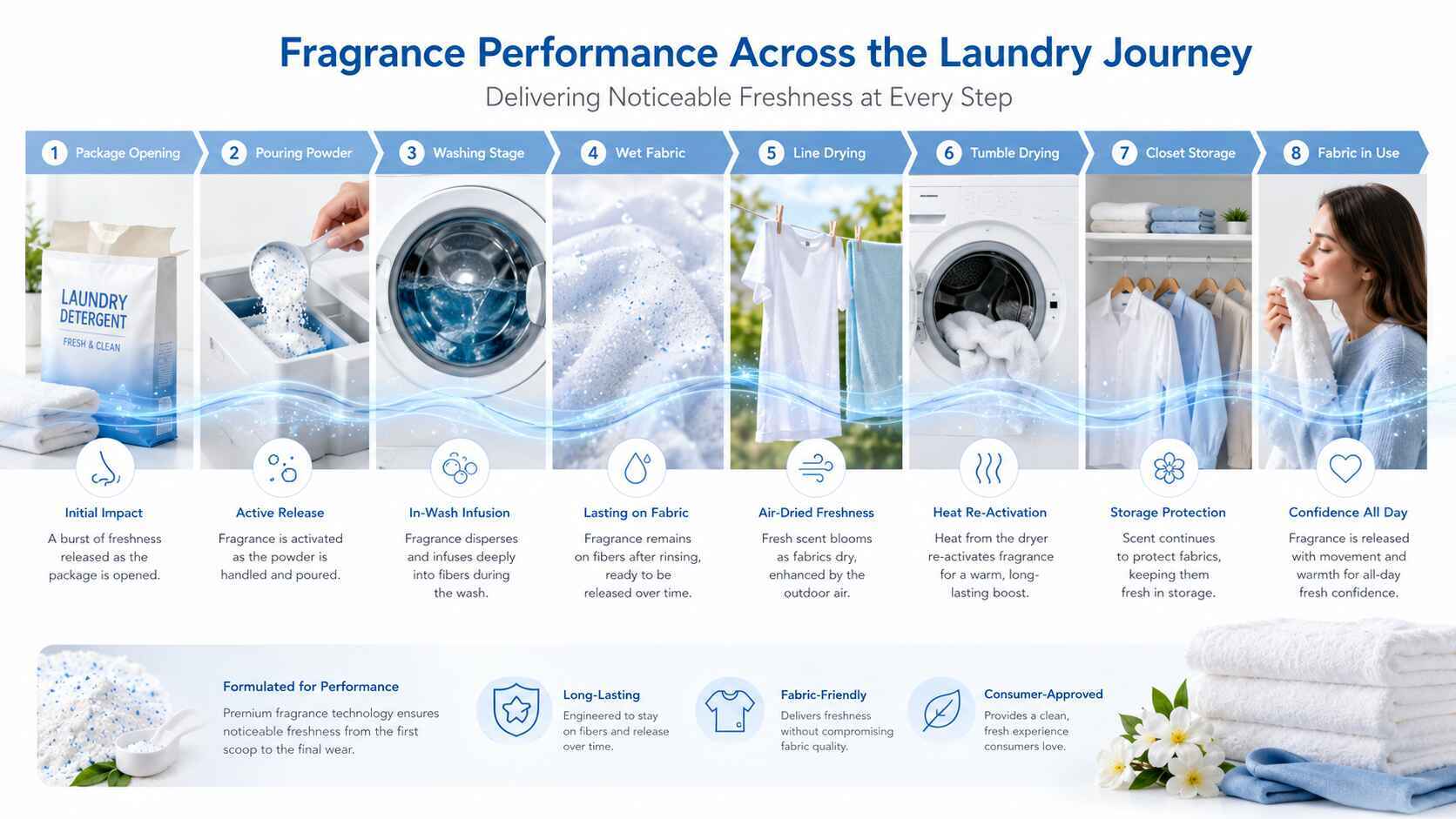
Fragrance Performance Stages
Decide where the consumer should notice the scent:
Opening the detergent package
Measuring or pouring the powder
During hand washing or the machine cycle
On wet fabric
After line drying
After tumble drying
During garment storage
When the fabric is rubbed or worn
A long-lasting laundry fragrance is not necessarily extremely strong at every stage. The better objective is a controlled scent curve.
An aggressive package odor followed by almost no fabric scent is not high performance. It is poor allocation.
Use a Controlled Testing Protocol, Not Personal Opinions
I would reject any fragrance approval process based only on comments such as “Sample B smells more premium.”
Premium to whom?
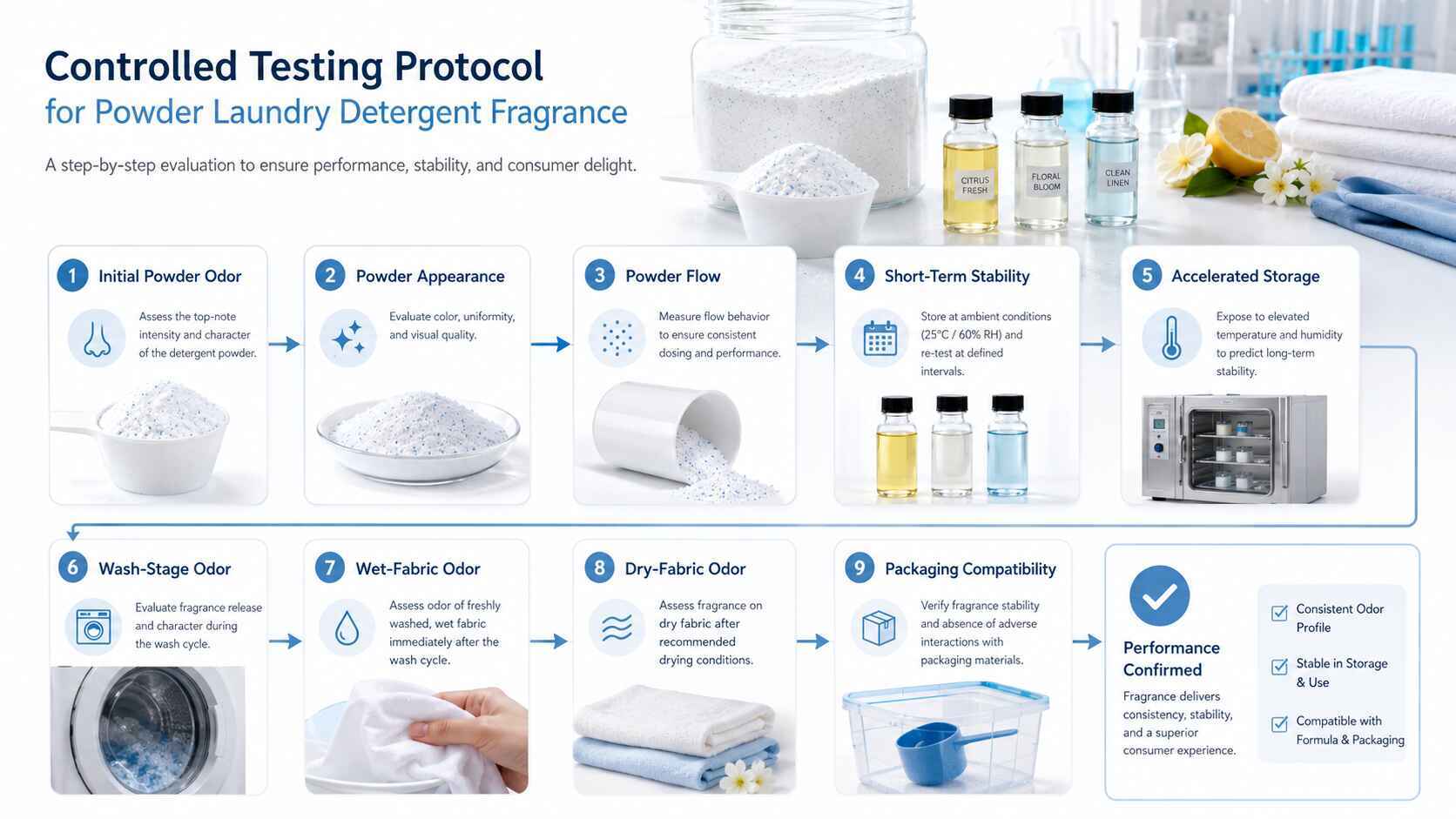
A useful evaluation protocol separates dry-powder stability, wash performance, fabric retention, and commercial feasibility.
Evaluation Point
What to Test
Warning Signs
Recommended Decision
Initial powder odor
Odor immediately after blending
Harsh solvent note, weak base coverage, chemical clash
Reformulate or adjust dosage
Powder appearance
Color and uniformity after fragrance addition
Yellowing, dark specks, wet spots
Reject unless appearance is intentionally designed
Powder flow
Free-flowing behavior and caking
Lumps, oil migration, compacted zones
Change carrier, addition method, or fragrance
Short-term stability
Compare retained samples after 24 hours and 7 days
Fast top-note loss or odor distortion
Do not scale yet
Accelerated storage
Sealed samples at ambient and elevated temperature
Discoloration, sour notes, perfume loss, caking
Investigate before approval
Wash-stage odor
Evaluate at realistic dosage and water conditions
Detergent base odor dominates
Improve bloom or base coverage
Wet-fabric odor
Smell after the normal rinse cycle
Sharp, medicinal, or nearly absent scent
Rebalance deposition
Dry-fabric odor
Check line-dried and machine-dried fabric
Excessive loss or unpleasant dry-down
Modify substantive materials
Packaging compatibility
Test the intended bag, carton, or liner
Perfume migration, panel odor, print damage
Upgrade barrier or change formula
Batch repeatability
Compare pilot and production batches
Different odor, color, or intensity
Audit raw materials and process controls
Test the Actual Production Base
Do not test the fragrance only in sodium sulfate or a simplified laboratory powder.
A laboratory carrier trial can help screen samples, but final approval should use the commercial formula with the real surfactant system, bleach, enzymes, builders, colorants, moisture level, and packaging.
The production process matters too. Adding fragrance to a cooled post-blend is different from exposing it to warm powder, aggressive mixing, or extended contact with absorbent raw materials.
Use Retained Control Samples
Keep an untreated detergent base and a fragrance benchmark beside every trial.
At each checkpoint, compare:
Control base
Current fragrance
New fragrance candidate
Low dosage
Target dosage
High dosage, where compliant and technically reasonable
This separates perfume failure from base-formula changes.
Test in Relevant Water and Drying Conditions
Hard water, soft water, washing temperature, rinse efficiency, fabric type, line drying, and tumble drying can change consumer perception.
Cotton may retain a fragrance differently from polyester. A fragrance that performs well after air drying may lose volatile notes in a heated dryer. Test both when both behaviors exist in the target market.
Choose the Fragrance Architecture for Detergent Performance
The best fragrance oil for powder detergent usually combines immediate cleanliness cues with enough body to survive storage, washing, and drying.
Top Notes Create Fast Freshness
Citrus, green, ozonic, herbal, and aldehydic materials can make a detergent smell bright when the package opens.
But top-heavy fragrances are easy to overestimate. They dominate the first blotter evaluation and then disappear quickly.
A sharp lemon opening may impress a buyer in the meeting room. The consumer, however, buys the result on the fabric.
Middle Notes Build Product Identity
Floral, aromatic, fruity, and clean-spice notes create the recognizable character of the detergent.
Common directions include:
Lavender and aromatic herbs
Rose and clean florals
Jasmine and white flowers
Apple, pear, or citrus fruit
Marine and ozonic freshness
Powdery floral notes
Green tea or botanical freshness
The goal is distinction without making the fragrance incompatible with the cultural meaning of “clean” in the target market.
Base Notes Support Fabric Retention
Musks, woods, amber-like notes, and selected substantive floral materials can extend the dry-fabric impression.
More base note does not automatically mean better longevity. Too much can make a detergent smell heavy, cosmetic, sweet, or dirty after repeated use.
For a coordinated laundry range, compare the powder perfume with the intended fabric softener fragrance. The two products should support each other rather than create a muddy mixture on fabric.
Free Fragrance, Carrier-Adsorbed Perfume, or Microcapsules?
There are three broad delivery routes.
Directly Added Fragrance Oil
Free fragrance oil is sprayed or blended directly into the powder.
Advantages include:
Simpler processing
Lower technical complexity
Fast package impact
Lower cost than advanced encapsulation
Easier fragrance switching
Risks include:
Uneven distribution
Volatility
Interaction with powder ingredients
Oil migration
Caking
Limited post-dry retention
The addition point, spray pattern, mixing time, temperature, and absorbent capacity of the base all matter.
Carrier-Adsorbed Fragrance
The fragrance can be adsorbed onto a suitable porous or powdered carrier before being added to the detergent.
This may improve distribution and reduce direct contact between concentrated perfume and reactive detergent ingredients. But the carrier adds cost, occupies formulation space, and must release the scent properly in water.
A carrier that holds perfume extremely well in the bag but refuses to release it during washing has failed.
Encapsulated Fragrance
Microcapsules can protect perfume and release it through friction, moisture, temperature, or another trigger.
They are useful when the target is post-dry fabric fragrance or fragrance release during garment wear. Yet they add cost, complicate deposition, and create a major regulatory issue for products entering the European Union.
The European Commission’s restriction on intentionally added microplastics states that synthetic polymer microparticles used to encapsulate fragrances receive a transition period until 17 October 2029. Conventional detergents containing other restricted synthetic polymer microparticles face an earlier date of 17 October 2028, subject to the regulation’s definitions, exemptions, and conditions.
That deadline changes purchasing decisions now.
A detergent brand planning an EU launch in 2028 should not approve a fragrance-capsule system solely because it performs well today. The buyer should ask for shell composition, regulatory status, biodegradability evidence, intended transition plan, and availability of non-microplastic alternatives.
Fragrance Compliance Must Be Checked Before Creative Approval
This is where many otherwise competent projects become expensive.
The scent is approved. Packaging artwork is printed. Then someone asks for the allergen statement, SDS, IFRA document, or market-specific classification.
Wrong order.
Understand What an IFRA Certificate Does
The IFRA Standards restrict, prohibit, or set specifications for certain fragrance materials based on intended product use.
But IFRA makes two points that buyers often misunderstand:
IFRA Standards do not replace national or regional law.
IFRA itself does not issue or approve individual Certificates of Conformity.
The fragrance mixture manufacturer issues the certificate for the intended application. The certificate is not a complete safety assessment, and responsibility for the finished detergent remains with the company placing it on the market.
Ask for an IFRA Certificate that matches the actual laundry-detergent application. Do not accept a generic certificate prepared for candles, perfume, or rinse-off cosmetics.
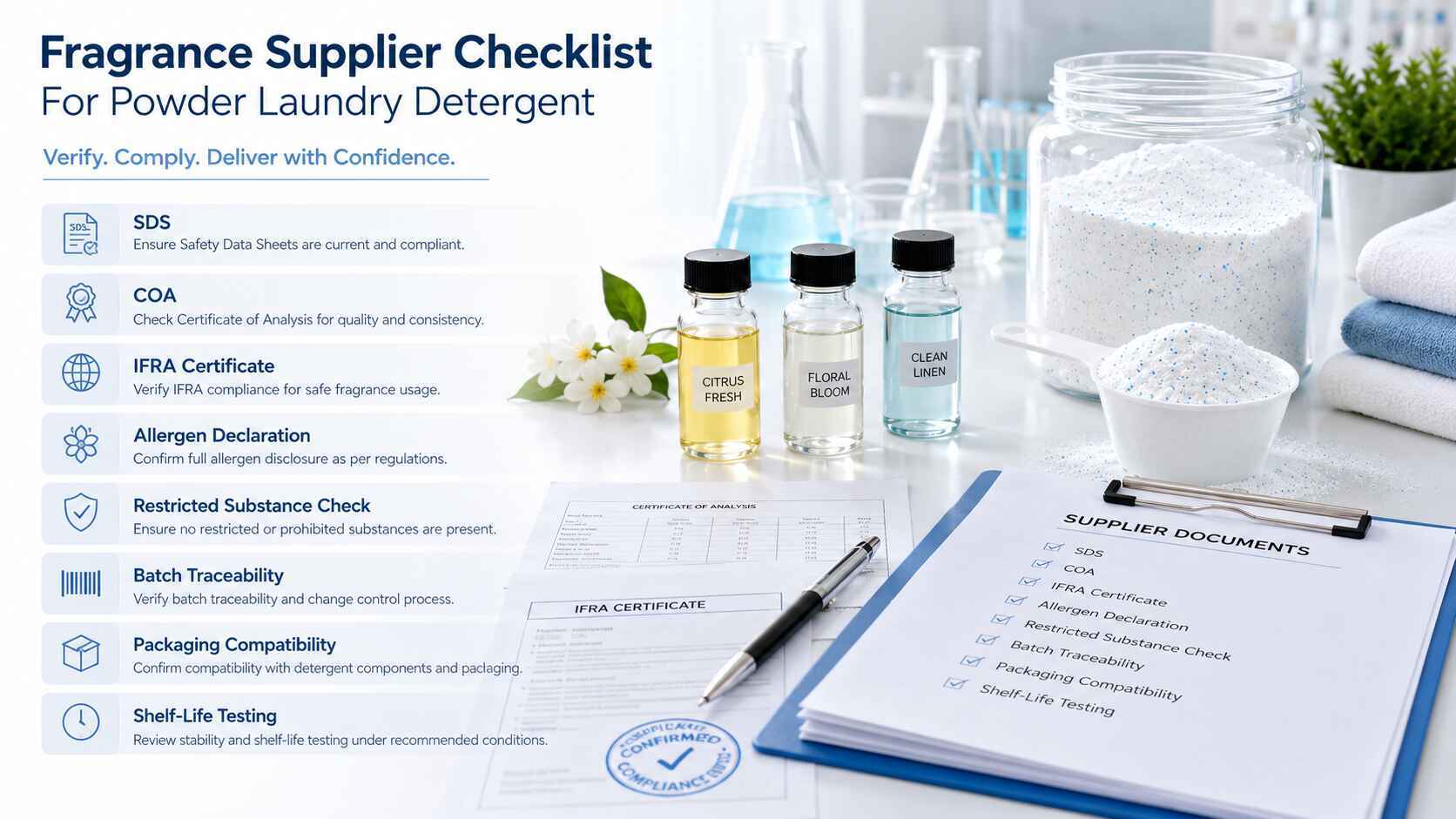
Check the SDS, COA, Allergen Data, and Restricted Substances
The European Union adopted Regulation (EU) 2026/405 on detergents and surfactants on 11 February 2026. It was published on 2 March 2026 and will generally apply from 23 September 2029, replacing Regulation (EC) No 648/2004.
Under the new framework, intentionally added fragrance allergens listed in the regulation must be labeled when they exceed 0.01% by weight, unless already covered through specified CLP labeling provisions. The regulation also introduces digital product passports and requires manufacturers to maintain relevant compliance information for ten years.
This is not a future problem to examine in September 2029. Fragrance formulas, packaging files, ingredient databases, and supplier agreements approved today may still be on the market then.
Consider U.S. Safer Choice Requirements
For brands seeking U.S. EPA Safer Choice positioning, the fragrance needs a different level of ingredient review.
The EPA Safer Choice Criteria for Fragrances exclude listed carcinogens, mutagens, reproductive or developmental toxicants, persistent bioaccumulative toxic compounds, and listed respiratory sensitizers. Dermal sensitizers must be disclosed, while non-fragrance ingredients such as solvents are evaluated under their applicable functional criteria.
“IFRA compliant” and “eligible for a Safer Choice formulation” are not interchangeable claims.
What Real Market Data Says About Fragrance Allergens
A 2018 peer-reviewed study inventoried 1,447 detergent and cleaning products across 131 German households. The 26 fragrance allergens examined appeared almost 2,000 times on product ingredient lists.
Limonene was listed on approximately 23.1% of the products, linalool on 20.1%, and hexyl cinnamal on 14.8%. The general term “perfume” appeared on about 60% of the detergents reviewed.
This is not a 2026 market census, and it should not be treated as one. But it demonstrates why allergen calculations cannot be postponed until packaging approval. Fragrance exposure can come from multiple household products, not just cosmetics.
The hard truth is that a formula can be legally usable and still be commercially awkward.
A high-allergen fragrance may require additional label declarations, complicate a sensitive-product positioning, or create problems for retailers with stricter ingredient policies. Regulatory acceptance is the floor, not the entire product strategy.
How to Evaluate a Laundry Detergent Fragrance Supplier
A supplier should be evaluated on more than scent selection and kilogram price.
Ask Application Questions
A serious supplier should ask about:
Powder composition
Bleach and enzyme content
Target fragrance dosage
Processing temperature
Addition method
Package material
Shelf-life target
Target country
Dry-fabric performance
Required regulatory documents
A supplier that recommends the same fragrance for soap, candle wax, liquid detergent, fabric softener, and powder detergent without additional testing is selling inventory, not solving an application problem.
Compare Cost in the Finished Detergent
Do not compare fragrance oils only by price per kilogram.
Compare:
Required dosage
Stability losses
Production waste
Caking risk
Rework risk
Package-barrier cost
Allergen-labeling impact
Consumer performance
Reorder consistency
A cheaper fragrance used at a higher dosage may cost more in the final detergent. It may also create more severe flow and labeling problems.
Require Batch Consistency
Before bulk approval, agree on:
Approved reference sample
Odor tolerance
Color tolerance
Specific gravity or density range, where relevant
Flash-point documentation
Batch coding
Retained samples
Change-notification procedure
Raw-material substitution policy
The OEM/ODM fragrance oil manufacturing service should be used to discuss application testing, formula management, documentation, bulk production, and repeat-order controls—not merely to request a copied scent.
FAQs
What is the best fragrance oil for powder laundry detergent?
The best fragrance oil for powder laundry detergent is a high-stability composition proven to resist alkaline builders, oxidizing ingredients, storage heat, humidity, and wash dilution while still delivering a recognizable scent in the dry powder, during washing, on wet fabric, and after line or machine drying.
The correct formula depends on the detergent base, target market, package, dosage, cost, and desired scent-delivery stage. There is no single fragrance that performs best in every washing powder.
What does powder detergent fragrance stability mean?
Powder detergent fragrance stability is the ability of a perfume composition to preserve its intended odor, color, dosage accuracy, and physical compatibility throughout manufacturing, warehousing, transport, shelf life, washing, rinsing, and drying despite exposure to alkaline salts, oxidants, enzymes, moisture, and fluctuating temperatures.
Stability should be evaluated in the actual detergent base. A fragrance that remains stable in pure sodium sulfate may still fail in a complete bleach-containing formulation.
How much fragrance oil should be added to powder detergent?
The correct fragrance dosage is the lowest concentration that meets sensory targets after storage and washing while remaining within the supplier’s IFRA limit, local legal requirements, formula cost, powder-flow tolerance, packaging performance, and allergen-labeling strategy; there is no universal percentage that is safe and effective for every detergent base.
Start with a controlled dosage ladder and test each level in the final base. Never copy a competitor’s claimed percentage without checking your own formulation and documentation.
Should powder detergent use free fragrance oil or encapsulated fragrance?
Free fragrance oil is suitable when the formula, carrier system, packaging, and shelf-life target can control volatility and caking, whereas encapsulated fragrance is used when the brand needs delayed fabric release or stronger post-dry perception and has confirmed regulatory, environmental, and cost feasibility.
Carrier-adsorbed fragrance provides a third option. For EU products, any synthetic polymer fragrance capsule should be reviewed against Regulation (EU) 2023/2055 and the 17 October 2029 transition deadline.
What is an IFRA Certificate of Conformity?
An IFRA Certificate of Conformity is a supplier-issued declaration showing that a specific fragrance mixture meets relevant IFRA restrictions for a stated product use and maximum concentration; it is not an IFRA-issued approval, a complete toxicological assessment, or a substitute for national detergent, CLP, REACH, or labeling laws.
Check the intended-use category, fragrance identification, amendment status, maximum permitted level, issue date, and supplier identity before relying on the document.
Why must fragrance be tested in the actual detergent powder?
A powder detergent fragrance should be tested in the actual commercial base because raw material grade, bleach content, enzyme coating, builder system, perfume carrier, packaging barrier, and production temperature can change odor stability, powder flow, discoloration, deposition, and finished-fabric performance in ways a blotter or generic laboratory base cannot predict.
Final testing should also use realistic washing dosage, water conditions, fabric types, storage temperatures, and drying methods.
Build a Powder Detergent Fragrance That Survives the Entire Wash
Do not choose a laundry detergent fragrance because it wins the first five seconds on a blotter.
Choose it because it remains stable in the powder, survives the warehouse, covers the base odor, releases during washing, leaves the intended fabric scent, complies with target-market rules, and can be reproduced from one production batch to the next.
Our team of 20+ senior perfumers leverages a vast library of 40,000+ formulas to deliver expert customization and scent replication with up to 98% accuracy. As premier perfume oil manufacturers, we bring your most complex fragrance concepts to life with precision.
Industry-Leading Speed
We empower your business with industry-leading speed. Samples are ready in just 1-3 days, mass production takes only 3-7 days, and our low 5kg MOQ allows you to test the market quickly and without risk, solidifying our role as agile fragrance oil suppliers.
Certified Quality & System Assurance
Our quality is built on trust and technology. We are fully certified with IFRA, ISO, GMP, and Halal, and our advanced ERP system guarantees complete traceability and batch-to-batch consistency, making us your reliable perfume raw materials supplier.