2026 Fragrance Trends for Beauty and Personal Care Brands
Fragrance trends in 2026 are not just about prettier notes. Beauty and personal care brands are facing a sharper market: younger consumers want scent wardrobes, regulatory pressure is rising, body mists are eating into old perfume logic, and “clean” now has to survive both label scrutiny and real formulation testing.
The Fragrance Boom Is Real, But Lazy Brands Will Miss It
Margins smell fear.
When a beauty brand treats fragrance as decoration rather than product architecture, it usually buys a fashionable oil, drops it into shampoo, lotion, soap, or body mist at a guessed dosage, and then acts shocked when the scent collapses after stability testing, label review, or the first wave of customer complaints. Why are we still calling that innovation?
Here is my hard view: fragrance trends in 2026 will punish brands that chase TikTok notes without understanding chemistry, compliance, format, and consumer behavior. The winners will not simply ask, “What smells popular?” They will ask, “What scent profile survives our base, fits our claims, meets IFRA limits, feels ownable, and can scale without humiliating us in production?”
That is less romantic. Good.
The money is real. McKinsey’s 2025 State of Beauty report puts the global beauty industry at roughly $450 billion, notes 7% annual growth from 2022 to 2024, and expects the global beauty market to grow about 5% annually through 2030 in its base outlook: McKinsey State of Beauty 2025. But McKinsey also points to skeptical consumers, value pressure, and a market that is no longer buying hype without proof.
Fragrance is one of the rare bright spots. Circana reported that in the first half of 2024, U.S. prestige beauty grew 8% to $15.3 billion, while fragrance was the fastest-growing prestige beauty category, with dollar sales up 12% versus the same period in 2023: Circana prestige beauty sales report. Even more interesting, body mists and sprays with average prices under $25 more than doubled in sales revenue during that period.
That data should make beauty founders uncomfortable. Not excited. Uncomfortable.
Because if lower-priced formats, minis, body sprays, hair mists, and personal care scent extensions keep gaining share, then a “perfume-only” strategy starts looking slow. Brands that understand personal care fragrance oils can turn shampoo, conditioner, hand wash, body lotion, soap, and mist into repeat-use scent touchpoints. Brands that do not will keep paying for one heroic launch and wondering why customers do not come back.
Table of Contents
2026 Fragrance Trends: What I’d Bet On, and What I’d Kill in a Brief
Gourmand Fragrance Trends Are Growing Up
Gourmand is not dead. The childish version is.
The old sugar-bomb formula — vanilla, caramel, cotton candy, done — feels cheap when everyone uses it, and it becomes even weaker in personal care where foam, pH, surfactants, heat, packaging, and usage rate can flatten the whole accord. In 2026, I would bet on salted gourmand, pistachio cream, matcha milk, coffee skin musk, coconut water, bourbon vanilla, and cereal-grain comfort instead of syrupy cupcake notes.
Spate’s 2026 fragrance report positions gourmand profiles, new scent formats, and social-search behavior as major signals for the year ahead: Spate 2026 Fragrance Report. I would not treat that as a shopping list. I would treat it as smoke from the fire.
Here is the trap: gourmand notes are easy to sell in a concept deck and hard to make elegant in formula. Vanillin, ethyl maltol, maltol, coumarin, benzaldehyde, lactones, and creamy musks can do beautiful work, but too much sweetness in shampoo or hand wash can feel sticky, childish, or even dirty after rinse-off.
So, no, “add vanilla” is not a strategy.
A smarter brand might use a creamy gourmand direction for a body lotion, then strip it back for a body wash, then create a sheer hair mist version with musks and woody ambers. If the brand needs a supplier conversation, it should start with a structured fragrance development brief for brand owners, not a Pinterest board and panic.
Skin Scents and Clean Musks Are Becoming Personal Care Infrastructure
Clean musk is not boring. Bad clean musk is boring.
The 2026 version of “clean” will not be just laundry, cotton, or white floral air. It will lean into skin-scent intimacy, transparent woods, soft amber, ambroxan-style diffusion, iso e super-type radiance, aldehydic lift, and musks that feel like expensive skin rather than detergent.
This matters because personal care products are used repeatedly. A perfume can be dramatic. A conditioner cannot smell like a nightclub for eight hours unless the brand wants complaints from half its buyers.
For shampoos, conditioners, baby care, intimate-adjacent body products, and sensitive-skin positioning, soft musks and low-color systems will become more valuable than loud top notes. A product like Shampoo-Safe Green Tea Personal Care Fragrance Oil makes strategic sense because green tea, citrus lift, watery florals, and clean musks fit daily-use behavior better than heavy dessert accords.
My opinion: the strongest beauty fragrance trends in 2026 will smell quieter in the bottle and better in the shower.
Body Mist Logic Will Invade Serious Beauty
Body mist used to be treated like the cheaper cousin of perfume. That view is outdated.
Circana’s report showed body mists and sprays under $25 more than doubled in sales revenue in the first half of 2024, while mini and travel sizes grew at twice the rate of the overall fragrance category: Circana prestige beauty sales report. Gen Z fragrance behavior makes the shift sharper. Circana also reported that Gen Z fragrance usage rose 5 percentage points to 83% in 2023, with younger consumers wearing fragrance heavily and buying for themselves multiple times per year: Circana Gen Z fragrance usage.
That does not mean every brand should launch a body mist. It means every brand should understand why mists work.
They are low-commitment. They invite layering. They support wardrobe behavior. They are easier to gift. They create repeat purchase. And they fit the consumer who wants one scent for the gym bag, one for sleep, one for work, one for dates, and one for the algorithm.
Perfume trends 2026 will not be about “signature scent” only. They will be about scent systems.
Functional Fragrance Will Get More Claims-Sensitive
The phrase “functional fragrance” is dangerous because marketers love it more than lawyers do.
Consumers clearly connect scent with mood. Circana reported that 80% of fragrance users said fragrance helps lift or enhance mood: Circana Gen Z fragrance usage. That is commercially useful. But brands should be careful before turning mood language into medical-style claims.
“Relaxing lavender-oat comfort” is one thing. “Clinically treats anxiety” is another.
For 2026 beauty fragrance trends, I expect more interest in citrus for energy cues, lavender for calm cues, green tea for balance cues, sandalwood for grounding cues, and mint/herbal notes for clarity cues. But the smart brands will phrase claims carefully and test the scent in the real base.
A spa-clean fragrance that smells balanced on a blotter can smell metallic in a sulfate system. A citrus top note can flash off too fast in hot-fill processing. A natural extract can drag allergen labeling baggage behind it. The right question is not “Is it natural?” The right question is “Can we prove it performs safely and consistently?”
Compliance Will Shape Creativity More Than Trend Decks
Regulation is not sexy. It decides launches.
In the U.S., the FDA explains that fragrance formulas can contain complex mixtures of natural and synthetic materials, that some components can trigger allergic reactions in sensitive people, and that fragrance formulas are often treated as trade secrets: FDA on fragrances in cosmetics. In the EU, fragrance allergen labeling has become far more demanding. Austria’s AGES summary of Regulation (EU) 2023/1545 explains that 82 substances are classified as established contact allergens in humans, including 54 individual chemicals and 28 natural extracts, with new product labeling deadlines by 31 July 2026 and existing product deadlines by 31 July 2028: AGES fragrance regulation summary.
That changes the creative process. Linalool, limonene, citral, citronellol, geraniol, eugenol, coumarin, benzyl salicylate, cinnamal, and benzyl alcohol are not just pretty INCI names. They are commercial friction points when they cross thresholds.
Brands that sell into the EU, UK-adjacent markets, or compliance-sensitive retailers should brief fragrance with allergen strategy from day one. For soap, rinse-off thresholds, high-pH behavior, discoloration, acceleration, and retained scent all matter. That is why a page like CP-soap stable lavender and oat fragrance oil is more useful than a generic “lavender fragrance” listing. It talks about the base, not just the fantasy.
The 2026 Scent Strategy Matrix for Beauty and Personal Care Brands
Here is the practical part. I would use this as a working filter before approving any fragrance direction.
2026 Fragrance Trend
Consumer Signal
Formulation Risk
Better Brand Move
Best-Fit Product Format
Salted gourmand
Consumers want edible comfort without childish sweetness
Too much vanillin, ethyl maltol, or lactonic cream can feel sticky
Pair pistachio, oat milk, coffee, or vanilla with musk, woods, mineral salt
Body lotion, perfume oil, body mist
Clean skin musk
Daily-use scent wardrobes need wearable softness
Weak top-note drama can make it smell generic
Build signature musk architecture with aldehydes, soft woods, and low-color materials
Shampoo, conditioner, body wash
Tea and citrus freshness
Wellness-coded personal care keeps gaining attention
Citrus terpenes can oxidize; tea notes can collapse in surfactants
Use green tea, bergamot, neroli, watery leaf, and clean musk with stability testing
Shampoo, hand wash, shower gel
Functional mood cues
Consumers associate fragrance with mood enhancement
Overclaiming can create legal and trust problems
Use careful language: “calming scent,” “refreshing aroma,” “bedtime ritual”
Pillow mist, body lotion, shower oil
Alcohol-free scenting
Mists, oils, and sensitive-positioned products keep rising
Solubility, preservation, and clouding issues
Build format-specific fragrance systems rather than diluting perfume oil blindly
Body mist, hair mist, roll-on oil
Low-allergen positioning
EU allergen rules and sensitive-skin buyers raise pressure
Natural oils can contain high allergen loads
Ask for IFRA, SDS, COA, allergen breakdown, and formula adjustment options
Baby care, facial care, intimate-adjacent body care
Refill-friendly fragrance
Refill packs and sustainable formats need consistency
Packaging interaction, oxidation, and scent drift
Test pouch compatibility, headspace change, and accelerated aging
Refill shampoo, hand wash, lotion
This is where many founders get offended. They want the romance of perfume and the economics of repeat-use personal care, but they do not want the discipline that connects the two.
I would start with the site’s broader wholesale fragrance oils and perfume raw materials category, then narrow by application. Fine fragrance, shampoo, cold-process soap, diffuser oil, and hand wash are not the same assignment. They never were.
Hard Truths Buyers Should Hear Before They Chase 2026 Perfume Trends
Hard Truth 1: A Trend Note Is Not a Brand Position
“Pistachio” is not positioning. Neither is “vanilla.” Neither is “skin musk.”
A brand position answers: who is this for, when do they use it, what emotion does it own, what products carry it, what price does it justify, and what repeat behavior does it create? If your 2026 fragrance strategy cannot answer those questions, you do not have a fragrance strategy. You have a note list.
Look at the big players. Reuters reported that L’Oréal’s $4.7 billion deal to buy Kering beauty assets included rare 50-year licenses, including Gucci, and control over Creed: Reuters on L’Oréal and Kering beauty deal. That deal was not about one note. It was about long-term control of brand worlds, distribution, premium fragrance equity, and luxury beauty rights.
Small brands should learn from that. Not imitate it. Learn from it.
Hard Truth 2: Personal Care Scent Has to Survive Abuse
A customer smells perfume on skin. A customer abuses personal care.
They leave shampoo in a hot bathroom. They pump hand wash thirty times a week. They expect body lotion to smell good after rubbing against cotton, sweat, SPF, and air. They want baby-care products to smell soft but not suspicious. They want “natural” until natural smells unstable.
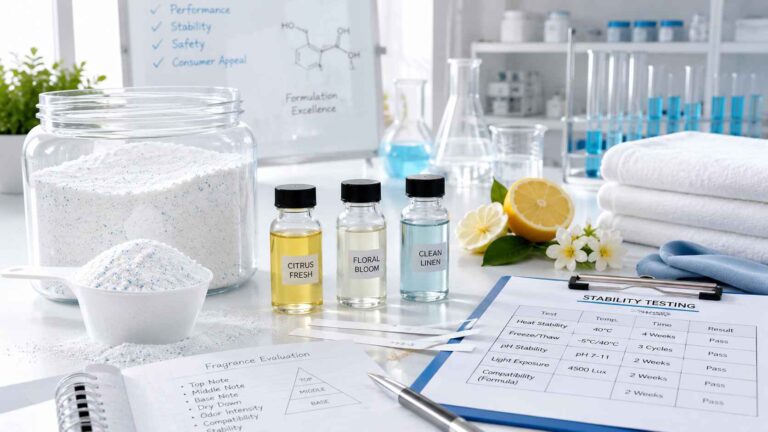
That is why fragrance oil dilution and concentration is not a minor technical topic. It is the difference between a scent that performs and a scent that simply smelled nice in a sample vial.
Hard Truth 3: The Best Scent Is Sometimes the One You Delete
I know this sounds brutal, but some trend ideas should be killed early.
If the fragrance pushes allergens too high for your target market, kill it. If it discolors your soap, kill it. If it makes your clear shampoo hazy, kill it. If it smells amazing for ten minutes and dead after rinse-off, kill it. If the supplier cannot provide IFRA documentation, SDS, COA, allergen detail, and batch consistency, walk away.
The market is too crowded for fragile romance.
Hard Truth 4: “Natural” Is Not a Safety Strategy
Natural can be beautiful. Natural can also be chemically messy.
Lavender oil may contain linalool and linalyl acetate. Citrus oils may bring limonene and citral. Clove-like effects can involve eugenol. Oakmoss materials carry their own restrictions. Meanwhile, synthetics can provide consistency, lower color, better stability, controlled diffusion, and fewer supply shocks.
The industry needs to stop pretending “natural” automatically means safer, cleaner, or better. The smarter question is: what does the finished product need to do?
How Can Beauty Brands Use Fragrance Trends in 2026?
Brands should use 2026 fragrance trends as market signals, not as copy-and-paste formulas.
Start with the consumer behavior. Gen Z wants scent wardrobes. Prestige buyers still pay for emotional value. Personal care buyers want daily rituals. Sensitive-skin consumers want transparency. EU-facing brands need allergen planning. Retailers want fewer compliance surprises. Operations teams want repeatable production.
Then build the scent system.
A practical 2026 fragrance plan might look like this:
Choose one master scent territory: clean tea musk, salted gourmand, skin floral, mineral citrus, soft amber, or herbal spa.
Translate it into three product intensities: hero perfume, daily body mist, and personal care base.
Test each version in the actual formula, not on blotters only.
Build launch content around ritual, usage, and repeat behavior.
The best fragrance trends for beauty brands are not the loudest ones. They are the ones that create memory across products.
A shampoo that leaves a clean green-tea musk trail. A body lotion that dries into oat milk and sandalwood. A hand wash that makes a guest ask what it is. A body mist that layers without choking the room. A soap bar that still smells like the brand after curing.
That is brand equity.
FAQs
What are the top 2026 fragrance trends for beauty and personal care brands?
The top 2026 fragrance trends are scent directions that combine emotional appeal, repeat-use behavior, and technical performance across formats such as perfume, body mist, shampoo, lotion, soap, and hand wash. Expect grown-up gourmands, clean skin musks, tea-citrus freshness, functional mood cues, alcohol-free mists, and allergen-aware scent design.
The weaker interpretation is “what note is trending?” The stronger interpretation is “what scent system can a brand own across the full customer routine?” In 2026, beauty fragrance trends will reward brands that connect perfume trends 2026 with formulation reality.
How can beauty brands use fragrance trends in 2026?
Beauty brands can use fragrance trends in 2026 by turning search and social signals into tested scent systems that fit product format, compliance limits, consumer mood, and repeat purchase behavior. The right process starts with a fragrance brief, moves through lab testing, and ends with claims that match actual formula performance.
Do not approve a fragrance because it smells good in the supplier’s office. Approve it because it works in your shampoo, body lotion, soap, mist, or perfume oil after stability, safety, and usage testing.
Why are gourmand fragrance trends important in 2026?
Gourmand fragrance trends are important in 2026 because consumers are still drawn to edible comfort notes, but the market is moving toward more sophisticated versions built around pistachio, oat milk, coffee, vanilla, coconut, caramel, salt, woods, and musk. The opportunity is emotional warmth without cheap sweetness.
For beauty and personal care brands, gourmand works best when adjusted by format. A perfume oil can carry richness. A shampoo may need a cleaner gourmand trace. A lotion can hold creamy sweetness better than a rinse-off product.
What should personal care brands test before launching a new fragrance?
Personal care brands should test fragrance stability, scent retention, solubility, color change, viscosity impact, pH tolerance, packaging interaction, allergen labeling, IFRA category limits, and consumer dry-down before launching. A fragrance that works on a blotter can fail badly in soap, shampoo, lotion, conditioner, or hand wash.
For rinse-off formats, test bloom during use and scent after rinsing. For leave-on products, test skin feel, allergen thresholds, and dry-down. For soaps, watch acceleration, ricing, separation, and discoloration.
Are fragrance allergens a brand risk in 2026?
Fragrance allergens are a brand risk in 2026 because regulators, retailers, and consumers are demanding more transparency around substances that can trigger sensitivity, especially in cosmetics and personal care products. EU Regulation (EU) 2023/1545 expands allergen-labeling expectations, making early allergen review a commercial necessity.
This does not mean fragrance is bad. It means sloppy fragrance sourcing is bad. Brands should request IFRA certificates, SDS, COA, allergen declarations, and updated documentation before approving a scent for production.
Your Next Steps: Build the Brief Before You Buy the Oil
Do not start 2026 with “We need something trending.”
Start with this:
What product are we scenting? Who uses it? How often? Is it rinse-off or leave-on? What markets will we sell into? What claims will we make? What allergens are acceptable? What price tier are we defending? What note family can we own for more than one season?
Then ask for fragrance samples.
If you are building a beauty or personal care line around 2026 fragrance trends, use the trend data as pressure, not permission. Push harder on the brief. Push harder on stability. Push harder on documentation. Push harder on whether the scent can become a brand asset instead of a seasonal costume.
Our team of 20+ senior perfumers leverages a vast library of 40,000+ formulas to deliver expert customization and scent replication with up to 98% accuracy. As premier perfume oil manufacturers, we bring your most complex fragrance concepts to life with precision.
Industry-Leading Speed
We empower your business with industry-leading speed. Samples are ready in just 1-3 days, mass production takes only 3-7 days, and our low 5kg MOQ allows you to test the market quickly and without risk, solidifying our role as agile fragrance oil suppliers.
Certified Quality & System Assurance
Our quality is built on trust and technology. We are fully certified with IFRA, ISO, GMP, and Halal, and our advanced ERP system guarantees complete traceability and batch-to-batch consistency, making us your reliable perfume raw materials supplier.