Fragrance Oils in Soaps and Personal Care: Addition Techniques
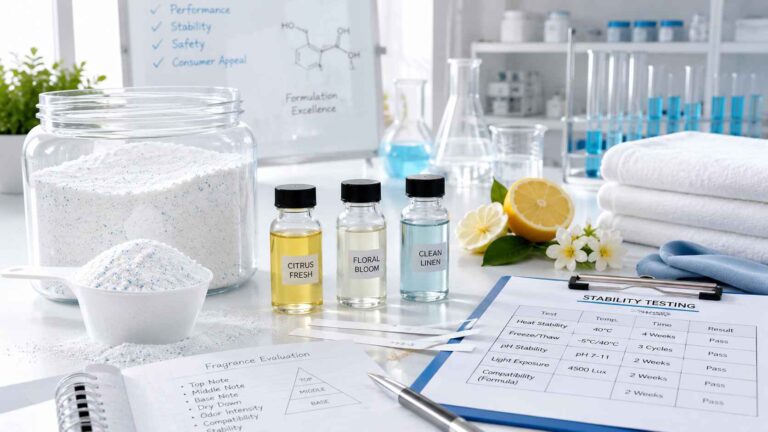
Fragrance oils are not decoration. They are functional formulation inputs that affect acceleration, discoloration, viscosity, allergen labeling, batch records, and consumer complaints. This guide breaks down when to add fragrance oil in soap making, how much fragrance oil to add to soap, and why supplier documentation matters more than a pretty scent strip.
The Expensive Lie: “Just Add Fragrance at the End”
That advice fails.
I have seen otherwise competent brands treat fragrance like a final splash of color, then act shocked when a cold process batch seizes, a white lotion turns beige, a shampoo loses viscosity, or a retailer asks for IFRA, SDS, COA, and allergen disclosure before onboarding. The hard truth is simple: fragrance oils for soap are not an afterthought; they are a process variable, a compliance variable, and a customer-complaint variable all at once.
So why do so many formulas still treat scent like garnish?
If you are sourcing from a serious soap fragrance oil manufacturer, the conversation should start before the formula hits the kettle: target base, pH, process temperature, expected fragrance load, market region, allergen rules, discoloration tolerance, and whether the oil has been tested in cold process soap, melt-and-pour, syndet bars, shampoo, conditioner, lotion, or body wash.
This is where the amateurs get exposed. A scent that smells expensive on a blotter can behave badly in sodium hydroxide, surfactant systems, cationic conditioners, or high-water emulsions.
Fragrance Oil Is Chemistry, Not Perfume Theater
The phrase “fragrance oil” sounds soft. The reality is sharper: a formula may contain dozens of aroma chemicals, natural isolates, essential oil fractions, solvents, stabilizers, and trace allergenic constituents such as limonene, linalool, citral, geraniol, coumarin, eugenol, benzyl alcohol, or citronellol.
That matters because soap and personal care bases are hostile environments. Cold process soap starts highly alkaline. Shampoo depends on surfactant balance. Conditioner leans on cationic materials like BTMS-25, BTMS-50, behentrimonium chloride, or cetrimonium chloride. Lotion emulsions can split if the fragrance phase is poorly chosen. Clear body wash can haze when the wrong hydrophobic load enters the system.
And regulators are watching harder now. The FDA reported in May 2026 that MoCRA implementation has produced more than 15,000 active cosmetic facility registrations and more than 1 million active cosmetic product listings, compared with 5,176 establishment registrations and 35,102 product listings under the old voluntary program, according to the FDA’s article on implementing landmark cosmetics legislation. That is not small paperwork. That is a surveillance upgrade.
For brands, the operational lesson is ugly but useful: if your fragrance oil supplier cannot provide documentation fast, your launch clock is already broken. I would rather buy a slightly less romantic scent with a clean document pack than a beautiful mystery oil that collapses during scale-up. Every time.
Table of Contents
Where to Add Fragrance Oils for Soap Without Causing Damage
Addition technique depends on the base. Not mood. Not habit. Not “what worked once.”
For cold process soap fragrance oil, the most common professional approach is to add fragrance after emulsification, usually at light trace, then mix only as much as needed. But that rule bends when the fragrance is known to accelerate, rice, discolor, or loosen the batter. In those cases, I prefer splitting the fragrance into warmed base oils, hand-stirring, and keeping the design simple. Swirls are not worth a ruined 40 kg batch.
For melt-and-pour soap, the issue is different. You are not fighting saponification; you are fighting evaporation, sweating, clouding, and poor dispersion. Add the fragrance when the melted base has cooled enough to reduce volatilization but remains fluid enough to mix evenly. Many makers work around 49–57°C, but supplier guidance should win over folklore.
For lotions and creams, the fragrance usually belongs in cool-down, often below 40–45°C, depending on the emulsion system and preservative package. Add too hot and you lose top notes. Add too aggressively and you can destabilize viscosity. Add without checking allergen thresholds and you may create a labeling problem before the first jar ships.
If you are developing beyond soap, the site’s personal care fragrance oils category is the better internal starting point than a generic scent library because personal-care applications demand skin-contact thinking from the first sample.
Addition Timing, Usage Rates, and Failure Modes
Here is the table I wish more indie brands printed and taped above the bench.
Product Type
Typical Addition Point
Practical Starting Range
Main Failure Risk
What I Check Before Approval
Cold process soap
Light trace or pre-blended into base oils
Often 3–6% of oil weight, capped by IFRA and supplier limit
Do not read that table as permission. Read it as a starting map.
The maximum safe level comes from the IFRA category and the supplier’s certificate, not from a Reddit thread, a spreadsheet template, or somebody’s old soap recipe. The IFRA Standards describe a risk-management system that can prohibit, restrict, or specify conditions for fragrance materials, and IFRA also states plainly that final responsibility for placing safe products on the market remains with companies.
That last sentence stings because it is supposed to. Suppliers provide documents. Brands own finished-product decisions.
How Much Fragrance Oil to Add to Soap: The Answer Nobody Likes
The correct answer is: less than the lowest applicable limit.
For how much fragrance oil to add to soap, I use a three-part ceiling: the IFRA Category 9 maximum, the supplier’s application recommendation, and the formula’s real-world behavior after cure. If IFRA allows 8% but the soap accelerates violently at 4%, your practical limit is not 8%. If a supplier suggests 5% but the fragrance discolors a white bar into tan by week two, your commercial limit may be lower unless the color fits the concept.
This is why “best fragrance oils for soap making” is a dangerous search phrase. Best for what? A white goat milk bar? A black charcoal bar? A fast-poured hotel amenity? A lavender-oat artisan loaf with a hanger swirl? A 100,000-piece private label order?
For a real soap program, I would test like this:
My Bench Test Sequence
Make a 300 g pilot batch. Add fragrance at 3%, 4.5%, and 6% of oil weight, unless the IFRA document forces lower. Record temperature, trace speed, pour time, color at 24 hours, color at 7 days, scent at 30 days, and any surface sweating, cracking, or drag marks.
Then do it again.
One test is gossip. Two tests begin to look like data. Three tests under slightly different temperatures tell you whether your process is robust or just lucky.
A product like CP-Soap Stable Lavender & Oat Personal Care Fragrance Oil is positioned around cold-process stability, low discoloration, and minimal acceleration, which is exactly the kind of application-specific claim I want to see before I waste production time on a complicated swirl design.
Essential Oils vs Fragrance Oils in Soap: Stop Pretending Natural Means Simple
I will say the unpopular part clearly: essential oils are not automatically safer, cleaner, or easier to formulate than fragrance oils.
Essential oils are botanical materials, and botanicals vary by crop, region, oxidation, storage, and distillation profile. Fragrance oils can be engineered for consistency, allergen control, performance, and documented application limits. Both can contain allergens. Both can irritate skin at the wrong level. Both can fail in soap.
The more honest comparison is not “natural versus synthetic.” It is documented versus undocumented.
If you need a full sourcing argument, the internal guide on fragrance oils vs essential oils is worth connecting inside this topic because it frames the real buyer questions: application system, compliance perimeter, failure mode, and reorder reality.
The EU has already moved hard on allergen disclosure. Under Regulation (EU) 2023/1545, manufacturers have transition periods for new fragrance allergen labeling: new products placed on the EU market face the 31 July 2026 deadline, and products already on the market face the 31 July 2028 deadline, as summarized by Austria’s public health agency AGES in its page on new fragrance regulation in cosmetics. In plain English: “parfum” is no longer enough if regulated allergens exceed reporting thresholds.
And in the United States, MoCRA section 609(b) requires fragrance allergens in cosmetic products to be identified on labels once FDA defines the required substances, as shown in the federal rulemaking entry for Fragrance Allergens in Cosmetic Products.
Soap brands that export should not wait for a retailer to discover this during onboarding. By then, you are negotiating from weakness.
Personal Care Fragrance Oils Need Different Addition Discipline
Soap makers often overestimate what they know when they move into lotions, shampoos, and conditioners.
I understand why. Soap feels demanding: lye, temperature, trace, cure, ash, color. But personal care emulsions and surfactant systems punish arrogance in quieter ways. A shampoo can look fine on day one and lose viscosity by day ten. A conditioner can smell wonderful in the beaker and feel waxy on hair. A body wash can turn cloudy under cold storage. A lotion can pass initial odor review and then develop a sour edge after 8 weeks at 45°C.
For fragrance oils for personal care products, I want the supplier to answer six questions before I even smell the sample:
Six Supplier Questions That Save Launches
Can you provide IFRA, SDS, COA, and allergen declaration?
Has this oil been tested in the target base type?
What is the recommended usage rate for rinse-off versus leave-on?
Does it contain vanillin, ethyl vanillin, high-terpene citrus fractions, or oxidation-sensitive materials?
Does it affect viscosity in surfactant or cationic systems?
Can you support batch traceability if we reorder for 12–24 months?
This is where a page like Fragrance Oil Safety: MSDS and COA Certifications Explained earns its internal link. Documentation is not decoration. SDS keeps handlers informed, COA protects batch consistency, and IFRA documentation sets use-boundary discipline.
The Insider Mistake: Testing Scent on Skin, Not in the Product
Here is a hard truth from the buying side: many brand owners pick fragrance like consumers, not manufacturers.
They smell a blotter. They smile. They approve. Then they blame the supplier when the fragrance behaves differently in soap, shampoo, lotion, or conditioner.
But fragrance is application-dependent. A citrus top note can disappear in high-pH soap. A gourmand accord can brown a pale bar because of vanillin. A powdery musk can feel elegant in lotion but too heavy in shampoo. A floral can bloom beautifully in warm shower steam but smell thin in a cured bar.
For supplier due diligence, the internal article on how to select high-quality fragrance oil material suppliers fits naturally here because supplier quality is not only about price per kilogram. It is about documents, testing support, change control, sample speed, allergen transparency, and whether technical staff can explain why the same formula behaves differently across bases.
Cheap fragrance is not cheap if it costs you three reformulations.
A Practical Addition Workflow for Brand-Scale Soap and Personal Care
If I were building a new fragranced soap or personal care SKU today, I would not start with “What smells good?” I would start with a one-page technical brief.
Step 1: Define the Product Exposure Category
Soap is rinse-off. Lotion is leave-on. Shampoo is rinse-off but scalp-contact. Conditioner may be rinse-off or leave-in. Body oil is leave-on. These differences affect IFRA category, allergen review, label risk, and consumer exposure.
Step 2: Set a Fragrance Load Target Before Sampling
For cold process soap, I usually want samples evaluated around 3–6% of oil weight unless restricted lower. For shampoo, conditioner, and lotion, I start far lower, often below 1%, because leave-on exposure, viscosity, and allergen load matter more.
Step 3: Ask for Documentation Before Approval
Do not approve a scent emotionally, then ask for IFRA later. That is backwards. Ask first. If the supplier hesitates, move on.
Step 4: Run Stability in the Real Base
Test at room temperature, elevated temperature, cold temperature, freeze-thaw if relevant, and final packaging contact. PET, HDPE, glass, pumps, caps, liners, and labels can all interact with fragrance.
Step 5: Approve by Data, Not Vibe
Record dosage, batch number, temperature, mixing method, pH, viscosity, odor at intervals, color change, and customer-facing performance. This is boring work. That is why it works.
FAQs
How do you add fragrance oil to soap?
To add fragrance oil to soap, measure it by weight, confirm the IFRA Category 9 and supplier usage limit, then incorporate it at the correct process stage for the soap type, usually light trace for cold process or controlled cool-down for melt-and-pour, while watching acceleration, discoloration, and scent retention.
For cold process, I prefer adding at light trace unless the fragrance is known to accelerate. For difficult oils, pre-blend into a portion of base oils and hand-stir. For melt-and-pour, add during cool-down while the base remains fluid enough to disperse evenly.
When should fragrance oil be added in cold process soap?
Fragrance oil should usually be added to cold process soap at light trace, after oils and lye solution have emulsified but before the batter thickens, because this timing allows even dispersion while reducing the mixing time that can trigger acceleration, ricing, or design failure in sensitive formulas.
If the fragrance has a reputation for fast trace, skip complex swirls, lower your working temperature, and mix by hand. Do not fight a misbehaving fragrance with more stick blending. That usually makes the problem worse.
How much fragrance oil should I add to soap?
The amount of fragrance oil to add to soap should be based on the lowest limit among the IFRA certificate, supplier recommendation, and your finished-batch performance testing, with many cold process formulas starting around 3–6% of oil weight only when documentation and stability allow it.
Never use a generic rate without checking the specific fragrance. One oil may be comfortable at 5%; another may be restricted far lower or may ruin texture, color, or cure performance even when technically allowed.
Are fragrance oils better than essential oils for soap making?
Fragrance oils are often better than essential oils for soap making when the goal is repeatable scent, controlled cost, broader odor range, and supplier documentation, while essential oils may appeal to natural-positioned brands but can vary by harvest, oxidation, allergen content, and performance in alkaline soap.
The better question is not which one sounds cleaner. The better question is which one is documented, stable, legal for the target market, and proven in your exact base.
What documents should a soap brand request before buying fragrance oils?
A soap brand should request an IFRA Certificate, SDS, COA, allergen declaration, recommended usage rate, application notes, batch traceability details, and any discoloration or acceleration data before buying fragrance oils, because those documents support safer formulation, retailer onboarding, customs review, and repeatable manufacturing.
I would also ask whether the oil has been tested in cold process soap specifically. “Skin safe” is not the same as “soap stable,” and “smells good” is not the same as “production ready.”
Your Next Steps: Test the Fragrance Like It Can Break the Launch
Do not choose fragrance oils for soap from a scent strip alone.
Pick the target product first. Ask for IFRA, SDS, COA, allergen data, recommended dosage, and application notes. Run small pilot batches. Record trace speed, color, pH, viscosity, odor retention, and stability. Then scale.
If you need a supplier conversation built around soap stability, personal-care compatibility, documentation, and fast sampling, start with custom fragrance oil development and sample support and bring a real brief: product type, base system, target market, desired scent profile, expected dosage, compliance region, MOQ, and launch date. That is how serious fragrance work begins.
Our team of 20+ senior perfumers leverages a vast library of 40,000+ formulas to deliver expert customization and scent replication with up to 98% accuracy. As premier perfume oil manufacturers, we bring your most complex fragrance concepts to life with precision.
Industry-Leading Speed
We empower your business with industry-leading speed. Samples are ready in just 1-3 days, mass production takes only 3-7 days, and our low 5kg MOQ allows you to test the market quickly and without risk, solidifying our role as agile fragrance oil suppliers.
Certified Quality & System Assurance
Our quality is built on trust and technology. We are fully certified with IFRA, ISO, GMP, and Halal, and our advanced ERP system guarantees complete traceability and batch-to-batch consistency, making us your reliable perfume raw materials supplier.