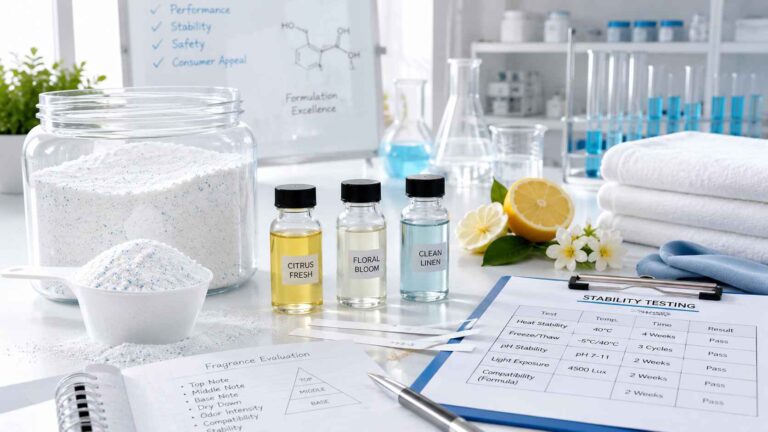
Case Study: Developing a Signature Detergent Fragrance for a New Brand
A detergent fragrance is not decoration. It is a retention device, a compliance risk, a cost line, and often the only reason a buyer remembers a new laundry brand after the first wash.
The uncomfortable truth: clean does not smell like “nothing”
Clean sells scent.
That sounds too simple, but after watching enough laundry startups obsess over bottle shape, Instagram typography, and “plant-powered” wording while treating detergent fragrance as a late-stage add-on, I’ve become convinced that most new brands misunderstand the category before they even brief the lab. They think the fragrance is a pleasant extra. It is not. It is the memory hook.
Ask the harder question: if two detergents remove the same stain, which one gets bought again?
For a new laundry brand, the signature scent must do four jobs at once. It has to smell good in the cap, survive the detergent base, bloom during the wash, and leave a controlled after-wash impression on fabric. That last word matters: controlled. Too weak and the brand feels cheap. Too loud and consumers complain, especially in family households, baby-care positioning, or export markets with stricter allergen labeling expectations.
This is why I would not start a detergent project with “lavender,” “cotton,” or “fresh linen.” Those are lazy directions. I would start with the brand’s use case, its formula chemistry, its region, its price band, and its risk tolerance. Then I would decide whether to build from a proven library or commission a true custom detergent fragrance.
For this case study, the brand was imaginary but realistic: a new private label laundry detergent brand entering the mid-premium segment, selling online first, then pitching regional retailers. The target was clear: a signature scent for a detergent brand that smelled modern, soft, clean, and expensive without pushing the formula cost into fantasy land.
The internal supplier path should begin with a category specialist, not a general perfume conversation. That is why the most natural first internal destination is the detergent fragrance manufacturer page, because detergent is a hostile chemical environment, not a fine-fragrance blotter test.
The case brief: what the new detergent brand actually needed
The founder wanted “premium clean.”
I hate that phrase, because it usually means five different things to five different people: one buyer imagines white musk, another imagines citrus aldehydes, another wants baby powder, and the operations person simply wants something that will not discolor the liquid after three months in a warehouse. So we translated “premium clean” into a usable fragrance development brief.
The working direction became:
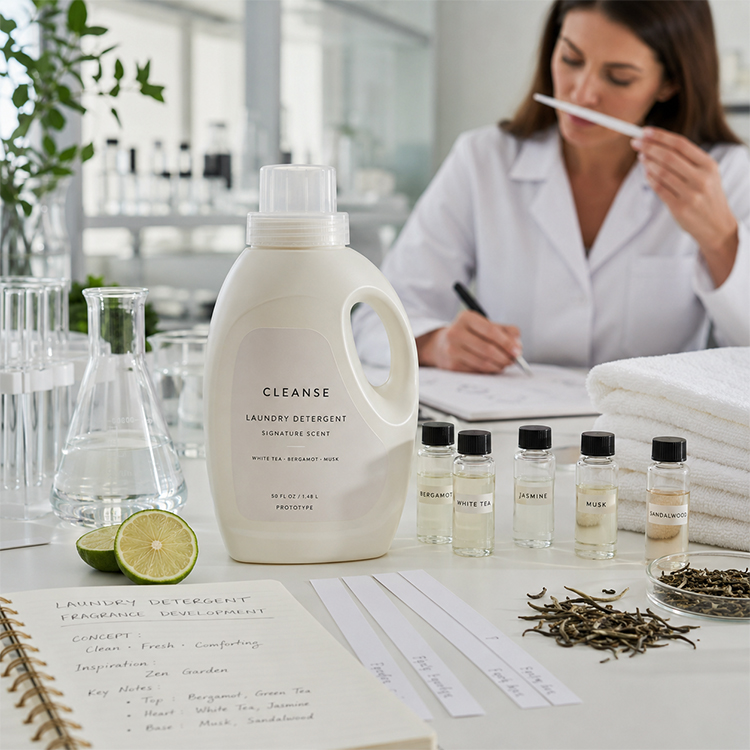
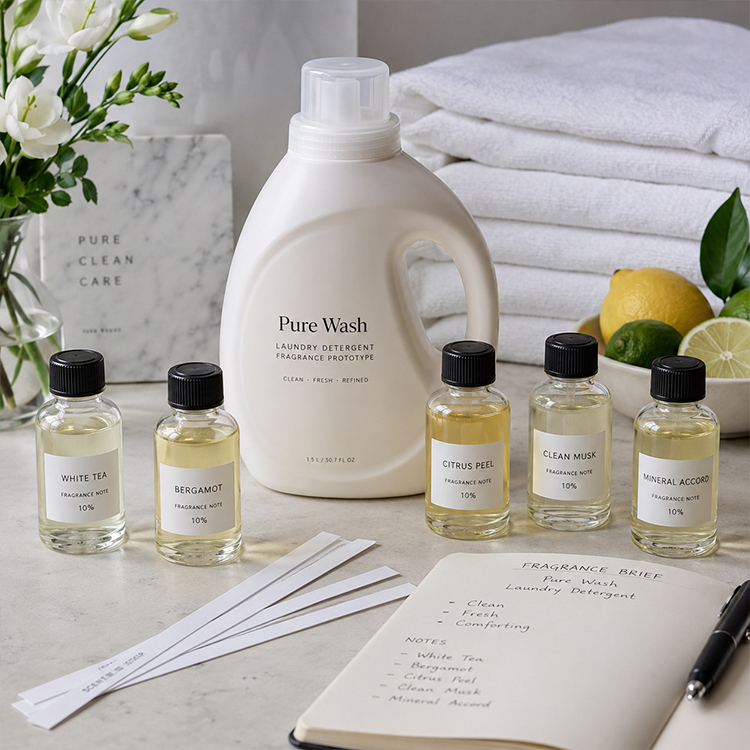
A soft mineral-citrus detergent fragrance with white tea, clean musk, transparent floral lift, low sweetness, and a dry fabric finish.
That is a brief. Not poetry. Not guesswork.
The brand also needed a fragrance system that could later move into fabric softener, scent booster beads, and an all-purpose cleaner. That makes the cross-category scent matrix relevant, because one signature accord can stretch across home care formats only if it is engineered for different bases and dose levels from the start.
The first hard filter: detergent chemistry
A detergent fragrance lives inside surfactants, builders, enzymes, preservatives, dyes, and sometimes high-pH systems. That is not a neutral home.
For laundry detergent fragrance development, the first question is not “does it smell beautiful?” The first question is “does it remain stable?”
The brand wanted a launch fragrance that felt expensive but scalable. So we did not brief the perfumer like a luxury perfume house. We briefed them like a manufacturer: target odor, target stability, target compliance, target cost.
If you are building this commercially, the fragrance oils collection is the right hub to connect the detergent project with broader B2B fragrance oil capabilities, including formula libraries, IFRA documentation, and category-ready scent families.
Table of Contents
Evidence the industry does not like to say out loud
Here is the controversial part: fragrance is often the emotional proof of cleaning, even when the cleaning chemistry did the real work.
P&G says its scent research focuses on how consumers experience fragrance at multiple moments, from opening the package to use and post-use, and its researchers designed scent notes to vary over time because people become familiar with surrounding odors. That is not a cute marketing anecdote; it is a development principle. Read P&G’s own R&D case study,
Now look at Gain. In March 2026, the brand announced Gain Plus with boosted perfume microcapsules and concentrated neat oil fragrance technology, while also pairing fragrance with enhanced enzymes and Oxi cleaning technology. The announcement even says the line was built for “more scent power” and long-lasting freshness. That is a mainstream detergent brand publicly saying the quiet part: scent is a performance feature, not decoration. See the Business Wire release, Gain Invites You to Sniff the Difference.
But scent claims can also become a liability. The U.S. EPA’s Safer Choice Criteria for Fragrances states that listed carcinogens, mutagens, reproductive or developmental toxicants, persistent bioaccumulative toxic compounds, and listed respiratory sensitizers are not allowed in Safer Choice-certified products; manufacturers must also disclose dermal sensitizers.
And if a founder wants to slap “eco,” “non-toxic,” or “safe” on the front label, I would send them to the FTC first, not the designer. The FTC Green Guides exist to help marketers avoid misleading environmental claims and explain how claims should be substantiated and qualified.
This is where detergent fragrance development gets political fast. The scent has to sell emotion, but the documentation has to survive legal review.
Building the signature detergent fragrance: from vague idea to working formula
The first submission should never be one fragrance.
Never do that.
A serious detergent fragrance manufacturer should send a controlled set of options: usually three to six directions, each with a reason to exist. If every sample smells like “fresh laundry,” the supplier is not developing a brand asset. They are sending shelf filler.
For this project, I would ask for six routes:
Route A: Mineral Citrus Musk
Bright bergamot-style lift, aldehydic sparkle, white tea, clean musk, and a dry cotton finish.
Best for: modern D2C laundry detergent, unisex household positioning, minimalist packaging.
Risk: can become thin or sharp if the detergent base already has chemical brightness.
Route B: Soft Floral Linen
Muguet-style floralcy, peony nuance, powder musk, and a washed-sheet drydown.
Best for: family care, softener extension, mainstream retail.
Risk: smells too familiar unless the musk and floral balance are handled with restraint.
Route C: Herbal Clean Spa
Lavender, rosemary, eucalyptus nuance, watery green top notes, and transparent woods.
Best for: natural-positioned detergent, refill concept, wellness brand.
Risk: “spa” can drift into surface cleaner territory if eucalyptus gets too medicinal.
Route D: Fruity Fresh Cotton
Pear, apple skin, watery floral, clean amber, and fabric musk.
Best for: younger buyers, TikTok-friendly scent naming, scent booster extension.
Risk: sweetness can fight the “serious clean” message.
Best for: premium private label laundry detergent fragrance.
Risk: subtle scents need excellent bloom technology or the consumer may miss them.
Route F: Odor Defense Fresh
Sharper citrus, green aldehydes, clean woods, and stronger drydown materials.
Best for: sportswear, pet households, humid climates.
Risk: can feel functional rather than beautiful.
The winner in this case would be Route E, with technical reinforcement from Route F. That is how good detergent fragrances are often made: not by choosing the prettiest blotter, but by stealing performance from the more functional option and aesthetics from the more premium one.
For a real brand, this is the stage where an effective fragrance development brief saves weeks. A brief forces everyone to define the customer, channel, base formula, compliance limits, scent references, rejection notes, and launch timeline before the perfumer wastes time chasing adjectives.
The raw testing matrix: where weak fragrances die
Most fragrance failures do not happen in the first sniff. They happen after heat, time, base interaction, packaging contact, or consumer over-exposure.
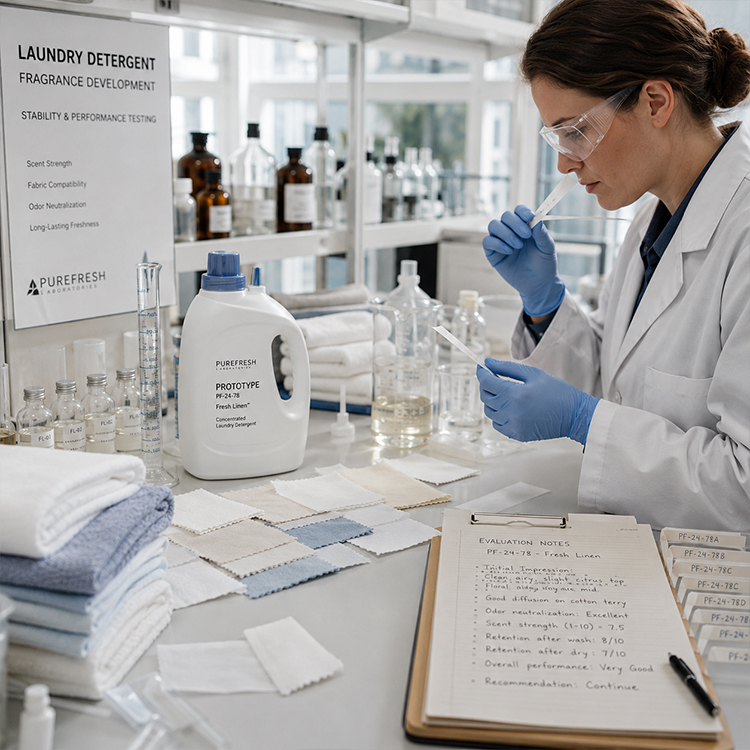
Here is the practical test matrix I would use before approving a custom detergent fragrance for mass production.
Test Area
What We Test
Working Pass Standard
Why It Matters
Base stability
Fragrance in final detergent base at 25°C and 40°C
No major odor distortion, separation, haze, or color shift after 4 weeks
Detergent chemistry can damage fragile top notes
pH tolerance
Fragrance in alkaline detergent environment
Scent profile remains recognizable after storage
Many laundry systems are not perfume-friendly
Bloom test
Scent release in wash water
Noticeable bloom at recommended dosage
Consumers smell the product during use, not only in the bottle
Fabric drydown
Cotton/polyester swatches after wash and dry
Clear but not aggressive scent after 24–72 hours
Rebuy often depends on post-wash memory
Malodor interaction
Sweat, cooking oil, musty towel, pet odor simulations
Fragrance supports odor perception without obvious masking failure
“Fresh” must compete with real household smells
Packaging compatibility
HDPE, PET, cap liner, pouch film if relevant
No swelling, leakage, staining, or odor scalping
Packaging can absorb or distort fragrance
Compliance pack
IFRA, SDS/MSDS, allergen declaration, COA
Complete before pilot run
Retailers and importers ask for documents late, then panic
Cost-in-use
Fragrance cost at intended dosage
Fits target COGS per bottle or per wash
A gorgeous scent that kills margin is not strategy
A common mistake is testing fragrance in water or on blotters and then assuming the detergent will behave the same. It will not.
The supplier’s home care fragrance oils positioning matters here because home care scents must handle high pH, heat, surfactants, and functional odor expectations. Fine fragrance thinking alone is not enough.
Compliance is not paperwork; it is product design
This part is dull until it becomes expensive.
For U.S.-leaning brands, I would screen fragrance materials against EPA Safer Choice expectations if the brand wants safer-ingredient credibility. For EU-facing brands, I would watch detergent labeling and allergen disclosure carefully. The EU’s new Regulation (EU) 2026/405 on detergents and surfactants says information on individual allergens in detergents matters so sensitized people can avoid substances to which they are allergic, and it establishes specific labeling requirements where those allergens are not already covered under CLP rules.
The Swedish Chemicals Agency summarizes the same shift clearly: the new EU regulation enters into force on 22 March 2026 and applies from 23 September 2029, with changes including digital product passports, digital labeling, stricter biodegradability requirements, and refill rules. Read its page on detergents and cleaning products.
So no, “natural fragrance” is not a shield. Limonene (C10H16), linalool (C10H18O), citral (C10H16O), benzyl salicylate (C14H12O3), and hexyl cinnamal (C15H20O) can be useful materials, but they also carry allergen and labeling implications depending on market, level, and product category.
Hard truth: a fragrance that looks beautiful in a founder deck can be a regulatory nuisance at scale.
The supplier decision: library adaptation or full custom build?
Not every new brand deserves full custom perfumery.
That may sound harsh, but it is true. If the order volume is small, the target scent is familiar, and the launch timeline is tight, adapting a proven detergent fragrance base may be smarter than demanding a ground-up formula. Custom development makes sense when the fragrance will become a brand signature, a multi-product system, or a defensible sensory asset.
A practical decision table looks like this:
Development Route
Best For
Speed
Differentiation
Risk
My Opinion
Stock detergent fragrance
Budget launch, fast private label, low MOQ testing
For this case, I would choose modified library development. Start from a proven detergent-stable base, then customize the top note, musk body, drydown, and nameable emotional signature. This gives the founder enough uniqueness without burning cash on vanity perfumery.
The OEM/ODM fragrance oil development pathway fits this logic because the real work is not only scent creation; it is sampling, approval, batch consistency, quality control, and production timing.
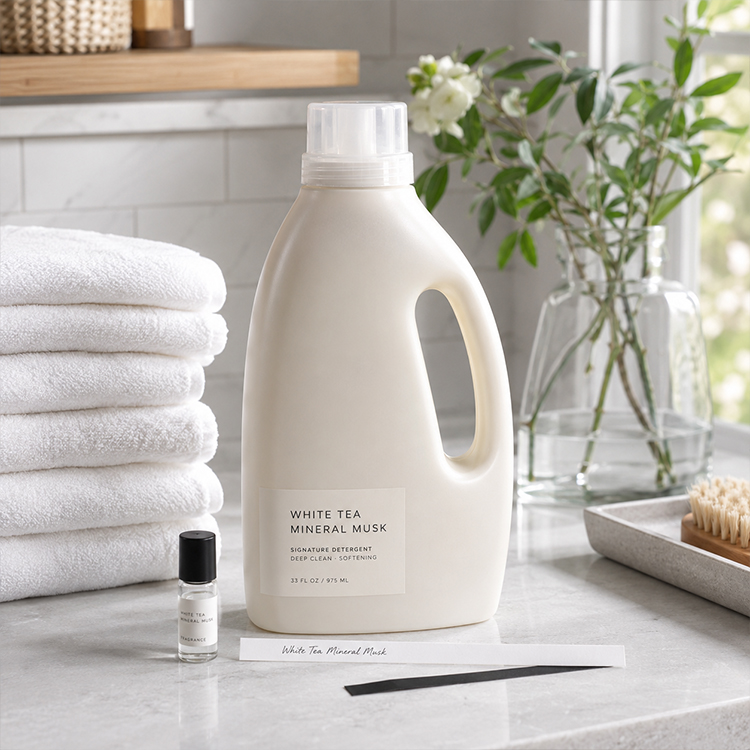
The winning scent: White Tea Mineral Musk
The final direction should not be called “Fresh Linen.”
Please stop doing that.
I would name the scent “White Tea Mineral Musk” internally, then test consumer-facing names later. The formula direction would use a clean citrus opening, tea transparency, soft floral lift, musky fabric retention, and a dry mineral finish. No syrup. No candy. No heavy powder.
The scent architecture might look like this:
Top: bergamot-type citrus, green tea nuance, light aldehydic sparkle
Heart: white tea, transparent jasmine, muguet-style clean floral tone
Base: white musk, soft amber, clean woods, fabric-dry mineral note
Functional support: odor-control-compatible freshness and stable drydown materials
The most important decision is restraint. In laundry, “premium” usually means controlled projection, not perfume-shop volume. The consumer should smell freshness when opening the bottle, again during washing, and then softly on fabric. They should not feel attacked while folding towels.
Launch claims: what I would allow and what I would kill
Founders love claims. Lawyers do not.
Here is my blunt claim review:
Claim
Use It?
Why
“Signature detergent fragrance”
Yes
Clear, brandable, low-risk if true
“Long-lasting fresh scent”
Maybe
Needs fabric drydown testing support
“Odor defense”
Maybe
Requires formula-level proof, not fragrance alone
“Non-toxic fragrance”
No
Too broad and risky without strong substantiation
“Hypoallergenic scent”
Usually no
High-risk unless supported by strict formulation and testing
“Eco-friendly fragrance”
No
Vague; FTC Green Guides risk
“IFRA-compliant fragrance oil”
Yes, if documented
Specific and verifiable
“Developed for laundry detergent bases”
Yes
Relevant and technical
This is where search intent and SEO intent overlap. People searching “best fragrance for laundry detergent” often want a simple scent list. But buyers searching “detergent fragrance manufacturer” or “private label laundry detergent fragrance” are usually closer to sourcing. The article should serve both: answer the educational question, then lead the serious buyer toward supplier evaluation.
What this means for SEO: the keyword strategy behind the case study
The primary keyword is Detergent Fragrance, but the article should not repeat it like a robot. Use it in the H1, early body, one H2, image alt text, and conclusion. Then support it with semantic terms:
Custom detergent fragrance
Laundry detergent fragrance development
Signature scent for detergent brand
Detergent fragrance manufacturer
Fragrance development for cleaning products
Private label laundry detergent fragrance
How to develop a detergent fragrance
Best fragrance for laundry detergent
The page should also answer sourcing questions, not just creative ones. Professional readers want to know MOQ, sample speed, stability documents, IFRA status, allergen declarations, base compatibility, and whether the supplier understands home care chemistry.
A detergent fragrance page that only talks about “beautiful aromas” is underpowered. A better page talks about formula survival, fabric drydown, regulatory risk, and brand memory.
FAQs
What is a detergent fragrance?
A detergent fragrance is a concentrated aromatic compound designed specifically for laundry detergents, fabric care products, and cleaning formulas, where it must remain stable in surfactants, alkaline systems, enzymes, dyes, preservatives, packaging, and storage conditions while delivering freshness during washing and after fabric drying.
In plain English, it is the scent system that makes a detergent memorable. A good one works in the bottle, in the wash, and on fabric. A bad one smells fine on a test strip and then disappears, turns sour, or fights the detergent base.
How do you develop a custom detergent fragrance?
Developing a custom detergent fragrance means translating a brand’s target customer, formula chemistry, price point, market regulations, and desired scent identity into a tested fragrance oil that performs in the actual detergent base, survives stability testing, and can be produced consistently with technical documentation.
The process should include a written brief, scent route development, base compatibility testing, bloom testing, fabric drydown testing, allergen review, IFRA documentation, and pilot production. I would not approve mass production until the fragrance passes heat stability and real fabric evaluation.
What is the best fragrance for laundry detergent?
The best fragrance for laundry detergent is usually a clean, stable, emotionally recognizable scent that balances fresh top notes, soft floral or tea-like body, and musky fabric retention without becoming too sweet, too sharp, or too allergen-heavy for the target market and product claim.
For many modern brands, white tea musk, mineral citrus, soft floral linen, herbal clean, and fresh cotton directions perform better than heavy perfume styles. The best option depends on base chemistry, region, consumer expectation, and whether the product is positioned as family care, premium, eco-conscious, or odor-defense.
Why does detergent fragrance stability matter?
Detergent fragrance stability matters because surfactants, pH, enzymes, preservatives, colorants, heat, oxygen, and packaging materials can distort, weaken, separate, or discolor a fragrance before the product reaches the consumer, damaging both product performance and brand trust.
A fragrance that smells good on day one but turns dull, sour, or cloudy after warehouse storage is not launch-ready. Stability testing at room temperature and accelerated conditions should happen before retail production, not after the first customer complaint.
Can one signature scent work across detergent, softener, and home care products?
One signature scent can work across detergent, fabric softener, scent booster, and home care products if the fragrance is designed as a core accord system and then modified for each formula base, dosage level, usage moment, regulatory category, and consumer expectation.
The mistake is copying one fragrance oil into every product. The smarter move is to build a recognizable scent identity, then adapt it technically. Detergent needs wash bloom and fabric drydown. Softener needs softness and retention. Surface cleaner needs immediate freshness and chemical clarity.
What should I ask a detergent fragrance manufacturer before ordering?
You should ask a detergent fragrance manufacturer about detergent-base stability, pH tolerance, IFRA documentation, SDS/MSDS, allergen declaration, COA availability, sample turnaround, MOQ, batch consistency, fragrance library size, custom development capability, packaging compatibility, and experience with liquid, powder, pod, or softener systems.
Do not ask only for “fresh scents.” Ask how the fragrance performs after 4 weeks at 40°C, whether it has been tested in surfactant systems, what documents come with the sample, and whether the supplier can adjust the scent for cost, region, and compliance.
Your Next Steps: build the scent before you build the slogan
If you are developing a new laundry brand, do not treat detergent fragrance as the last decorative decision. Treat it as product strategy.
Start with a serious brief. Define the customer, format, base chemistry, price point, target markets, and claim boundaries. Then work with a supplier that understands detergent stability, IFRA documentation, allergen risk, and fabric drydown — not just pretty top notes.
A signature scent can make a new detergent feel familiar after one wash. But only if it is built like a technical asset, not a mood board.
Our team of 20+ senior perfumers leverages a vast library of 40,000+ formulas to deliver expert customization and scent replication with up to 98% accuracy. As premier perfume oil manufacturers, we bring your most complex fragrance concepts to life with precision.
Industry-Leading Speed
We empower your business with industry-leading speed. Samples are ready in just 1-3 days, mass production takes only 3-7 days, and our low 5kg MOQ allows you to test the market quickly and without risk, solidifying our role as agile fragrance oil suppliers.
Certified Quality & System Assurance
Our quality is built on trust and technology. We are fully certified with IFRA, ISO, GMP, and Halal, and our advanced ERP system guarantees complete traceability and batch-to-batch consistency, making us your reliable perfume raw materials supplier.