How to Build a Complete Packaging System for a Private Label Perfume Brand
A practical guide to building private label perfume packaging as a controlled system—from fragrance formula and bottle compatibility to custom boxes, legal artwork, transit testing, and bulk-production approval.
A complete perfume packaging system connects the formula, bottle, pump, cap, label, box, insert, shipping carton, compliance copy, testing plan, and production records. Each component must work with the others. Treating packaging as decoration usually creates leakage, scuffed labels, crushed boxes, delayed launches, and expensive rework.
That distinction matters.
A private label perfume brand is not buying a bottle and then adding a nice box. It is building a repeatable manufacturing system in which every material, dimension, finish, tolerance, supplier, test result, and approval decision must remain controlled from the first sample to the fifth reorder.
Perfume Packaging Is a System, Not a Pretty Box
Most founders begin with mood boards. I would begin with failure modes.
A perfume package has at least six connected layers:
The fragrance formula
The primary container
The dispensing and closure system
The label and printed identification
The retail presentation box
The transport packaging
Change one layer and the others may need to change.
A higher ethanol concentration may affect label adhesive. A heavier cap may alter insert support. A taller pump may make an approved box dieline unusable. A soft-touch coating may look expensive in a studio photograph but show fingerprints after one week in a distributor’s warehouse.
Boxes fail quietly.
When a 50 mL glass bottle moves only 4 mm inside its insert, repeated vibration can still scuff the label, loosen a decorative collar, deform the carton edge, or place direct impact pressure on the pump during parcel delivery.
Why discover that after 5,000 units have been printed?
My hard view is simple: packaging artwork should not be approved until the filled bottle, closure, label stock, insert, retail box, and shipping method have been tested together.
Table of Contents
Freeze the Product Brief Before Requesting Packaging Quotes
Packaging suppliers cannot engineer around a moving target. Yet private label brands routinely request quotes while the perfume concentration, bottle, cap, market, and order quantity are still undecided.
That produces a low quote, not an accurate quote.
Start by defining the commercial product.
Confirm the fragrance format
Specify whether the product is:
Eau de Cologne
Eau de Toilette
Eau de Parfum
Extrait de Parfum
Alcohol-free perfume oil
Roll-on perfume oil
Solid perfume
Hair fragrance mist
Discovery-set spray
The formula influences bottle compatibility, leakage risk, transport classification, fill process, label language, and customer expectations. Brands still selecting their scent direction should review available fine fragrance oils before locking the packaging architecture.
The packaging team needs these numbers early. A $29 direct-to-consumer perfume sold through paid social advertising does not have the same cost structure as a $180 niche fragrance placed in independent perfumeries.
And it should not use the same box.
Separate catalog products from custom development
Private label perfume packaging moves faster when the brand selects a proven bottle, pump, and cap combination. Fully custom bottles may require molds, decoration trials, higher minimum order quantities, and longer approval cycles.
The same trade-off applies to scent development. A catalog fragrance can shorten the project, while custom fragrance development from brief to bulk production gives the brand more control over differentiation, performance, and market positioning.
Neither route is automatically better. The correct route depends on cash, timing, expected volume, and how much differentiation the brand can actually monetize.
Build a Packaging Bill of Materials Before Approving Artwork
A packaging bill of materials, or BOM, is the controlled list of every component required to produce one finished saleable unit.
Do not leave it inside scattered emails.
Packaging Layer
What Must Be Specified
Common Failure
Approval Evidence
Fragrance formula
Formula code, concentration, color, fill volume, batch standard
Product identity, net quantity, ingredients, company details, warnings
Customs hold, retailer rejection, relabeling
Market-specific regulatory approval
Each line should also identify the supplier, revision number, approved color reference, sample date, minimum order quantity, lead time, defect limit, and replacement policy.
That sounds administrative. It is.
But the BOM is what prevents a purchasing employee from replacing a 1.5 mm greyboard with a cheaper alternative six months later because both materials were described only as “rigid board.”
Engineer the Bottle, Closure, Label, and Box Together
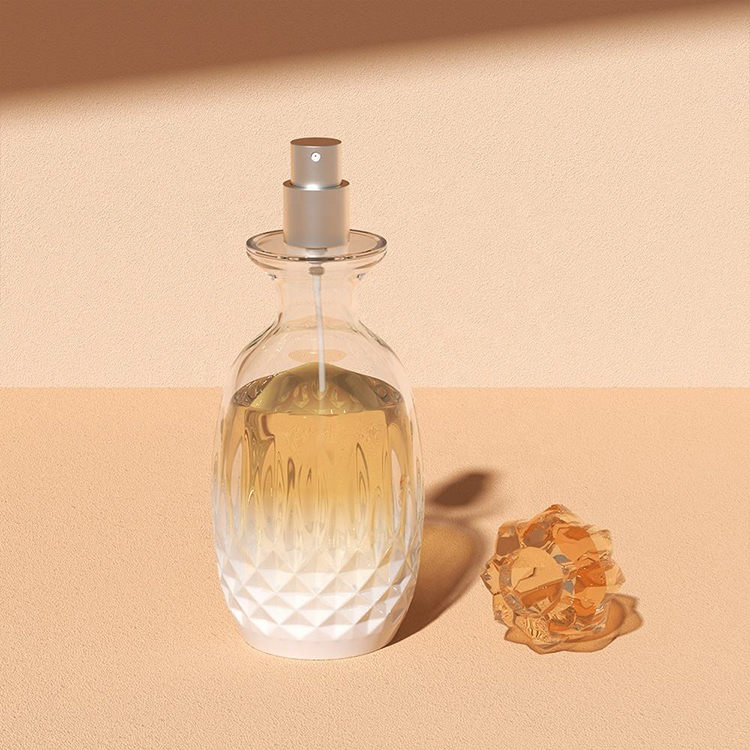
The bottle may be the visual center of the product, but the closure system carries most of the technical risk.
Test the bottle with the actual fragrance
Never approve a bottle using water alone.
Use the final or near-final perfume formula. Store filled samples upright, sideways, and inverted according to the test plan. Check for:
Leakage around the pump or neck
Formula evaporation
Clouding or discoloration
Coating damage
Label adhesive failure
Pump blockage
Cap loosening
Odor change
Dip-tube deformation
A clear formula can become yellow or amber during storage. That change may be acceptable chemically but disastrous inside a transparent bottle selected for a “water-white” visual identity.
Measure pump performance instead of judging one spray
Record the pump dosage per actuation, spray pattern, priming strokes, leakage, and output consistency.
For example, a nominal 0.10 mL pump may require roughly 500 full actuations to dispense 50 mL, although actual usable output will depend on residual liquid, dip-tube design, bottle geometry, and pump variation.
A brand should test multiple units, not one perfect showroom sample.
Choose label materials after compatibility testing
Paper labels can work beautifully on dry, clean glass. But alcohol exposure, condensation, oil contamination, curved bottle walls, and surface coatings change adhesive performance.
Test the complete label construction:
Face stock
Adhesive
Ink
Lamination or varnish
Foil
Application pressure
Application temperature
Bottle surface treatment
Then rub it. Chill it. Expose it to small amounts of the finished perfume. Leave it in a warm storage environment.
Luxury appearance means little when the label edge starts lifting after three days.
Build the perfume box around the real bottle
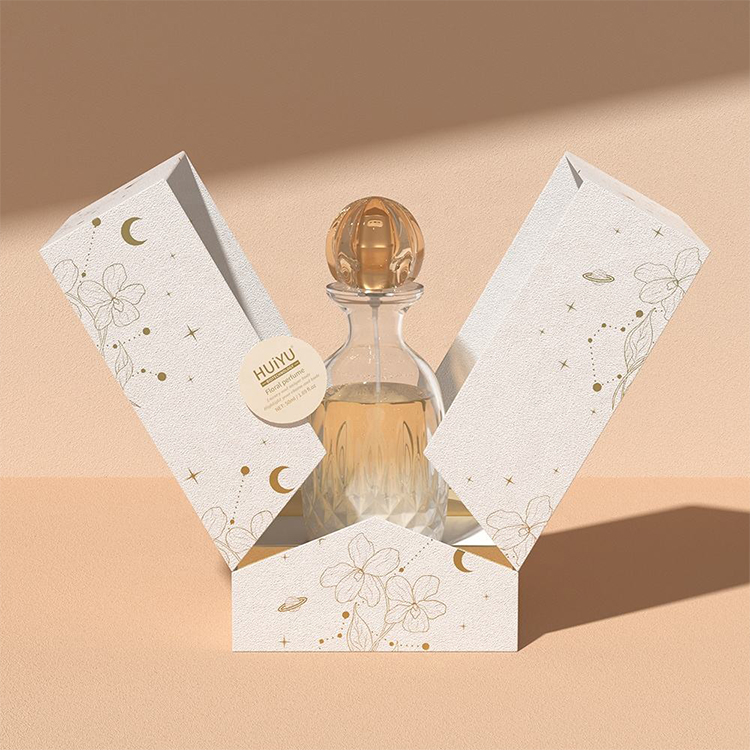
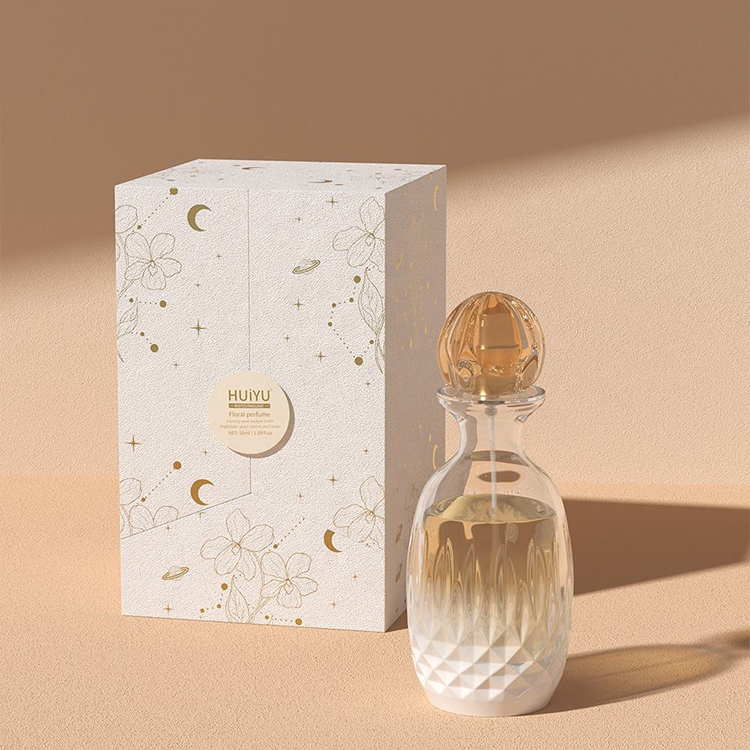
The retail box should be engineered from the final bottle drawing, filled weight, cap height, label position, and intended distribution method. A supplier offering custom perfume box packaging can use those details to evaluate rigid boxes, folding cartons, drawer structures, mailer boxes, and protective inserts rather than forcing the bottle into a generic stock size.
Common perfume box formats include:
Folding cartons for larger retail runs
Two-piece rigid boxes for premium gift presentation
Drawer boxes for controlled unboxing
Magnetic rigid boxes for gift sets and launch kits
Corrugated mailer boxes for direct-to-consumer shipping
Paper tubes for cylindrical concepts
Sample wallets for discovery sets
My unpopular opinion? Many young brands buy too much box.
A rigid magnetic box may look impressive, but it increases material use, assembly labor, storage space, freight volume, and cash tied up in packaging. For a first 1,000-unit launch, a well-designed folding carton with disciplined typography and a secure paperboard insert may be commercially smarter.
Use controlled clearances
Consider an illustrative 50 mL bottle measuring 55 × 35 × 110 mm and weighing 310 g when filled.
The box cannot simply be ordered at 55 × 35 × 110 mm internally. The designer must account for:
Label and decoration thickness
Bottle manufacturing tolerance
Insert compression
Finger clearance
Cap removal
Board thickness
Fold accumulation
Assembly variation
Transit movement
The correct clearance is structure-specific. There is no universal “add 2 mm” rule.
Approve the structure using production-intent materials and several bottle samples from different positions in the supplier’s production run.
Design Compliance Into the Artwork
Compliance is not a sticker added on the night before shipping. It controls the artwork grid from the beginning.
U.S. perfume labeling
In the United States, perfume marketed for application to the body is generally regulated as a cosmetic. The package may need information including product identity, net quantity, ingredient declaration, business details, and applicable warning statements.
The FDA Cosmetics Labeling Guide provides step-by-step guidance, while the agency’s labeling summary explains the legal framework affecting cosmetic packages. Final artwork should still be reviewed for the exact product and claims being made.
Do not write “FDA approved” on a standard cosmetic perfume. FDA explains that cosmetics, apart from color additives, generally do not require premarket approval, although companies remain responsible for legal compliance and product safety.
European packaging rules are changing
The European Union’s Packaging and Packaging Waste Regulation, Regulation (EU) 2025/40, entered into force on February 11, 2025, and generally applies from August 12, 2026. The regulation moves packaging toward recyclability, material minimization, clearer labeling, and reduced packaging waste, with broader recyclability requirements scheduled toward 2030.
For a perfume brand entering the EU, that means packaging decisions made today can affect compliance, redesign costs, and retailer acceptance later.
Ask difficult questions:
Can the insert be separated from the box?
Is the magnetic closure necessary?
Does the decoration interfere with recycling?
Can the same box fit multiple SKUs?
Are environmental claims documented?
Is empty space being used for protection or merely appearance?
“Luxury” is not an exemption from poor engineering.
Packaging copy can create intellectual-property exposure
On March 12, 2026, Reuters reported that Estée Lauder sued perfumer Jo Malone and Zara UK, with the use of the name “Jo Malone” on Jo Loves fragrance packaging forming part of the dispute. It was a lawsuit, not a final judgment, but it offers a useful warning: packaging copy is not harmless decoration.
Before printing, review:
Brand name
Fragrance name
Collection name
Descriptive claims
Comparison language
Geographic references
Logos and symbols
Artwork licensing
Typeface licensing
Retailer-exclusive language
A trademark problem printed on 20,000 cartons is far more expensive than a trademark problem found in a PDF proof.
Package for Distribution, Not Photography
The retail box and the shipping carton perform different jobs.
The retail box communicates the brand and gives the bottle local protection. The master carton must survive stacking, vibration, handling, humidity, pallet movement, and potentially small-parcel delivery.
A reliable packaging hierarchy may include:
Bottle and closure
Retail box and insert
Individual protective wrap, where needed
Inner carton or divider
Master shipping carton
Pallet pattern, stretch wrap, corner protection, and labels
Treat alcohol-based perfume as a logistics issue
Perfume containing flammable solvents may be treated as dangerous goods during transportation. FedEx, for example, identifies flammable perfumes as hazardous materials and advises shippers to confirm the applicable dangerous-goods conditions. Classification depends on the finished formula, flash point, quantity, packaging, route, and carrier rules.
Your fragrance supplier, filling factory, freight forwarder, and carrier should align on:
SDS information
Flash point
UN classification, where applicable
Inner packaging limits
Outer-carton requirements
Marks and labels
Shipper documentation
Air versus sea eligibility
Destination-country restrictions
The decorative retail box does not replace compliant transport packaging.
Use a defined transit test
ISTA Procedure 3A is designed for packaged products weighing 70 kg or less moving through parcel delivery systems. It covers common parcel-package configurations and evaluates hazards such as shock and vibration. The correct test depends on the distribution route, package type, weight, and retailer requirements.
For a direct-to-consumer perfume, the test plan should examine:
Bottle breakage
Pump leakage
Cap movement
Label scuffing
Insert collapse
Retail-box deformation
Master-carton compression
Product movement
Seal integrity
Post-test spray performance
Photograph every failure. Record the carton orientation. Keep the failed sample.
“Passed” and “failed” are useless words without defined acceptance criteria.
Control Packaging Cost Before It Controls the Brand
Unit price is only one line in the packaging cost.
Consider an illustrative 5,000-unit launch. These numbers are an example, not a supplier quotation:
Cost Item
Illustrative Cost per Unit
Decorated bottle
$0.92
Pump, collar, and cap
$0.44
Printed label
$0.10
Folding retail carton
$0.38
Paperboard insert
$0.16
Assembly labor
$0.12
Tooling and samples amortized
$0.07
Inbound packaging freight
$0.21
3% allowance for defects and loss
$0.07
Illustrative packaging total
$2.47
A founder looking only at the $0.38 carton will miss most of the system.
Watch SKU fragmentation
Suppose a brand orders 10,000 boxes across ten fragrances. That does not necessarily produce the same cost as one design ordered at 10,000 units.
Each SKU may require:
Separate artwork setup
Printing-plate changes
Color adjustments
Die-cutting setup
Foil or embossing setup
Sorting
Packing
Carton markings
Quality inspections
The total volume rose. The production efficiency may not have risen with it.
This is why packaging should be modular where possible. One outer structure can sometimes support several fragrances by changing a label, sleeve, sticker, or internal card rather than printing a completely separate rigid box for every scent.
Set a cost ceiling before design begins
For each SKU, define:
Target retail price
Wholesale price
Distributor margin
Product cost
Packaging cost
Fulfillment cost
Freight allowance
Marketing allowance
Expected return and damage rate
Required gross margin
A packaging designer who does not know the cost ceiling is designing fiction.
Sustainability Requires Fewer Claims and Better Engineering
The U.S. Environmental Protection Agency reported that containers and packaging accounted for more than 82 million tons, or 28.1%, of municipal solid waste generated in 2018. The category’s recycling rate was 53.9%, but performance varied sharply by material and packaging type.
That data does not mean every paper perfume box is environmentally sound.
A paper box with laminated films, magnets, plastic windows, EVA foam, metallic layers, and permanent adhesives may be difficult to process through normal recycling systems. Meanwhile, under-packaging a heavy glass bottle can increase breakage, replacement shipments, and product waste.
The better objective is not “use less material at any cost.” It is “use the minimum material required to deliver the product safely and consistently.”
Practical improvements include:
Reducing unused internal volume
Removing decorative plastic windows
Replacing mixed-material inserts with folded paperboard
Designing inserts for easy separation
Using one box structure across several SKUs
Avoiding unnecessary magnets
Reducing oversized gift packaging
Printing environmental claims only when evidence exists
Testing lighter materials before bulk adoption
Measuring damage rates after launch
Green theater is expensive. Good engineering is quieter.
Use Approval Gates Instead of Endless Revision
A packaging project needs decision gates. Without them, suppliers work from different files, old dimensions survive in email threads, and founders keep changing artwork after production materials have been ordered.
I recommend the following sequence:
Gate 1: Product architecture approval
Confirm perfume format, target market, bottle size, sales channel, price position, launch quantity, and planned SKUs.
Gate 2: Fragrance approval
Complete scent evaluation, compatibility planning, and the expected normal fragrance sampling rounds before locking colors and transparent bottle effects.
Gate 3: Bottle and closure approval
Approve bottle drawings, pump dosage, collar, cap fit, decoration, filled weight, and leakage performance.
Gate 4: Structural packaging approval
Approve a plain white sample using the real bottle. Check insertion, removal, movement, cap protection, board strength, assembly, and master-carton packing.
Gate 5: Regulatory artwork approval
Confirm required text, claims, symbols, language, barcode, batch-code area, and responsible company information for every market.
Gate 6: Printed sample approval
Review color under controlled lighting. Check Pantone references, CMYK reproduction, foil position, embossing depth, coating, barcode readability, and artwork alignment.
Gate 7: Pilot packing run
Pack a limited quantity using production-intent materials and normal operators. Measure packing time and record recurring defects.
Gate 8: Transit and storage testing
Test filled products in final retail and shipping packaging. Include the planned distribution route and environmental conditions.
Gate 9: Golden sample approval
Sign and date the final reference sample. Store one with the brand, one with the filling factory, and one with the packaging supplier.
No gate should be passed with “looks fine” written in a messaging app.
FAQs
What is a complete perfume packaging system?
A complete perfume packaging system is the controlled combination of the fragrance formula, bottle, pump, cap, label, secondary box, protective insert, master carton, legal copy, testing plan, and approved specifications that allows every unit to look consistent, survive distribution, meet market rules, and be reordered without guesswork.
The system should include a packaging BOM, technical drawings, approved artwork, compatibility results, transit-test records, defect standards, signed samples, supplier information, and revision control.
What is the best packaging for a private label perfume brand?
The best packaging for a private label perfume brand is the least complex structure that protects the bottle, communicates the intended price position, meets labeling and shipping requirements, and can be produced consistently at the brand’s realistic order volume without consuming too much cash in tooling, inventory, or freight.
For many first launches, that may be a standard glass bottle, reliable pump, printed label, folding carton, and paperboard insert. Rigid boxes are better reserved for products whose margin, gifting purpose, or retail position supports the added cost.
When should the perfume box be designed?
A perfume box should be designed only after the final bottle, pump, collar, cap, label area, filled weight, and sales channel are confirmed, because even a small change in cap height, bottle shoulder, insert thickness, or shipping method can alter the dieline, internal clearance, carton strength, and finished unit cost.
A structural white sample should be tested with several production-intent bottles before printed artwork is approved.
How many packaging samples does a private label perfume need?
Private label perfume packaging normally needs a structural white sample, a printed color sample, a filled pilot pack, and a transport test, with each approval tied to a signed specification sheet and golden sample so the factory cannot quietly substitute board, coatings, adhesives, inserts, or print settings during bulk production.
Additional samples may be required when a project uses custom-molded bottles, complex decoration, multiple SKUs, new adhesives, heavy caps, magnetic boxes, or unfamiliar shipping routes.
What makes perfume packaging sustainable?
Sustainable perfume packaging is packaging that uses fewer materials, separates cleanly, avoids unnecessary mixed components, protects the product well enough to prevent damage and replacement shipments, and makes environmental claims that match real collection and recycling systems rather than relying on vague words such as green, eco, natural, or recyclable.
Brands should review the complete product-to-package ratio, insert design, decoration, freight volume, damage rate, supplier evidence, and destination-market infrastructure.
Build the System Before You Print the Box
A successful private label perfume launch does not begin with gold foil. It begins with controlled decisions.
Freeze the product brief. Approve the fragrance. Test the bottle and pump. Engineer the insert. Review the legal copy. Pack the master carton. Run the transit test. Sign the golden sample.
Then print.
Brands preparing a new EDP, perfume oil, discovery set, or niche fragrance collection can begin with an OEM/ODM perfume oil development brief covering the scent direction, target market, product format, volume, compliance needs, packaging materials, launch quantity, and delivery schedule.
A beautiful box can win attention. A controlled packaging system protects the business.
Our team of 20+ senior perfumers leverages a vast library of 40,000+ formulas to deliver expert customization and scent replication with up to 98% accuracy. As premier perfume oil manufacturers, we bring your most complex fragrance concepts to life with precision.
Industry-Leading Speed
We empower your business with industry-leading speed. Samples are ready in just 1-3 days, mass production takes only 3-7 days, and our low 5kg MOQ allows you to test the market quickly and without risk, solidifying our role as agile fragrance oil suppliers.
Certified Quality & System Assurance
Our quality is built on trust and technology. We are fully certified with IFRA, ISO, GMP, and Halal, and our advanced ERP system guarantees complete traceability and batch-to-batch consistency, making us your reliable perfume raw materials supplier.