How to Customize Fragrance Oils for Different Consumer Markets
Custom fragrance oils should not be localized with stereotypes. This guide explains how to convert market data, consumer behavior, product format, climate, and legal limits into formulas that can survive testing and sell.
They change the oud level, sweeten the dry-down, redesign the label, and call the result “localized,” even though nobody has tested whether the target consumer wants that intensity, can use that format, or will tolerate the formula in the intended climate.
What exactly has been customized?
That question matters because fragrance is selling unusually well. According to Reuters reporting on Circana data, households with a Gen Z member generated about 38% of fragrance spending during the 26 weeks ending in July 2025. Prestige fragrance sales rose 6% to $3.9 billion in the first half of 2025, while prestige makeup grew only 1% and skincare declined 1%.
The money is real.
So is the waste.
My blunt view is that most failed fragrance localization projects are not failures of perfumery. They are failures of segmentation, documentation, product engineering, and testing. A beautiful custom fragrance oil can still be commercially useless when it is built for the wrong consumer, wrong base, wrong dosage, wrong climate, or wrong regulation.
Consumer Markets Are Not Scent Stereotypes
The lazy version of market customization sounds familiar.
Middle Eastern buyers want oud. European buyers want understated florals. Americans want vanilla. Asian consumers want light, clean scents.
There may be useful signals inside those statements, but treating them as fixed truths is poor research. It turns millions of consumers into four mood boards.
The science is less convenient. An NIH review of perfume and olfactory preference notes that cross-cultural scent preferences are heavily influenced by associative learning rather than being universally hardwired. People learn what smells clean, luxurious, edible, mature, intimate, masculine, feminine, safe, or medicinal through culture and experience.
That means geography is only one layer.
A useful consumer-market definition should include:
Region and climate: temperature, humidity, seasonality, urban density, indoor air conditioning, and typical exposure conditions.
Demographics: age, income, gender identity, household type, and fragrance experience.
Usage behavior: daily wear, ceremonial use, layering, gifting, home scenting, personal care, or odor control.
Product format: extrait, EDP, EDT, body mist, attar, roll-on, lotion, shampoo, detergent, candle, or diffuser.
Sales channel: department store, TikTok Shop, salon, hotel, supermarket, pharmacy, distributor, or direct-to-consumer website.
Regulatory destination: United States, European Union, United Kingdom, ASEAN, GCC, Japan, or another jurisdiction.
Why? Because a 24-year-old fragrance collector in Dubai may have more in common with a niche-perfume buyer in London than with a price-sensitive shopper living ten kilometers away.
Table of Contents
Build the Market Brief Before You Modify the Formula
A perfumer cannot formulate “for Europe.”
Europe is not a dosage. It is not a fragrance family. It is not a price point.
A workable custom fragrance formulation brief needs measurable instructions. I would require the following before the first laboratory modification:
Target consumer: age range, buying motivation, current products, desired identity, rejection triggers, and expected retail price.
My preferred architecture is a core-and-module system. Keep roughly 70% to 85% of the central fragrance identity consistent, then reserve 15% to 30% of the formula direction for market-specific adjustment. Those figures are operating ranges, not chemical laws, but they force the team to decide what must remain recognizable and what may change.
The core might contain the signature amber-wood structure.
The regional module might adjust sweetness, citrus lift, floral texture, musk cleanliness, diffusion, spice, or dry-down weight.
This is smarter than creating unrelated fragrances for every market, and safer than forcing one global formula onto consumers who use scent in very different ways.
A Practical Consumer-Market Customization Matrix
The table below is a starting framework. It is not permission to skip local testing.
The hard truth is that a market profile does not tell you the finished formula. It tells you what questions to ask.
How I Would Adapt Custom Fragrance Oils by Market
North America: Design for Identity, Discovery, and Layering
The North American market is not simply “sweet.”
It is highly segmented, heavily influenced by social media, and increasingly comfortable with owning multiple scents. Consumers may use one fragrance for work, another for evenings, and a body mist or roll-on for layering.
The Gen Z spending figures reported by Reuters explain why large beauty companies are investing in boutiques, discovery, AI-assisted scent language, and short-form video. But chasing the latest viral vanilla is not a durable strategy.
I would customize for North America by strengthening immediate recognition without making the dry-down flat. A bright fruit, spice, or aromatic opening can support trial, while a textured musk, amber, wood, or gourmand base creates repeat wear.
Price architecture also matters. A formula designed for a $28 body mist cannot depend on the same raw-material budget as a $180 EDP. The scent should be adjusted for the actual concentration and package, not watered down after the creative work is finished.
And I would test the language. “Clean,” “cozy,” “skin-like,” “sexy,” “edible,” and “fresh laundry” are not interchangeable descriptions, even when consumers point to similar materials.
Europe: Restraint Does Not Mean Weakness
Some briefs translate “European” into low projection and citrus.
That is lazy.
A restrained fragrance can still have technical depth, persistence, and identity. The difference is often texture rather than raw strength: dry woods instead of sugary amber, a mineral floral instead of a syrupy bouquet, or a close-wearing musk that develops over four hours rather than shouting during the first ten minutes.
Europe also creates a serious labeling burden. Commission Regulation (EU) 2023/1545 added individual labeling requirements for 56 additional fragrance allergens. The regulation keeps concentration triggers of 0.001% in leave-on cosmetics and 0.01% in rinse-off cosmetics. It also cites an estimated fragrance-allergy prevalence of 1% to 9% within the European Union.
Those numbers change formulation decisions.
Linalool, C₁₀H₁₈O, and limonene, C₁₀H₁₆, can contribute freshness and lift, but oxidation products and allergen disclosure cannot be dismissed because the creative team likes the opening.
I would formulate the scent and its label at the same time. Doing the legal review after formula approval is how brands pay for reformulation, new cartons, delayed production, and destroyed inventory.
GCC and Middle East: Stop Treating Oud as a Shortcut
Oud is not a strategy.
A market-specific fragrance for Saudi Arabia, the United Arab Emirates, Qatar, Kuwait, Bahrain, or Oman should consider intensity, layering, ceremonial use, oil formats, fabric application, climate, retail positioning, and religious or halal-related expectations where relevant.
The region also contains different consumer clusters. A traditional attar buyer, a luxury-mall customer, a young niche-fragrance collector, and a hotel procurement team are not asking for the same scent.
For some buyers, a dense rose-saffron-amber structure may perform well. Others may prefer modern woody ambers, fruit, vanilla, white musk, leather, or fresh citrus over a persistent base. The mistake is loading an accord with smoke, oud, and sweetness until it becomes a parody.
Format matters as much as notes. The choice between oil and ethanol changes projection, intimacy, evaporation, packaging, and use ritual. A technical comparison of oil-based perfume versus alcohol-based perfume should be part of the market decision, not an afterthought.
My position is simple: I do not buy “halal-ready.” I buy traceable ingredients, verified process controls, defensible documentation, and a claim that survives review.
East and Southeast Asia: Humidity Changes the Brief
A fragrance that feels airy in a European laboratory can become sharp, thin, or exhausting in humid weather.
And a scent that appears weak on a blotter may perform perfectly in an air-conditioned office, commuter train, salon, or compact apartment where personal space is limited.
For tropical and subtropical markets, I would test citrus, tea, transparent florals, fruit, clean musks, and soft woods under actual heat and humidity. Volatility matters. So does the consumer’s willingness to reapply.
The answer is not always “make it stronger.” Sometimes the right adjustment is a smoother opening, better mid-note continuity, or a base that stays recognizable without creating a large scent cloud.
Format can solve problems that formulation alone cannot. A hair mist, roll-on oil, compact EDT, or lower-alcohol product may fit the usage occasion better than a conventional 100 ml EDP.
This is why consumer-market customization must connect fragrance choice to product behavior.
Formulation Is Where Marketing Claims Go to Die
The fragrance has to survive chemistry.
Ethanol releases volatile top notes quickly. MCT oil produces a quieter diffusion curve. Shampoo surfactants can suppress or distort materials. Cold-process soap exposes the fragrance to alkalinity. Candle wax changes throw and burn behavior. Detergent creates a fight between the base odor, wash cycle, wet fabric, and dry fabric.
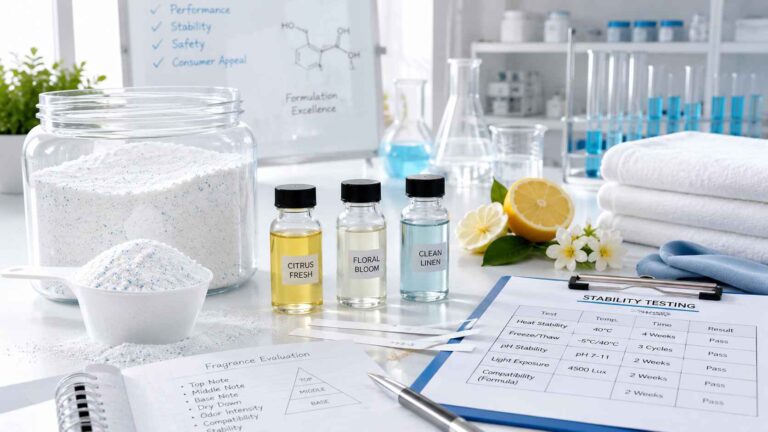
I would test at several realistic dosage levels rather than using one arbitrary concentration. A shampoo might be assessed at 0.3%, 0.5%, and 0.8%, while a fine-fragrance project may require a very different range. The exact percentages depend on the application, IFRA category, formula, supplier recommendation, and applicable law.
Then I would stress the product:
Ambient storage
Refrigerated or freeze-thaw exposure where relevant
Accelerated aging at 40°C or 45°C
Light exposure
Packaging contact
Evaluation after 24 hours, 7 days, 14 days, and 30 days
Longer real-time stability before a major launch
A vanilla-heavy fragrance may discolor a white cream. Citrus lift may collapse in alkaline soap. A marine accord can turn metallic in detergent. A diffuser formula may cloud. A candle may produce acceptable cold throw and disappointing hot throw.
Pretty blotters lie.
Compliance Is Part of Customization
A formula is not market-specific when it cannot legally enter the market.
The FDA’s Modernization of Cosmetics Regulation Act information covers requirements involving facility registration, cosmetic product listing, safety substantiation, adverse-event reporting, records, and future rulemaking that includes fragrance-allergen labeling.
For serious cosmetic adverse events in the United States, the responsible person generally has 15 business days to report to the FDA.
That deadline makes traceability operational, not theoretical.
The IFRA 51st Amendment introduced 47 new Standards, prohibited one fragrance ingredient, revised Standards for 11 ingredients, and brought the total to 263 Standards. IFRA also set different implementation timelines for new and existing fragrance creations.
But an IFRA certificate is not a universal passport.
It must match the exact formula, exact product category, and intended dosage. A certificate for an air-care application does not automatically authorize use in a leave-on cosmetic. And IFRA conformity does not replace national law, product safety assessment, labeling, or registration.
I would reject any supplier response that says only, “Yes, it is IFRA certified.”
Certified for what?
At what percentage?
Under which formula code?
Test Consumers Without Letting Them Become Perfumers
Consumer research can become expensive theater.
Ask untrained participants to debate top, middle, and base notes, and many will repeat language they believe sounds sophisticated. That does not tell you what they will buy.
I prefer behavioral questions:
Which sample would you wear tomorrow?
Which one feels appropriate at work?
Which one would you gift?
Which one feels too strong after 30 minutes?
Which one still smells recognizable after four hours?
What retail price would you expect?
Which sample would you purchase with your own money?
For an early directional screen, I would use a small qualitative group to identify language, confusion, and rejection triggers. For a commercial decision, I would move to a larger controlled test, often 150 to 300 target consumers when budget and market size justify it.
The exact sample size should come from the research objective and required confidence, not from a fashionable number copied into a presentation.
Every test should use coded samples, randomized order, the actual carrier, the intended concentration, and realistic packaging where possible. Test the opening and the dry-down. Test blind preference before showing the brand story.
Otherwise, you are measuring branding.
Not fragrance.
Lock the Approved Formula Before Bulk Production
Approval must produce a record.
The final file should identify the formula version, sample code, dosage, product base, fragrance category, target markets, COA, SDS, allergen declaration, IFRA documentation, evaluation dates, packaging, and authorized decision-makers.
Verbal approval over WhatsApp is not control.
The guide to approving a fragrance oil sample for mass production recommends testing the fragrance in its real base and recording results at several stages. That discipline matters because raw materials change, regulations change, and substitutions can alter odor, color, stability, or documentation.
I would also keep a retained reference sample from the approved laboratory batch and the first production batch. Future deliveries should be compared against that standard using agreed sensory and analytical controls.
Without a locked standard, “batch consistency” is a sales phrase.
The Mistakes I Would Refuse to Approve
Changing Notes Without Changing Performance
Adding more oud, vanilla, citrus, or musk does not solve a format problem. Projection, substantivity, evaporation, carrier, and dosage may require adjustment before the note pyramid changes.
Using Country-Level Stereotypes as Research
A country is not one consumer. Segment by age, channel, price, usage, experience, climate, and occasion.
Testing Only Neat Fragrance Oil
Consumers will not smell the oil from the supplier’s bottle. They will smell it in shampoo, perfume, detergent, candle wax, lotion, or diffuser base.
Treating the Cheapest Formula as the Commercial Winner
A fragrance that costs $4 less per kilogram but causes staining, instability, returns, reformulation, or rejected labels is not cheaper.
Launching One Formula Everywhere for Operational Convenience
Sometimes one formula passes every test. Often it does not. Operational simplicity is useful, but consumer rejection and compliance failure are more expensive than controlled regional variants.
Confusing Intensity With Quality
More ethyl maltol, C₇H₈O₃, more amber wood, and more musk may create impact. They do not automatically create sophistication, balance, or preference.
FAQs
What is fragrance oil customization?
Fragrance oil customization is the controlled adjustment of a scent formula, carrier system, dosage, performance profile, documentation, and packaging compatibility so one fragrance concept can meet the sensory expectations, climate conditions, product format, price point, and legal requirements of a defined consumer market.
It may involve modifying fragrance notes, but serious customization also addresses volatility, diffusion, color, oxidation, product-base stability, IFRA category, allergen disclosure, cost, and manufacturing repeatability.
How do you customize fragrance oils for different consumers?
Customizing fragrance oils for different consumers means converting research on age, culture, climate, usage occasion, desired intensity, product format, and spending behavior into measurable changes to the accord, concentration, carrier, stability target, allergen profile, and final presentation before bulk manufacturing begins.
Start by defining the consumer job. Decide whether the fragrance should signal status, provide freshness, create intimacy, cover a base odor, support relaxation, scent a room, or become part of a layering ritual. Formulate and test against that job.
What are the best fragrance notes for different consumer markets?
The best fragrance notes for a consumer market are the materials and accords that satisfy a tested local preference while remaining stable, affordable, legally sellable, and compatible with the intended base, whether that base is ethanol, MCT oil, shampoo surfactant, candle wax, detergent, or diffuser solvent.
Regional signals can guide first samples, but no note family should be treated as universally preferred. Oud may underperform in one GCC segment, while vanilla may work in both American and Asian markets for completely different emotional reasons.
Can the same fragrance oil formula be sold worldwide?
A single fragrance oil formula can be sold globally only when its ingredients, dosage, allergen disclosures, IFRA category, carrier, stability, packaging, and claims satisfy every target jurisdiction and when consumer testing shows that the same scent intensity and character are acceptable across those markets.
Many brands keep a recognizable core accord while altering concentration, carrier, labeling, or a limited part of the formula. This reduces duplication without pretending that climate, regulation, format, and consumer behavior are identical everywhere.
How much testing is required before launching custom fragrance oils?
Market-specific fragrance testing is a staged validation process that checks sensory appeal, product-base performance, accelerated stability, packaging compatibility, documentation, and purchase intent before a formula is approved, with each test using the exact concentration, carrier, and application planned for commercial production.
At minimum, evaluate the fragrance neat and in the final base, run timed sensory checks, review stability and packaging contact, verify market documents, conduct target-consumer testing, and approve a coded pilot batch before committing to a large order.
Turn Your Market Data Into a Production-Ready Fragrance
Do not send a supplier a country name and three adjectives.
Send a real brief.
Define the consumer, product base, target price, usage occasion, intensity, climate, format, dosage, regulatory destination, rejection triggers, testing plan, and order volume. Then require coded samples, application testing, full documentation, a retained standard, and a controlled pilot before bulk production.
That is how custom fragrance oils become market assets rather than expensive guesses.
Start by reviewing the available OEM/ODM fragrance oil customization process, prepare your market-specific brief, and request samples built for the actual product your consumers will use.
Our team of 20+ senior perfumers leverages a vast library of 40,000+ formulas to deliver expert customization and scent replication with up to 98% accuracy. As premier perfume oil manufacturers, we bring your most complex fragrance concepts to life with precision.
Industry-Leading Speed
We empower your business with industry-leading speed. Samples are ready in just 1-3 days, mass production takes only 3-7 days, and our low 5kg MOQ allows you to test the market quickly and without risk, solidifying our role as agile fragrance oil suppliers.
Certified Quality & System Assurance
Our quality is built on trust and technology. We are fully certified with IFRA, ISO, GMP, and Halal, and our advanced ERP system guarantees complete traceability and batch-to-batch consistency, making us your reliable perfume raw materials supplier.