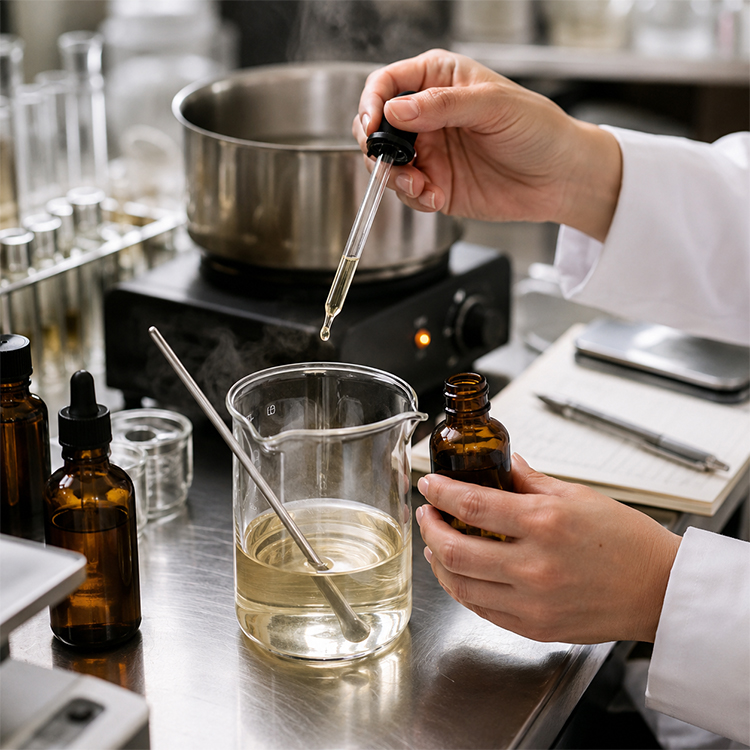
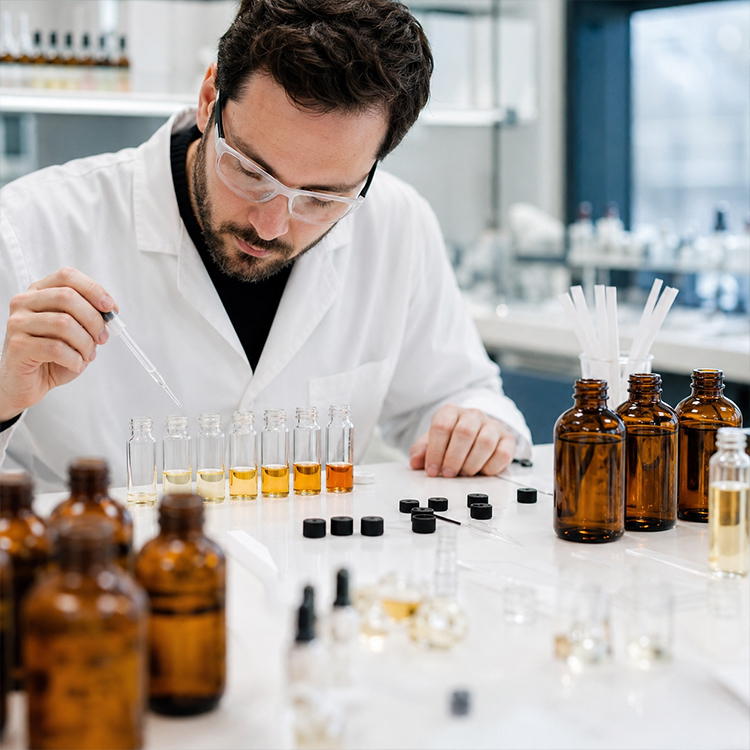
Production heat can distort fragrance oil, weaken top notes, accelerate oxidation, and create safety issues near flash point. Here is the blunt manufacturing answer brands need before scaling candles, soaps, cosmetics, diffusers, detergents, or perfume oils.
I have watched good fragrance oils fail not because the formula was cheap, not because the buyer picked the wrong scent family, and not because the perfumer missed the brief, but because production treated fragrance like a decorative liquid instead of a volatile chemical system with flash point, vapor pressure, oxidation behavior, and application limits.
So yes, production heat can damage fragrance oil. But the better question is nastier: how much heat, for how long, in what base, under what airflow, and with which raw materials?
That is where brands lose money.
The Short Answer: Heat Can Damage Fragrance Oil, But Not Always in the Way People Think
Fragrance oil heat damage usually means scent distortion, evaporation of volatile top notes, oxidation, discoloration, weaker hot throw, lower freshness, or performance failure in the finished product. It does not always mean the oil “burned.” In many factory cases, the damage is subtle enough to pass a quick sniff test and still fail in-market.
That is the trap.
A fragrance oil is not a single ingredient. It is a blend of aroma chemicals, naturals, solvents, carriers, stabilizers, and sometimes hundreds of micro-dosed materials. Citrus terpenes such as limonene, C10H16, do not behave like vanillin, C8H8O3. Linalool, C10H18O, does not behave like a heavy musk. Aldehydes do not sit politely when heat, air, and alkaline conditions get involved.
If you are buying wholesale fragrance oils for commercial production, stop asking only, “Does it smell good?” Ask, “What happens after 30 minutes at 75°C in my exact base?”
That is the professional question.
My unpopular opinion
Most fragrance failures blamed on the supplier are actually process failures.
I do not say that to protect suppliers. Some suppliers oversell weak formulas, hide behind vague “premium quality” language, and ship oils with documentation that looks like it was assembled five minutes before lunch. But I have also seen buyers dump fragrance into overheated wax, high-pH soap slurry, hot detergent base, or aggressive surfactant systems and then act shocked when the approved sample smells thin two weeks later.
What did they expect?
Table of Contents
Flash Point Is a Safety Number, Not a Scent-Quality Guarantee
Fragrance oil flash point is the temperature at which the liquid gives off enough vapor to ignite under defined test conditions. It is not the temperature at which fragrance oil automatically disappears, explodes, or becomes useless.
This distinction matters because people abuse flash point language constantly.
OSHA’s flammable liquid rule, 29 CFR 1910.106, classifies Category 4 flammable liquids as those with flash points above 60°C and at or below 93°C, and it adds special handling logic when liquids are heated near their flash point. That is a workplace safety issue, not a perfume-performance promise.
The hard truth: a fragrance oil with a flash point of 93°C can still lose delicate top notes at much lower temperatures if the formula is rich in volatile materials.
So when someone asks, “Does heat damage fragrance oil if I stay below the flash point?” my answer is blunt: possibly, yes.
Flash point tells you about ignition risk. It does not fully answer fragrance oil scent loss, aroma balance, oxidation, wax throw, soap stability, or diffuser performance.
Where Production Heat Actually Hurts Fragrance Oil
Heat damage usually appears through four channels: evaporation, oxidation, chemical reaction with the base, and process exposure time.
1. Volatile Top Notes Leave First
Top notes are the first casualties.
Citrus, green, herbal, fruity, ozonic, aldehydic, and some fresh floral materials often contain higher-volatility components. When a production line runs too hot, those materials can evaporate before the fragrance is locked into the base. The result is familiar: the oil smells fine in the bottle, but the finished product smells flatter, warmer, sweeter, or duller.
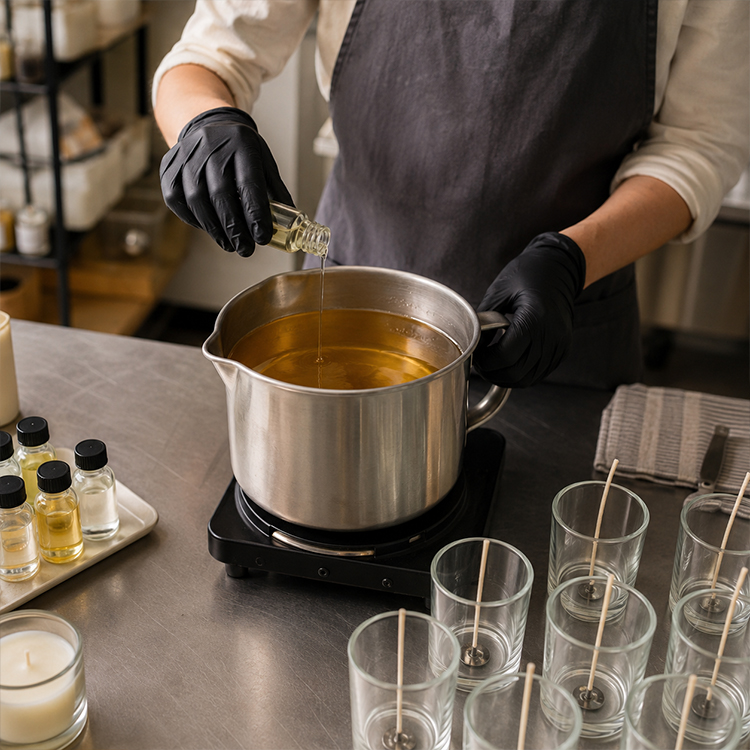
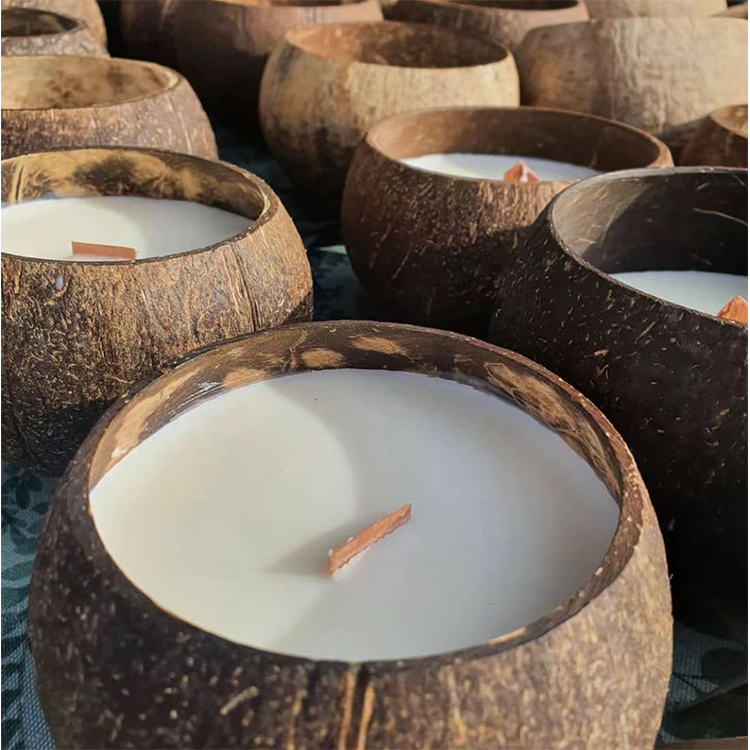
In candles, that may show as weak cold throw or a hot throw that lacks sparkle. For brands developing wax products, this is why formula evaluation should connect directly to candle fragrance oils built for hot and cold scent throw, not just a blotter strip dipped in oil.
Blotters lie.
2. Oxidation Accelerates Under Heat
Heat speeds oxidation. Oxygen does the dirty work, and temperature pushes it along.
The FDA’s cosmetic shelf-life guidance says U.S. law does not require cosmetics to carry specific shelf lives or expiration dates, but manufacturers remain responsible for safety, and FDA treats shelf-life determination as part of that responsibility: FDA cosmetic shelf-life guidance.
That sentence should make every serious brand uncomfortable.
If heat exposure changes odor, color, texture, or allergen-related chemistry, “our supplier said two years” is not a defense strategy. It is a shrug with paperwork attached.
3. The Base Can Attack the Fragrance
Some bases are friendly. Others are bullies.
Cold-process soap has high alkalinity. Detergent systems contain surfactants, builders, solvents, and sometimes enzymes. Hair care formulas may include quats, acids, salts, and polymer systems. Hot wax is its own performance theater.
That is why a fragrance oil temperature limit is meaningless unless tied to the application.
A CP soap fragrance should be judged differently from a reed diffuser oil, a body lotion scent, or a shampoo fragrance. If your project sits in an alkaline or cure-heavy system, evaluate it through a soap fragrance oil manufacturer mindset, not a fine-fragrance mood board.
Nice words do not survive sodium hydroxide.
4. Time at Temperature Matters More Than Peak Temperature Alone
A two-minute exposure at 65°C is not the same as a forty-minute hold at 65°C. A sealed vessel is not the same as an open tank. Low headspace is not the same as an uncovered mixing kettle under poor ventilation.
I care less about the single number on a production sheet than the full heat story:
Production Variable
Low-Risk Practice
High-Risk Practice
What Usually Fails
Addition temperature
Add fragrance at the lowest workable processing temperature
Add fragrance while the base is still aggressively hot
Top-note loss, scent flattening
Hold time
Mix only until uniform
Keep fragrance in hot mass for long dwell time
Oxidation, evaporation, imbalance
Vessel exposure
Closed or partially covered vessel where appropriate
Open tank with heat and airflow
Volatile loss, worker exposure
Batch size
Pilot and scale-up tested
Direct jump from lab sample to bulk
Drift between sample and production
Documentation
SDS, COA, IFRA, batch code, retain sample
“Same as last time” verbal approval
Disputes, rework, compliance gaps
The ugly part is that most fragrance oil degradation is not dramatic. It looks like a product that is “almost right” but never matches the approved standard.
That “almost” can ruin a launch.
Best Temperature to Add Fragrance Oil: Stop Copying Generic Rules
The best temperature to add fragrance oil depends on the base, viscosity, wax melt point, emulsification stage, surfactant system, flash point, volatility profile, and supplier guidance. There is no universal number that works for candles, soap, lotion, perfume oil, detergent, and diffuser products.
But I will give you the practical rule I use.
Add fragrance as cool as your process allows while still achieving uniform dispersion, acceptable viscosity, and stable finished-product performance.
For soy wax, many makers work around the wax supplier’s recommended fragrance-addition range, often roughly in the 65–85°C zone depending on wax type and process. For personal care emulsions, fragrance is commonly added during cool-down to reduce volatility and preserve sensitive materials. For detergent and home care systems, temperature must be checked against surfactant compatibility, solubilization, clarity, and odor after storage.
For broad product lines, I would connect heat questions to a custom fragrance oil development process before scaling. A serious brief should include the production temperature, base pH, packaging, target market, use level, stability test plan, and documentation needs.
Otherwise, you are not developing a fragrance. You are gambling with smell.
The Regulatory Angle Nobody Wants in the Sales Call
Heat damage is not only a sensory issue. It can become a compliance issue.
The EU’s Regulation (EU) 2023/1545 expanded fragrance allergen labeling requirements for cosmetic products. The official regulation identifies additional fragrance allergens that must be disclosed when present above relevant thresholds.
Now connect the dots.
If heat, oxygen, or poor storage increases oxidation products in sensitive fragrance materials, the final product may not behave like the original evaluation sample. That does not mean every warm batch becomes illegal. It means serious brands cannot treat fragrance oil stability as a warehouse superstition.
IFRA also states that its Standards are a globally recognized risk-management system for safe fragrance ingredient use, while final responsibility for safe products remains with companies placing products on the market: IFRA Standards.
That matters.
An IFRA Certificate is not a magic shield. It is a use-level and category document tied to a specific fragrance mixture and application. If your production process abuses the material, the certificate does not fix your batch.
What I Would Test Before Approving Bulk Production
I would not approve fragrance oil for production based only on a blotter, a sample bottle, or a supplier’s confident sales email.
I want evidence.
Minimum Testing Checklist
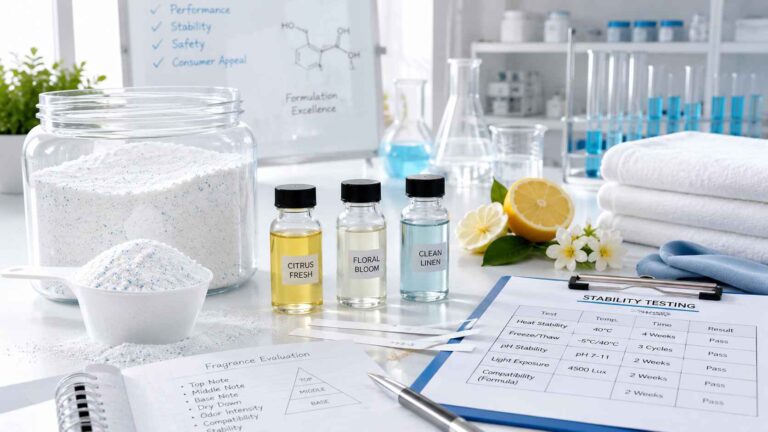
Test the fragrance in the real product base, not just neat oil. Then test after heat exposure, cooling, storage, and packaging contact.
Here is the stripped-down version I would require before signing off:
Test
Why It Matters
My Pass/Fail Bias
Neat oil odor check
Confirms supplier sample baseline
Useful, but not enough
Heat-exposure trial
Shows production heat and fragrance oil stability
Required for hot-fill, wax, soap, detergent
Finished-product aging
Reveals fragrance oil scent loss over time
Required before bulk launch
pH compatibility
Detects instability in soap, shampoo, body wash, cleaners
Required for alkaline or acidic systems
Packaging contact
Checks absorption, discoloration, migration
Required for plastic, rubber, liners
Retain sample comparison
Gives QA a real reference
Non-negotiable
SDS and flash point review
Controls safety handling
Non-negotiable
IFRA category check
Confirms permitted use level
Non-negotiable for regulated products
If you are managing mixed applications—say candles, diffusers, shampoo, and body wash—start from personal care fragrance oils and air care fragrance oils as separate technical categories. Do not assume one oil behaves across everything.
It usually does not.
How to Prevent Fragrance Oil Degradation in Production
Preventing fragrance oil degradation is boring work. Good.
Boring systems save launches.
Control the Heat Window
Write down the target addition temperature, maximum hold temperature, maximum hold time, and mixing speed. Do not let operators improvise because “the batch looked thick.”
For heat-sensitive profiles, especially citrus, green, aldehydic, herbal, marine, and fresh fruity scents, reduce heat exposure wherever possible.
Use Real Retain Samples
Keep a sealed retain sample from the supplier batch and a finished-product retain from your production batch. Store both under defined conditions.
I prefer 15–24°C storage for most fragrance oils unless the supplier gives a specific range. Keep containers closed, away from sunlight, away from boilers, away from loading docks, and away from the glorious chaos of “temporary” production shelves.
They heat wax high, add fragrance late or early depending on whatever blog they read in 2019, stir vaguely, pour inconsistently, and then blame the fragrance oil for weak hot throw.
Sometimes the oil is bad. Often the process is bad.
Use the wax supplier’s technical sheet, run controlled addition-temperature trials, measure actual vessel temperature, and test cold throw and hot throw after cure. The nose is not a thermometer.
Demand Documentation Before Romance
Ask for SDS, COA, IFRA Certificate, allergen data where applicable, flash point, recommended application range, suggested use level, and known incompatibilities.
A fragrance supplier that cannot answer heat-stability questions is not a production partner. It is a scent catalog.
FAQs
Does heat damage fragrance oil?
Heat can damage fragrance oil by evaporating volatile top notes, accelerating oxidation, changing aroma balance, and reducing finished-product performance in candles, soaps, cosmetics, diffusers, and detergents. The damage may happen below flash point, especially when the oil is held hot for too long or exposed to air during mixing.
What is fragrance oil flash point?
Fragrance oil flash point is the lowest temperature at which the oil releases enough vapor to ignite under specific laboratory test conditions. It is mainly a safety and transport handling value, not a guarantee that the fragrance will smell stable or perform well at every temperature below that number.
What is the best temperature to add fragrance oil?
The best temperature to add fragrance oil is the lowest workable temperature that still allows complete mixing, stable dispersion, and acceptable finished-product performance in the specific base. The right number depends on wax type, soap process, surfactant system, emulsion stage, viscosity, flash point, and supplier instructions.
Can fragrance oil go bad from heat?
Fragrance oil can go bad from heat when high temperature accelerates oxidation, drives off volatile aroma materials, causes discoloration, or changes the balance between top, middle, and base notes. The oil may not smell rotten, but it can become weaker, sharper, flatter, cloudy, or unreliable in production.
How do I prevent fragrance oil scent loss during production?
You prevent fragrance oil scent loss by reducing heat exposure, shortening hot hold time, covering vessels where appropriate, adding fragrance during cool-down when the process allows, checking flash point and SDS data, testing the real base, and comparing finished batches against sealed retain samples after aging.
Is fragrance oil ruined if heated above its flash point?
Fragrance oil is not automatically ruined just because it briefly exceeds flash point, but the situation becomes a serious safety and quality concern. Flash point relates to ignition risk from vapor, while scent damage depends on formula volatility, exposure time, oxygen, airflow, container openness, and finished-product compatibility.
Final Thoughts: Treat Fragrance Oil Like a Production Material, Not a Pretty Smell
Here is the move: before your next bulk order, ask your supplier for the fragrance oil flash point, SDS, COA, IFRA documentation, recommended use level, application fit, and heat-stability guidance for your exact product base.
Then run one controlled heat trial.
Not ten guesses. One disciplined trial with temperature, time, mixing, pH, packaging, and retain samples recorded.
If you are scaling candles, soaps, cosmetics, air care, detergents, or private-label perfume oil, work with a manufacturer that can connect scent design to factory reality. Start with a technical brief, define the production heat window, and make the fragrance prove itself before you put it into a paid launch.
Your nose deserves data. Your customers deserve consistency. And your batch record should be strong enough to survive a complaint, not just a sales meeting.
Our team of 20+ senior perfumers leverages a vast library of 40,000+ formulas to deliver expert customization and scent replication with up to 98% accuracy. As premier perfume oil manufacturers, we bring your most complex fragrance concepts to life with precision.
Industry-Leading Speed
We empower your business with industry-leading speed. Samples are ready in just 1-3 days, mass production takes only 3-7 days, and our low 5kg MOQ allows you to test the market quickly and without risk, solidifying our role as agile fragrance oil suppliers.
Certified Quality & System Assurance
Our quality is built on trust and technology. We are fully certified with IFRA, ISO, GMP, and Halal, and our advanced ERP system guarantees complete traceability and batch-to-batch consistency, making us your reliable perfume raw materials supplier.