How Many Sampling Rounds Are Normal in Custom Fragrance Development?
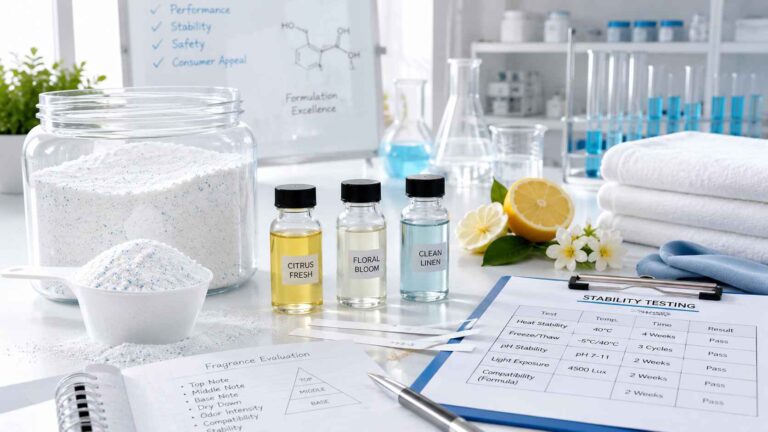
Most credible custom fragrance projects are completed in two to four structured sampling rounds. This guide explains what counts as a round, why revisions multiply, and how buyers can prevent endless reformulation.
Most custom fragrance development projects should reach approval within two to four structured sampling rounds.
Three rounds is my working benchmark.
One round may be enough when a buyer selects an existing fragrance and requests only a minor adjustment. Four or five rounds can be justified when the project involves an original fine fragrance, an unstable product base, multiple target markets, restricted ingredients, packaging compatibility, or several internal decision-makers.
But six, seven, or eight rounds?
That usually indicates a management failure rather than a perfumery challenge.
There is no audited global database that reports the average number of fragrance modification rounds across every perfume house, fragrance-oil factory, private-label brand, candle company, and personal-care manufacturer. Any supplier claiming that “exactly three rounds is the industry standard” is presenting a planning convention as statistical fact.
Still, buyers need a usable number. Based on how a properly controlled fragrance sampling process should operate, two to four rounds is normal, three is efficient, and more than five deserves an investigation.
What Actually Counts as One Sampling Round?
A sampling round is one formal cycle in which the supplier submits one or more coded fragrance versions, the buyer evaluates them against agreed criteria, and the buyer returns one consolidated set of instructions.
That definition matters.
Receiving Samples A, B, and C in the same shipment does not mean you have completed three rounds. It normally means you received three modifications, or “mods,” within Round 1.
A practical sequence might look like this:
Round 1: Three directional samples—A, B, and C
Round 2: Two refined versions based on the preferred direction
Round 3: One final confirmation sample in the intended base
Pilot confirmation: A retained production-standard sample, not another creative round
This means a buyer might evaluate six individual perfume development samples while completing only three sampling rounds.
Suppliers and buyers should define this language before work begins. Otherwise, a quotation promising “three free samples” may be interpreted as three versions by the supplier and three full revision cycles by the buyer.
That misunderstanding gets expensive.
A professional fragrance development brief should specify the number of included rounds, the number of mods per round, the sample volume, courier responsibility, feedback deadline, and charges for additional revisions.
Table of Contents
The Normal Number of Rounds by Project Type
Not every fragrance project deserves the same timeline. Pulling a citrus-floral formula from an established library is not comparable to developing a globally compliant extrait around a proprietary brief.
The following ranges are planning benchmarks, not regulatory limits or universal industry statistics.
Custom fragrance project
Normal sampling rounds
Typical sample pattern
When I would question the process
Existing library fragrance with no modification
1
One selected formula plus confirmation sample
More than 2 rounds
Existing formula with light adjustment
1–2
Original, then one sweeter, fresher, stronger, or less costly mod
More than 3 rounds
Benchmark-inspired fragrance replication
2–4
Initial match, correction, dry-down adjustment, final confirmation
More than 5 rounds without analytical or sensory evidence
Original fine fragrance formulation
3–5
Directional set, architecture refinement, performance adjustment, final selection
More than 6 rounds without a changed brief
Shampoo, lotion, detergent, soap, or candle fragrance
3–6
Olfactive screening followed by actual-base and stability modifications
Repeated blotter-only approvals
Multi-market or restricted-ingredient formula
4–6+
Creative development plus compliance, substitution, and application confirmation
Revisions with no documented reason
The central answer remains simple: two to four rounds is normal for a well-managed project.
Anything outside that range needs context.
What Each Fragrance Modification Round Should Accomplish
Three rounds work.
When the brief is complete, the benchmark is stable, the final product base is available, and one decision-maker consolidates feedback, three controlled rounds are usually enough to move from broad direction to technical correction and then to final confirmation without turning development into an open-ended taste contest.
Why pay for a sixth round to solve a problem the brief created before Round 1?
Round 1: Choose the Correct Direction
The first round should answer a strategic question: Are we building in the right olfactive territory?
It is not supposed to produce a finished masterpiece.
A useful first submission may contain three clearly differentiated routes:
Sample A: brighter citrus top and transparent floral heart
Sample B: warmer amber base and stronger sweetness
Sample C: cleaner musk profile with less diffusion
The buyer should evaluate broad attributes such as fragrance family, emotional tone, target consumer, perceived price position, opening impact, heart character, and dry-down direction.
Feedback such as “We do not like it” is worthless.
Useful Round 1 feedback sounds like this:
Sample B is the preferred direction. Reduce the vanilla effect by approximately one-third, keep the amber warmth, add more bergamot lift during the first 15 minutes, and remove the powdery dry-down detected after four hours.
That gives the perfumer something measurable to work with.
Round 2: Correct the Architecture
Round 2 is where the perfumer adjusts balance, diffusion, tenacity, transitions, cost, and unwanted effects.
The fragrance may already smell commercially acceptable. That does not mean it is ready.
This is the stage where I would compare the leading versions at fixed intervals—immediately, 15 minutes, two hours, six hours, and 24 hours where the format allows it. Blind-coded evaluation is better than showing the panel which version the creative director prefers.
“Sample C produces visible haze in the base after seven days” is a failure.
Those are not the same category of feedback.
Round 3: Confirm Performance in the Real Product
Round 3 should normally be a confirmation round, not another creative reset.
The shortlisted fragrance must now be tested at the intended dosage in the actual commercial base and, where possible, inside the intended packaging system. A scent approved at 10% in ethanol cannot automatically be assumed to work in a sulfate-free shampoo, soy wax, fabric softener, body lotion, reed-diffuser solvent, or high-pH cleaner.
This is where fantasy ends.
A fragrance can smell elegant on blotter and still:
Lose its top notes in a surfactant system
Cloud a clear shower-gel base
Discolor a white lotion
Produce weak hot throw in candle wax
Attack a plastic liner
Change viscosity
Generate sediment
Drift after heat exposure
Exceed a category-specific ingredient limit at the proposed dosage
Common materials such as limonene (C10H16), linalool (C10H18O), citronellol (C10H20O), and isoeugenol (C10H12O2) are not merely note descriptions. Their concentration, oxidation behavior, allergen status, and contribution from natural complex substances can affect the formula’s technical headroom.
That is why final approval should follow a documented fragrance oil sample approval procedure, not a casual email saying, “Sample B smells good—please produce.”
Round 4: Use It Only When Evidence Justifies It
A fourth round is reasonable when Round 3 exposes a specific technical problem.
Examples include:
The scent passes on blotter but weakens in the final base
A raw material becomes unavailable
The target cost per kilogram changes
The intended dosage exceeds the available compliance limit
Stability testing reveals color drift
The brand changes its target market
Packaging compatibility fails
A retailer introduces a restricted-substance list
The final formula needs a documented allergen reduction
Round 4 should solve a named problem.
It should not reopen the entire creative brief because a new executive joined the meeting and prefers woody fragrances.
Why Some Projects Need More Sampling Rounds
The Brief Was Vague
The most common cause of excessive fragrance modification rounds is not a weak perfumer. It is a weak brief.
“Fresh, premium, long-lasting, and suitable for everyone” is not a fragrance specification. It is a collection of adjectives that can describe thousands of incompatible formulas.
Five reviewers can produce ten contradictory opinions.
Marketing wants stronger diffusion. Product development wants lower allergen exposure. Finance wants a cheaper formula. The founder wants the fragrance to resemble a memory from a hotel visited twelve years ago. Sales wants whatever the largest customer requested yesterday.
Nobody is necessarily wrong.
But the perfumer cannot formulate against five moving targets.
I recommend one decision owner, one technical reviewer, and one consolidated feedback document. Panel comments can be collected separately, but only the approved summary should reach the laboratory.
The Benchmark Keeps Changing
A benchmark should define direction, not become a constantly moving finish line.
Changing the reference from a citrus cologne in Round 1 to a sweet amber perfume in Round 2 and a clean musk in Round 3 creates three separate projects. Charging for additional rounds in that situation is not supplier greed. It is basic project control.
The Final Base Arrived Too Late
This is common in personal care, home care, candles, and air care.
The fragrance team develops in a generic laboratory base because the buyer’s final shampoo, lotion, wax, diffuser solvent, or detergent system is not ready. The scent is approved. Then the real base arrives and behaves differently.
Now everyone calls the correction “another fragrance round.”
Technically, it is a delayed application-development round caused by incomplete inputs.
The site’s guide to fragrance sampling and delivery lead time correctly separates laboratory speed from total project speed. A supplier may prepare a sample in one to three business days while the full approval cycle still takes several weeks.
Compliance Was Checked After Creative Approval
This is backwards.
The FDA’s Modernization of Cosmetics Regulation Act of 2022 expanded cosmetic-industry obligations involving safety substantiation, facility registration, product listing, serious adverse-event reporting, records, and future fragrance-allergen labeling requirements.
Europe has also moved. Commission Regulation (EU) 2023/1545 introduced labeling provisions covering 56 additional fragrance allergens, with transition periods affecting products placed on the EU market.
Compliance is not a document ordered after the scent is selected.
It shapes the formula.
As of June 25, 2026, IFRA’s publicly operational documentation still centers on the 51st Amendment, while the 52nd Amendment consultation closed on June 12, 2026 and publication is expected later in 2026. Buyers approving long-life formulas should therefore check the current IFRA Standards Library again before commercial lock.
A formula can smell perfect and still become commercially inconvenient when a restricted ingredient, target-market rule, retailer policy, or use-category limit forces reformulation.
How Many Perfume Samples Should You Expect?
For a three-round project, five to seven individual sample vials is a sensible working expectation.
One practical configuration is:
Stage
Number of samples
Purpose
Round 1
3
Compare distinct olfactive directions
Round 2
2
Compare refinements of the selected direction
Round 3
1
Confirm the final formula in the intended base
Retained control
1
Preserve the signed production reference
Total
7
Complete decision and production record
More samples do not automatically create better decisions.
Ten nearly identical mods can exhaust the panel and produce false distinctions. Three genuinely different directions often produce better feedback than eight versions separated by tiny dosage changes.
I prefer fewer, better-explained samples.
Each vial should carry a unique code, date, version number, intended dosage, base identification, and storage instructions. The supplier should retain a matching control.
Why Finished-Product Testing Cannot Be Replaced by More Smelling
The fragrance industry sometimes treats sampling as if more smelling will eventually reveal the truth.
It will not.
A 2017 published Arm & Hammer fragranced laundry-product safety assessment used several distinct methods, including a Human Repeat Insult Patch Test, a 10-day cumulative irritation study, a wrist-band wear test, and safety-in-use testing.
That was not a fine-fragrance project, and it does not establish a universal perfume-testing protocol. But it demonstrates the broader point: serious fragranced products are evaluated through layered evidence, not one pleasant blotter session.
One additional creative round cannot compensate for missing:
Stability testing
Compatibility testing
Safety substantiation
Application testing
Compliance review
Pilot-batch confirmation
Retained-sample control
The correct question is not “Can we smell one more version?”
It is “What unresolved risk would the next version actually address?”
When Five or More Rounds Are Still Reasonable
Five or more rounds are not automatically excessive.
They may be justified when:
The fragrance is being created entirely from scratch
The project covers several formats, such as EDP, lotion, candle, and diffuser
Different regional formulas are required
Natural raw-material variability affects the profile
A key material is restricted or discontinued
The formula must meet a strict retailer exclusion list
The product base changes during development
Consumer-panel results contradict the internal team’s preference
The pack creates migration, discoloration, or odor interaction
A pilot batch behaves differently from the laboratory sample
But the reason must be documented.
A project that requires six evidence-based rounds can still be healthy. A project that requires six rounds because the buyer keeps saying “make it more premium” is not.
The Commercial Cost of Endless Sampling
The fragrance category is not waiting for indecisive brands.
Reuters reported that prestige fragrance sales rose 6% to approximately $3.9 billion in the first half of 2025, while prestige makeup increased only 1% and prestige skincare declined 1% over the same period.
That growth attracts more launches, more flankers, more private-label programs, and more competition for laboratory attention.
Speed matters.
But rushed approval is not speed. And endless revision is not quality.
Every unnecessary round can add:
Laboratory time
Compounder time
Sample material
Documentation work
International courier charges
Internal panel meetings
Stability resets
Packaging delays
Missed production slots
Delayed retailer submissions
The cheapest way to reduce the fragrance development timeline is not to pressure the perfumer to work faster. It is to make each feedback cycle more decisive.
How to Keep Custom Fragrance Development Within Three Rounds
Freeze the Brief Before the First Sample
Do not change the target consumer, fragrance family, benchmark, product format, dosage, or cost ceiling halfway through development unless you accept that the project has been materially restarted.
Send the Actual Base Early
For shampoo, lotion, detergent, soap, candle, diffuser, and cleaner projects, the real base should reach the fragrance laboratory before final olfactive approval.
Limit the First Round to Three Useful Directions
Three distinct samples are usually enough to establish direction without creating panel fatigue.
Score Samples Before Discussing Them
Use blind codes and score opening, heart, dry-down, similarity, diffusion, off-notes, application performance, and overall preference independently before holding the group meeting.
Consolidate Feedback
The supplier should receive one approved document, not separate WhatsApp messages from purchasing, marketing, the founder, and a distributor.
Define Rejection Rules
Reject a sample when it fails an agreed criterion—not merely when somebody says it feels “slightly less elegant.”
Lock a Retained Standard
Once the final formula is approved, sign and retain the control sample with its formula code, dosage, base, date, and approval record. Production batches should be compared with that standard.
Brands using an OEM/ODM custom fragrance manufacturing service should ask how the supplier controls formula versions, retained samples, batch traceability, documentation, and change authorization before placing the commercial order.
FAQs
How many sampling rounds are normal in custom fragrance development?
Two to four structured sampling rounds are normal for most custom fragrance development projects, with three rounds serving as a practical benchmark: one round to select the olfactive direction, one to correct balance and performance, and one to confirm the final formula in the actual product base and intended packaging.
A simple library selection may finish in one round, while an original fine fragrance or technically difficult personal-care, home-care, candle, or diffuser project may require four to six. The number alone is less important than whether each round has a defined objective.
What counts as one fragrance sampling round?
One fragrance sampling round is a complete submission-and-feedback cycle in which the supplier sends one or more coded fragrance versions, the buyer evaluates them under agreed conditions, and one authorized decision-maker returns consolidated instructions that the perfumer uses to prepare the next formal submission.
Three samples delivered together as A, B, and C normally count as three mods within one round, not three separate rounds. This distinction should be written into the development quotation before sampling begins.
How many perfume samples are usually needed before approval?
Five to seven individual perfume samples are usually sufficient for a disciplined three-round program: approximately three directional versions in Round 1, two refinements in Round 2, one final confirmation sample in Round 3, and one retained control used as the signed reference for commercial production.
Highly technical projects may need more samples, but an excessive number of nearly identical versions often creates sensory fatigue rather than better evidence. Every sample should answer a specific development question.
Is it a problem when fragrance development reaches five rounds?
Five sampling rounds are not automatically a problem when the project involves original formulation, several product bases, multi-market compliance, raw-material substitution, packaging interaction, stability failure, consumer-panel research, or a documented change to the commercial brief that legitimately requires additional technical work.
It becomes a warning sign when the benchmark keeps changing, reviewers contradict one another, feedback remains subjective, the final base was never supplied, or nobody can explain what measurable problem the next modification is expected to solve.
How long does a three-round fragrance development process take?
A three-round fragrance development process commonly takes several weeks from accepted brief to final approval because laboratory preparation, international shipping, buyer evaluation, feedback consolidation, actual-base testing, stability checkpoints, documentation review, and final confirmation occur sequentially even when each laboratory sample takes only a few business days to prepare.
Fast projects move quickly because decisions and materials are ready, not because testing is skipped. Buyers should separate sample-production time from the complete fragrance development timeline.
Can a fragrance be approved after only one sample?
A fragrance can be approved after one sample when the buyer selects an existing, documented formula that already performs in the intended application and no meaningful customization is required, but the sample should still be checked at the target dosage in the actual base before commercial production is authorized.
One-round approval is far less convincing for an original fragrance, benchmark replication, sensitive-skin product, high-pH cleaner, candle, diffuser, or formula intended for several regulatory markets.
Turn Sampling Into a Controlled Approval System
Plan for three rounds.
Begin with a complete technical brief. Ask for three clearly differentiated directions rather than a pile of vague variations. Test the preferred fragrance in the real product base. Consolidate feedback. Check compliance before final approval. Then retain a signed production standard.
And set a stop rule.
When a project reaches Round 5, pause and ask whether the next modification is solving an olfactive problem, a technical failure, a compliance issue, or simple internal indecision.
For a structured sampling plan, prepare your target fragrance family, reference products, application base, dosage range, target market, documentation requirements, cost position, expected order volume, and launch date. Then contact the fragrance development team to request a controlled sample program instead of an open-ended series of revisions.
Our team of 20+ senior perfumers leverages a vast library of 40,000+ formulas to deliver expert customization and scent replication with up to 98% accuracy. As premier perfume oil manufacturers, we bring your most complex fragrance concepts to life with precision.
Industry-Leading Speed
We empower your business with industry-leading speed. Samples are ready in just 1-3 days, mass production takes only 3-7 days, and our low 5kg MOQ allows you to test the market quickly and without risk, solidifying our role as agile fragrance oil suppliers.
Certified Quality & System Assurance
Our quality is built on trust and technology. We are fully certified with IFRA, ISO, GMP, and Halal, and our advanced ERP system guarantees complete traceability and batch-to-batch consistency, making us your reliable perfume raw materials supplier.