Fragrance Oil Sampling: Designing Effective Test Protocols
Most fragrance launches do not fail because the scent was boring. They fail because the sample program was weak, political, or lazy. This article lays out a fragrance testing protocol I’d actually trust when money, compliance, and repeat orders are on the line.
I have watched teams fall in love with a fragrance on a strip, approve it after one flattering afternoon, and then spend the next eight weeks pretending the problem was the wax, the surfactant, the bottle, the shipping lane, the weather, or “consumer subjectivity,” when the real problem was simpler and uglier: they never built a real fragrance oil testing protocol in the first place. Why are we still treating sampling like a mood board exercise?
Here is my blunt view: most fragrance oil sampling is theater. The strip gets sprayed, the room nods, the most senior person declares Sample B “more premium,” and nobody asks what happens at 40°C, inside PET, after four freeze-thaw cycles, or under retail lighting. That is not fragrance oil evaluation. That is procurement cosplay.
And the legal bar is not getting softer. The FDA says the Modernization of Cosmetics Regulation Act of 2022, or MoCRA, is the biggest expansion of FDA cosmetic authority since 1938 and specifically includes fragrance allergen labeling requirements, while UK product-safety authorities recalled fragrances in December 2025 and March 2026 over butylphenyl methylpropional (BMHCA/lilial) and related prohibited ingredients. If your sample protocol still ends at “smells nice,” you are behind the law, not just behind the market.
Most sample programs fail before the first vial is opened
Three words first.
If the brief is mush, the sample set will be mush too, because no perfumer, factory, or trader can rescue a request that never fixed the use case, IFRA category, target dosage, pack type, storage risk, and approval rules before Round 1 left the building. Why do buyers keep acting surprised when vague briefs produce vague samples?
I start every fragrance oil test method with five questions. What is the real end use: candle, reed diffuser, shampoo, EDP, detergent, or body mist? What is the real dosage window: 0.8%, 3%, 8%, or 20%? What is the real pack: glass, PET, HDPE, PP, lined cap, unlined cap? What is the real climate exposure: 5°C winter freight, 25°C shelf, 40°C warehouse, 45°C stress? And what is the real kill rule: what exact odor, color, haze, paperwork, or panel score gets a sample rejected?
But here is the industry lie I’m tired of hearing: “We’ll figure that out after we smell it.” No, you won’t. You’ll fight about it after you smell it.
The fragrance oil testing protocol I actually trust
Pretty strips deceive.
A sample protocol that only tests “smell appeal” is an amateur protocol, because a commercial fragrance has to survive four different courts at once: sensory, application, packaging, and compliance, and those courts do not vote the same way. Should one charming blotter really outrank a failed pack test?
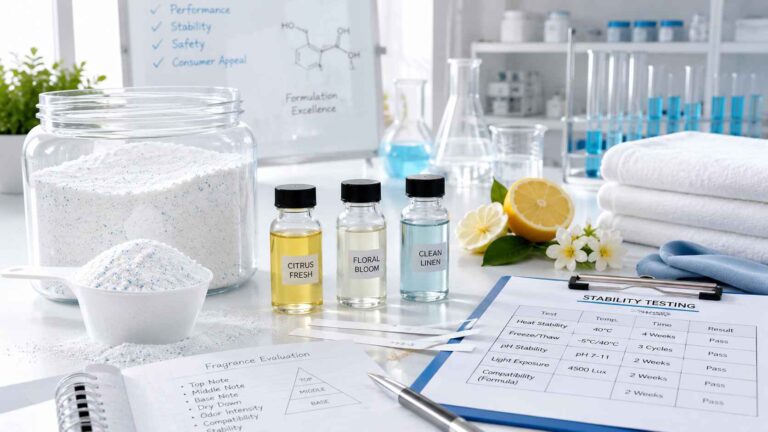
I design fragrance oil sampling in layers. First, neat oil vial screening to catch identity problems, solvent bite, sulfur, metallic lift, or obvious muddiness. Second, blotter strip fragrance testing under fixed dosage so I can compare opening, heart, and drydown cleanly. Third, sample vial testing inside the real base at 0.5x, 1.0x, and 1.5x target dosage, because overdosing often exposes problems faster than polite lab concentrations. Fourth, packaged stress work in the real commercial container. Fifth, blind comparison against a retained control.
solubility, haze, pH drift if relevant, odor behavior
separation, clouding, souring, color shift
Pack compatibility
actual bottle, cap, liner, label, reed, wick, or pump
40°C and 45°C stress, plus ambient
odor drift, taint, leakage, warp, clogging
plastic taint, swelling, leaks, liner pickup
Retained control
locked “golden sample”
compare at every checkpoint
delta in odor, color, clarity, throw
“close enough” arguments replacing data
That table is not glamorous. Good. Glamour has ruined plenty of launches.
So how to test fragrance oils without fooling yourself? Blind-code the samples. Keep one owner for the log. Run the same dose on the same substrate at the same time markers. Force the team to score impact, clarity, diffusion, drydown, and off-notes separately. And never let “brand fit” outrank technical failure. I’ve seen too many expensive mistakes wearing expensive language.
The hard data that should make you meaner about testing
Numbers hurt.
Fragrance is still marketed as atmosphere, identity, mood, and seduction, yet the real-world data says it also sits inside exposure, complaint, and enforcement systems that punish sloppy testing far faster than brand teams admit in public. Why are so many professionals still pretending this is only an aesthetic category?
California surveillance data tied to CDC records identified 270 fragrance-associated work-related asthma cases from 1993 through 2012, representing 3.8% of confirmed cases; perfume was the ninth most common exposure, and nearly a quarter of fragrance-associated cases were new-onset asthma. That alone should end the lazy habit of judging performance only by “strength” rather than by fit, restraint, and exposure logic.
And the chemistry story got sharper in 2025. Purdue engineers reported that scented chemical products such as air fresheners, wax melts, floor cleaners, and deodorants can rapidly fill indoor air with nanoscale particles small enough to get deep into the lungs, while the EPA states that exposure to fragrances can cause some sensitive people to experience asthma episodes and other adverse health impacts. In plain English, throw is not just a luxury metric anymore. In some categories, it is also an exposure metric.
I’ll add one more hard truth from the business side. In February 2025, Reuters reported that a U.S. judge allowed price-fixing claims against four fragrance makers to move forward. I am not saying every supplier is dirty. I am saying any serious buyer should stop treating single-source supplier claims as sacred and start testing comparative lots, comparative paperwork, and comparative performance the same way a skeptical operator would test any other mission-critical input.
Blotters matter, but finished systems decide
Strips are scouts.
They are useful because blotter strip fragrance testing tells me whether the accord opens cleanly, whether the heart collapses, whether the base turns dusty, syrupy, or burnt, and whether Sample C is actually better than Sample A when the room has stopped flattering it. But does a scout win the war?
I also test categories differently. Candle fragrance oil testing lives and dies on cure time, hot throw, wick behavior, soot, and wax compatibility. Personal-care fragrance oil evaluation is about surfactant survival, emulsion fit, clarity, skin-feel contamination, and labeling headroom. Reed-diffuser work is a separate animal again: climb rate, week-2 retention, reed choke, and evaporation curve. One protocol for all formats is lazy. And lazy gets expensive.
Pass/fail rules that survive internal politics
Meetings distort noses.
I have sat through enough of them to know that seniority, ego, brand mythology, and “I just prefer B” can wreck a sampling round faster than any raw material issue, which is why I force the approval system to be rude, numeric, and hard to charm. Why should the loudest person in the room outrank the sample data?
My pass/fail rules are simple. If the drydown score falls below the agreed threshold, it fails. If the sample discolors visibly in a clear pack, it fails. If haze or sediment shows up after seven days in-base, it fails. If odor drift appears under 40°C stress by Week 2, it fails. If the supplier cannot provide IFRA, SDS, and COA support at the stage you locked in the artwork, it fails. And if the team cannot tell the difference between Sample B and the retained control in a blind-coded repeat session, then you do not have an improved sample. You have meeting entertainment.
But let me be even less diplomatic. The industry loves “strong opinions” until someone proposes a rejection rule that costs time. Then suddenly everyone wants nuance. I do not. I want fewer returns, fewer reformulations, fewer embarrassed emails, and fewer excuses that start with “the pilot looked fine.”
Fragrance oil testing is a controlled process for evaluating a scent sample in neat form, on blotter, inside the finished base, and inside final packaging so a team can measure odor accuracy, stability, safety fit, and commercial performance before approving production. After that definition, the practical point is this: if you only smell the oil and never challenge the system, you are not really testing it. You are admiring it.
How many fragrance oil samples should you test before approval?
An effective fragrance oil sampling protocol usually means testing at least three directional mods plus one retained control across blotter, skin or substrate, final base, and final pack, because one pretty vial tells you almost nothing about how the oil will behave in market conditions. I prefer A/B/C plus control for early rounds, then a narrowed A/B against the locked benchmark. One sample is hope. Four samples are data.
Is blotter strip fragrance testing enough on its own?
Blotter strip fragrance testing is a fast sensory screen that shows opening, heart, drydown, and obvious off-notes under standardized dosage, but it cannot predict with confidence how the same formula will throw in wax, sit in surfactant, discolor in clear packaging, or react with heat. So yes, use blotters early. But never let a strip outrank the finished base or the final pack. The strip is the audition, not the contract.
What conditions should a fragrance testing protocol include?
A serious fragrance testing protocol should include ambient control storage, elevated heat such as 40°C and 45°C, defined light exposure for clear or translucent packs, and freeze-thaw or temperature cycling when the product will move through rough logistics, because stable samples are the ones that survive insult, not compliments. I would also add real packaging, real dosage, and a retained standard. Otherwise the protocol looks scientific but behaves like gossip.
Our team of 20+ senior perfumers leverages a vast library of 40,000+ formulas to deliver expert customization and scent replication with up to 98% accuracy. As premier perfume oil manufacturers, we bring your most complex fragrance concepts to life with precision.
Industry-Leading Speed
We empower your business with industry-leading speed. Samples are ready in just 1-3 days, mass production takes only 3-7 days, and our low 5kg MOQ allows you to test the market quickly and without risk, solidifying our role as agile fragrance oil suppliers.
Certified Quality & System Assurance
Our quality is built on trust and technology. We are fully certified with IFRA, ISO, GMP, and Halal, and our advanced ERP system guarantees complete traceability and batch-to-batch consistency, making us your reliable perfume raw materials supplier.