High Concentration Fragrance Oil Formulations: Tips and Risk Management
I have seen brands ruin a good perfume oil formulation by pushing concentration without respecting carrier behavior, allergen math, packaging interaction, or legal exposure. This guide breaks down how to build high concentration fragrance oil formulations that survive real manufacturing, real regulation, and real customer use.
I have watched perfectly decent fragrance oil formulation work turn stupid the moment someone in the room decides that more concentrate automatically means more luxury, when the truth is nastier: high concentration fragrance oil formulations magnify every weakness in the system at once, from solubility and oxidation to allergen labeling, packaging interaction, and complaint risk after launch. Why do so many teams still treat concentration like a shortcut instead of a multiplier of risk?
Table of Contents
The ugly truth about high concentration fragrance oil
Strong is easy.
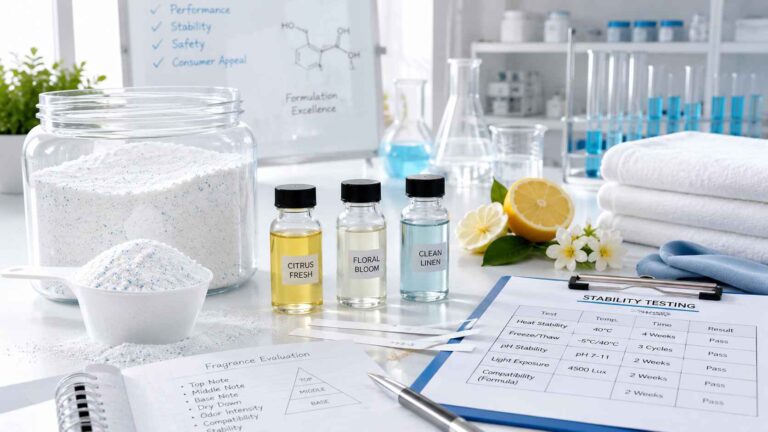
Balanced is harder, because a perfume oil formulation at 20% to 50% aromatics can smell expensive on Day 1 and still fail in clarity, skin feel, documentation, or pack stability by Week 3 if the carrier system and end-use logic were lazy. On CustomFragranceOil’s own perfume oil formulation guide, the working range starts around 15% to 30% aromatics for oil-based perfume oils, with extrait-style systems pushed to 20% to 50% only when the formula stays clear and still fits IFRA for the intended use.
Here is the hard part nobody likes to admit. A high concentration fragrance oil is not just “more scent.” It is more limonene, more linalool, more citral, more solvent pressure, more color drift, more chance that a beautiful accord turns greasy, cloudy, sharp, or legally awkward once it leaves the lab and enters real packaging. Natural materials do not magically rescue that problem either. On this site’s raw materials explainer, the argument is blunt and correct: naturals and synthetics both carry sensitization and compliance consequences when dose and exposure get sloppy.
And the exposure data is not soft. In a 2024 systematic review on fragrance sensitization, pooled sensitization rates in patch-tested European dermatitis patients were 6.81% for Fragrance Mix I and 3.64% for Fragrance Mix II, with measurable prevalence even in children. That is not boutique dermatology trivia. That is a warning that “just push the fragrance load” is amateur behavior in any leave-on or high-contact system.
Where perfume oil formulation usually fails first
Carriers do not forgive bad decisions
Pick the wrong carrier balance and the formula will tell on you later, because IPM, DPG, TEC, jojoba, and fractionated coconut oil do not just dilute a fragrance oil; they change glide, bloom, clarity, crystal behavior, and oxidation profile. I have seen teams blame the perfume when the real culprit was a carrier system that looked elegant in a sample vial and then turned sticky, hazy, or dull in production. The site’s fragrance development brief template gets this right by forcing teams to define use scenario, dosage window, pack type, and compatibility before the lab starts guessing.
Fragrance load is not fragrance architecture
Fragrance load is the number. Fragrance architecture is whether the number behaves.
I get impatient with brands that boast about high concentration fragrance oil without asking whether the top notes burn off in 20 minutes, whether the base smears into the pack, or whether the drydown gets muddy once the formula sits inside lotion, shampoo, wax, or a reed system. That is why I would send readers from this article straight into testing diffusion and throw in formulations and then into the site’s fragrance oil sampling protocol. A blotter can flatter. A real system will not.
Packaging exposes weak formulas faster than consumers do
Plastic lies quietly.
Then it taints the scent, softens the cap liner, drags top notes flat, or adds a waxy off-odor nobody budgeted for, which is why I do not approve a concentrated formula until it has seen the actual commercial pack. CustomFragranceOil already has the right next-step page here: plastic packaging odor: preventing tainting of finished scent. Most brands read that lesson after the complaint emails arrive. That is late.
The risk table I use before I approve a high concentration build
Pretty samples mislead.
A high concentration fragrance oil formulation should be treated like a risk stack, because the same move that improves richness can also erase allergen headroom, increase oxidation, trigger discoloration, or make the packaging smell cheap under heat and light. Why would I approve concentration first and ask technical questions later?
Risk vector
What usually breaks
Early warning sign
Control I insist on
Solubility and clarity
Haze, sediment, crystal fallout
Clouding after 24-72 hours
Carrier rebalance, 10% stock solutions for stubborn materials, freeze-thaw check
Accelerated heat, photostability, retained control comparison
Pack interaction
Plastic taint, liner pickup, leaks, warping
Odor shift in PET or cap after stress
Real-pack test at ambient and elevated temperature
Performance inflation
Loud opening, weak mid, messy base
“Smells strong” but dies in use
In-base testing at 0.5x, 1.0x, and 1.5x target dose
Paperwork failure
Shipment delay, retailer rejection, relabeling
Missing lot COA, stale IFRA, incomplete SDS
Release pack tied to lot, date, category, and market
My bias is simple: if a formula needs excuses, it is not ready. And yes, I mean before the sales team starts talking about “premium density.”
Compliance stopped being back-office gossip
Paperwork bites.
The IFRA Standards are a real safety framework, and I use them, but IFRA itself says the standards are a risk-management system and that final responsibility for placing safe products on the market stays with the company. That means IFRA is necessary, not magical. If your team is treating an IFRA certificate like absolution, your risk management is ornamental.
The U.S. got sharper too. Under FDA’s MoCRA framework, the responsible person must maintain records supporting adequate safety substantiation, and FDA explicitly flags fragrance allergen labeling among the regulations it must establish. So no, “we have been doing it this way for years” is not a defense anymore.
Europe moved earlier and harder. The July 26, 2023 fragrance-allergen rule, Commission Regulation (EU) 2023/1545, created a transition period to July 31, 2026 for placing non-compliant products on the market and a sell-through window to July 31, 2028, while California’s fragrance-allergen reporting guidance mirrors the same pressure with disclosure thresholds at 0.001% for leave-on cosmetics and 0.01% for rinse-off cosmetics. That is where high concentration fragrance oil becomes a labeling problem, not just a blending problem.
And yes, enforcement is real. The UK’s product-safety system published 2025 recalls for fragrances and body mists containing butylphenyl methylpropional, also called BMHCA or lilial, stating the ingredient is prohibited in cosmetic products and may harm the reproductive system while also causing skin sensitization. Anyone still telling you banned fragrance materials are a theoretical issue is selling fantasy, not operations.
My blunt rules for how to formulate perfume oil without getting burned
Start smaller.
I do not care how confident the creative team feels; if the concentrated accord has not passed a real stability test plan for fragrance oils, it is still a draft wearing expensive language. Heat, light, and time expose weak formulas faster than meetings do. On the site’s stability article, the advice is practical: test odor, color, clarity, packaging compatibility, and claim support, not just “does it still smell nice.”
Use categories, not vibes.
If the end use is Cat. 4 fine fragrance, Cat. 5 leave-on, Cat. 9 rinse-off, or Cat. 11 home fragrance, I want the formula built around that from the first bench sample, not retrofitted after marketing falls in love. That is why a fragrance development brief template is not bureaucracy. It is loss prevention.
Test the finished system, not the fantasy version.
I have seen concentrated perfume oils behave beautifully in amber glass and then flatten in PET, overbloom in wax, or go chemically thin in surfactants. The right workflow is brief, sample, in-base test, pack test, then scale. Anything else is laziness with a deadline. CustomFragranceOil’s fragrance oil sampling protocol and testing diffusion and throw in formulations belong in that sequence.
Stop assuming stronger equals better.
Purdue engineers reported in 2025 that scented chemical products such as air fresheners, wax melts, floor cleaners, and deodorants can rapidly fill indoor air with nanoscale particles formed when fragrance compounds react with ozone, and the university said between 100 billion and 10 trillion particles could deposit in the respiratory system within 20 minutes of exposure to scented products. In air care and home care, fragrance load is not just a luxury choice. It is an exposure decision.
Treat sourcing risk as formulation risk.
That sounds harsh. It is still true.
Reuters reported in February 2025 that a U.S. judge allowed price-fixing claims against four major fragrance makers to move forward, and Reuters later reported a $26 million antitrust settlement by IFF in October 2025. My point is not that every supplier is compromised. My point is that concentrated formulas with narrow cost headroom should never depend on blind trust, single-source paperwork, or casual lot comparison.
FAQs
What is a high concentration fragrance oil formulation?
A high concentration fragrance oil formulation is a scent system in which the aromatic concentrate is pushed near the upper performance or commercial limit for its product type, forcing the formulator to manage solubility, skin exposure, allergen disclosure, oxidation, packaging interaction, and documentation at the same time. I use that definition because “high concentration” without end-use context is empty talk.
How do you formulate perfume oil safely?
To formulate perfume oil safely, start with the intended end use, set the correct IFRA category and dosage window, choose carriers that keep the system clear and stable, and verify allergen, packaging, and stress-test performance before you scale from bench sample to bulk production. In practice, that means you do not approve a concentrated oil on scent alone.
What is the difference between fragrance load and fragrance concentration?
Fragrance concentration is the percentage of aromatic material inside the formula, while fragrance load is the practical dosing level used in a finished system such as wax, lotion, shampoo, or diffuser base, where hardware, solvents, airflow, and temperature decide whether that percentage behaves beautifully or badly. I wish more teams respected that distinction before blaming the perfume.
Is IFRA compliance enough for risk management?
IFRA compliance is a category-based safety framework for fragrance ingredients, but it is not a complete legal, toxicological, packaging, or market-readiness clearance, because you still need supplier records, lot-specific COA and SDS files, local labeling compliance, and proof that the exact formula survives real storage and use conditions. That is why I never sign off on IFRA alone.
Your next move
Build the formula like you expect it to be questioned.
Our team of 20+ senior perfumers leverages a vast library of 40,000+ formulas to deliver expert customization and scent replication with up to 98% accuracy. As premier perfume oil manufacturers, we bring your most complex fragrance concepts to life with precision.
Industry-Leading Speed
We empower your business with industry-leading speed. Samples are ready in just 1-3 days, mass production takes only 3-7 days, and our low 5kg MOQ allows you to test the market quickly and without risk, solidifying our role as agile fragrance oil suppliers.
Certified Quality & System Assurance
Our quality is built on trust and technology. We are fully certified with IFRA, ISO, GMP, and Halal, and our advanced ERP system guarantees complete traceability and batch-to-batch consistency, making us your reliable perfume raw materials supplier.