Fragrance Oil Pricing Trends: Raw Materials and Competitive Analysis
Fragrance oil pricing is not a neat formula. It is a messy collision of raw materials, compliance, batch economics, and supplier discipline. Here is the version procurement teams need, not the version sales decks prefer.
I do not buy the polite fiction that fragrance oil pricing is just raw material cost plus a tidy margin, because every serious fragrance quote is carrying hidden passengers: documentation, stability risk, substitution risk, MOQ pain, freight, compliance exposure, and the supplier’s private opinion about how badly you need speed this quarter. Want the hard truth?
Most buyers still compare the wrong number.
The price tag is built long before procurement asks for a quote
I have watched too many teams obsess over a $2-per-kilo difference while ignoring whether the formula is loaded with oxidation-prone citrus fractions, whether the allergen profile is going to trigger a relabel, and whether the supplier can reproduce the same odor profile after the first pilot batch. That is how “cheap” turns into expensive.
And here is the part most people miss. Even when broad commodity chatter sounds softer, perfume raw material prices can still move the other way. The U.S. BLS aromatics index, tracked through FRED, climbed from 210.257 in December 2025 to 227.513 in March 2026, an 8.2% jump in three months, even as Reuters reported the World Bank expected overall commodity prices to fall 12% in 2025 and another 5% in 2026. If you work in fragrance oil market analysis, that mismatch should bother you. It bothers me.
So what does that mean in plain English?
It means a fragrance concentrate built around synthetics like benzyl alcohol, linalool-rich accords, Hedione-style jasmines, musks, or solvent-heavy systems can get squeezed even when the macro headline says “commodities are easing,” because aroma chemicals do not move in a straight line with the headlines procurement people read over coffee.
Table of Contents
Raw materials move faster than supplier promises
Citrus is a textbook example of why naturals make finance teams nervous
Crop stories matter.
In January 2025, Reuters reported that Brazil’s orange juice exports fell 19.7% year over year in the first six months of the 2024/25 crop, to 430,078 metric tons, according to CitrusBR. Then the situation got nastier: in August 2025, Reuters reported that a 50% U.S. tariff would also hit orange byproducts including orange cells and essential oils used for aroma. If your fragrance oil pricing trends report is not tracking citrus feedstocks, you are leaving money on the table and risk on the table too.
Why does that matter for fragrance oil raw materials?
Because citrus-heavy profiles do not just depend on romance words like “fresh,” “zesty,” or “sunlit.” They depend on real molecules, real harvests, and real trade policy. D-limonene, citral, and terpenic fractions may look easy on a creative brief, but they can drag in oxidation issues, documentation burdens, and supply volatility at the exact moment a brand wants a clean launch window.
Synthetics are not the “stable cheap side” people pretend they are
That old story is lazy.
Synthetic-heavy fragrance systems usually win on consistency, batch control, and odor reproducibility, but when aromatics, solvents, and intermediates rise together, the buyer who thought synthetic equals stable pricing gets a blunt lesson in chemical inflation. I have seen buyers act shocked when “safe” formula architecture still gets repriced. Why are they shocked?
Because they confuse olfactive stability with commercial stability.
And yes, naturals still have their place. But when a formula leans too hard on naturals without a sourcing strategy, the quote often carries weather risk, harvest timing, extraction yields, oxidation risk, and wider batch drift. That is why buyers should read this site’s breakdown of fragrance oil raw materials and its practical guide on fragrance oils vs essential oils for sourcing and applications before arguing over price with a supplier.
Regulation is now part of the price, whether you like it or not
Compliance bills arrive late.
The legal precedent here is not abstract. Under EU Regulation 2023/1545, the European Commission amended Regulation (EC) No 1223/2009 on cosmetic products for fragrance allergen labelling, and the regulation text says the transition period should be 3 and 5 years. The same regulation also shows how listed substances such as Citral and Limonene trigger label disclosure thresholds at 0.001% in leave-on products and 0.01% in rinse-off products. That does not just affect labels; it changes formula choices, paperwork load, packaging decisions, and old-stock risk.
I will say it plainly. A supplier who talks only about odor and price, but not IFRA category fit, allergen disclosure, peroxide stability, SDS, COA, and application-specific limits, is not really quoting you a finished commercial solution. They are quoting you a partial problem.
Competitive analysis: who is actually cheap, and who only looks cheap
I dislike simplistic supplier rankings because they usually reward the prettiest spreadsheet, not the lowest all-in cost. Still, buyers need a frame, so here is mine.
Supplier Type
Typical Front-End Quote
What Usually Gets Hidden
Best Fit
My View
Broker or trading house
Lowest headline number
Substitution risk, thin technical files, variable batch control
Fast spot buying on low-risk profiles
Cheap until it is suddenly not
Regional blender
Mid-range
Narrower raw-material pool, uneven application testing depth
A real fragrance oil competitive analysis should score suppliers on formula architecture, regulatory readiness, substitution policy, technical support, pilot stability, lead time discipline, and how they behave when one raw material blows up mid-quarter. I do not care how friendly the account manager is. I care what happens when the citrus fraction is late, the musk alternative smells flatter, and the customer deadline does not move.
And this is where buyers usually make their biggest mistake. They benchmark quote A against quote B, but they never benchmark failure cost: reformulation hours, relabel costs, sample reruns, air freight, delayed launch, customer complaints, and dead stock. That is amateur math.
How I would benchmark fragrance oil pricing right now
Start narrower.
I would split every quote into six buckets: raw materials, carrier or solvent system, documentation package, batch-size economics, logistics, and risk premium. Then I would force every supplier to identify which notes are botanically exposed, which molecules are substitution-sensitive, and which parts of the formula are likely to move if aromatics, citrus fractions, or musks tighten.
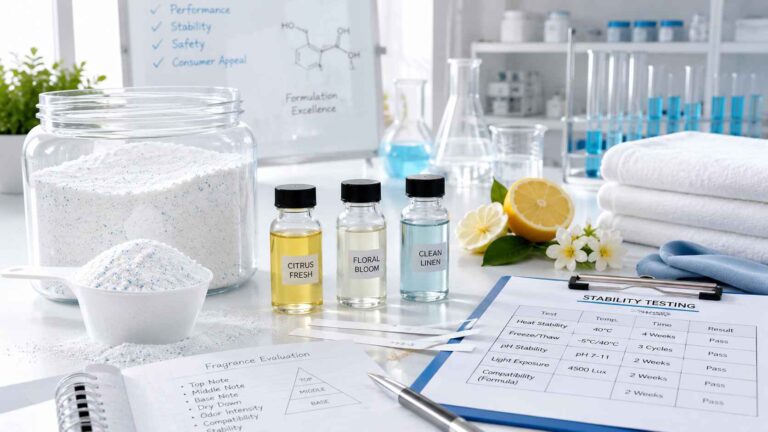
And I would not stop there. I would compare the quote against the site’s stability test plan for fragrance oils, because a cheap oil that discolors, hazes, oxidizes, or collapses in surfactant, wax, or alcohol is not cheaper. It is defective budgeting.
Need another unpopular opinion?
The best fragrance oil suppliers are usually not the ones who promise the impossible. They are the ones who tell you, early, that your bergamot top will drift, your allergen profile is ugly, your 5 kg MOQ fantasy will cost more per kilo than you expected, and your “inspired by” brief is missing the application data that decides everything. If you are still building briefs loosely, fix that first with this site’s fragrance development brief template. Bad briefs create fake price comparisons.
FAQs
What is fragrance oil pricing?
Fragrance oil pricing is the all-in commercial value of a scent formula, including aroma chemicals, naturals, carriers, compliance paperwork, testing, minimum order economics, packaging, freight, and supplier margin, rather than the simple per-kilo quote many buyers mistake for a real comparison. Once you price it that way, the “cheap supplier” often stops looking cheap.
What drives fragrance oil pricing trends?
Fragrance oil pricing trends are driven by the interaction of crop volatility, petrochemical input costs, allergen and documentation rules, freight, currency, batch size, and supplier structure, which means a formula can become more expensive even when broad commodity indexes or crude oil are moving in the opposite direction. Brazil citrus pressure and aromatics inflation are good recent examples.
How do I analyze fragrance oil pricing?
To analyze fragrance oil pricing, break the quote into formula composition, dosage rate in the finished product, documentation quality, stability risk, regulatory fit, MOQ, lead time, and reformulation exposure, then compare total delivered cost per compliant sellable unit instead of chasing the lowest kilogram number. I would also ask which raw materials are likely to be substituted if supply tightens.
What makes the best fragrance oil suppliers competitive?
The best fragrance oil suppliers are competitive when they combine stable raw-material sourcing, transparent IFRA and SDS support, repeatable batch control, realistic MOQs, fast sampling, and honest substitution policies, because that mix lowers launch risk and rework costs even if the opening quote is not the cheapest. In practice, discipline beats charm.
Why do perfume raw material prices feel disconnected from headline commodity news?
Perfume raw material prices feel disconnected from headline commodity news because fragrance formulas sit at the intersection of petrochemicals, agricultural feedstocks, trade policy, documentation rules, and application testing, so a soft macro market can still produce harder pricing inside citrus oils, aromatics, musks, or allergen-sensitive blends. That disconnect is real, not imagined.
Final Thoughts
Stop buying stories.
If you are reviewing wholesale fragrance oil pricing this quarter, do not ask suppliers for “best price” and call it strategy. Ask for formula-level risk notes, allergen impact, substitution policy, application test data, and documentation timing. Then compare suppliers against the wholesale fragrance oils catalog and the supporting technical articles linked above, build a tighter brief, and force the conversation away from perfume theater and toward commercial reality. That is where better margins usually start.
Our team of 20+ senior perfumers leverages a vast library of 40,000+ formulas to deliver expert customization and scent replication with up to 98% accuracy. As premier perfume oil manufacturers, we bring your most complex fragrance concepts to life with precision.
Industry-Leading Speed
We empower your business with industry-leading speed. Samples are ready in just 1-3 days, mass production takes only 3-7 days, and our low 5kg MOQ allows you to test the market quickly and without risk, solidifying our role as agile fragrance oil suppliers.
Certified Quality & System Assurance
Our quality is built on trust and technology. We are fully certified with IFRA, ISO, GMP, and Halal, and our advanced ERP system guarantees complete traceability and batch-to-batch consistency, making us your reliable perfume raw materials supplier.