Scenting in offices/hospitals: evaluating low-allergen acceptance
Most ambient scenting programs fail for one boring reason: nobody measures acceptance like a safety KPI. Here’s how to run low-allergen scenting in offices and hospitals without walking into an HR, ADA, or clinical backlash cycle.
Smell is politics. In any office or hospital, you’re changing shared air—so you’re making a decision for people who didn’t consent, including asthma patients, migraine-prone staff, chemo visitors, and the one employee who won’t complain until their lawyer does. Who gets a vote?
I’m going to say the quiet part out loud: “low-allergen acceptance” is not a fragrance spec. It’s an operations spec. If you don’t treat it like an indoor-environment change (controls, documentation, monitoring), you’ll get the exact outcome you deserve: a few compliments, then a spike in complaints, then a panicked shutdown and a memo nobody wants to sign.
Table of Contents
The uncomfortable baseline: hospitals are not malls
If you’re scenting patient-care zones, you’re already behind. The American Medical Association has explicitly pushed for fragrance-free policies in patient-care environments, and it frames fragrance sensitivity as potentially disability-relevant under ADA logic, not “preference.” It also cites survey stats that should bother any administrator: over 30% report fragrance sensitivity, 50% prefer healthcare facilities be fragrance-free, and 7% lose workdays due to workplace fragrance exposure.
That’s not a vibe check. That’s an operational risk profile.
So where does ambient scenting belong in healthcare? Lobby, retail pharmacy entrance, maybe admin corridors—if you can prove control and give people clean ways to avoid it. In clinical areas: you’re arguing with both ethics and workflow.
What the chemistry is doing while marketing is talking
Most “hypoallergenic fragrance diffuser” claims I see in the wild are sloppy language. Allergens aren’t binary, and “hypoallergenic” isn’t a magic shield when the delivery system is blasting volatile compounds into an HVAC return.
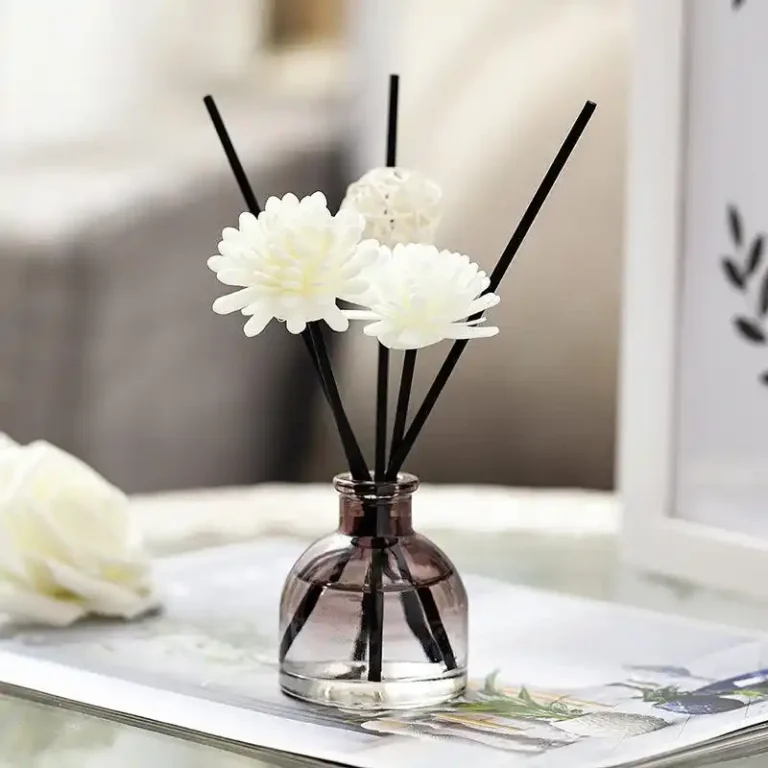
One 2024 open-access study in Cell Reports Physical Science tested VOC emissions from a typical reed diffuser and found the top VOCs were linalool acetate, linalool, and α-pinene, with linalool acetate at 31.4%–43.6% of total VOCs at 25°C. That’s the part vendors skip: composition, fractions, and how temperature and placement change distribution.
Now translate that into real buildings:
α-pinene (C₁₀H₁₆) and linalool (C₁₀H₁₈O) are common terpene-family ingredients. Terpenes react indoors (ozone chemistry is a thing), which can create secondary pollutants.
“Same oil, different air” isn’t philosophy; it’s why your office ambient scenting system behaves fine on Monday and becomes a complaint magnet on Thursday after HVAC balancing, humidity swings, or a cleaning-product change.
If you want a practical internal primer on how air conditions change diffuser behavior, the site’s breakdown on mists/nebulizers evaporation curve and fall-out is a decent starting point before you even talk fragrance notes. Mists/Nebulizers evaporation curve and fall-out
The legal/HR angle nobody budgets for
If your plan is “we’ll stop if someone complains,” you’re operating like it’s 1999.
Workplace fragrance restrictions show up in modern policy language because employers keep getting cornered between competing needs (employee preference vs. accommodation). Reuters Practical Law even includes an optional “Fragrance-Free Workplace” clause template, and calls the topic controversial—translation: it’s common enough to require standard wording.
If you’re implementing ambient scenting, you need the inverse too: a written, boring, defensible protocol for complaints, opt-outs, and adjustments. Canada’s CCOHS guidance is blunt about how to build a scent-free policy and why it exists (health triggers, accessibility, and reducing disputes).
My framework: how I evaluate “low-allergen acceptance” in 30 days
1 Pre-screen the formula like a compliance person, not a perfumer
Require SDS + allergen disclosure to the extent feasible.
Don’t let “proprietary blend” become “no accountability.”
If you’re sourcing oils for diffusion, start from vendors who build explicitly for air applications, not skin-first compositions. The site’s Air Care fragrance category is literally positioned for ambient scenting products and systems. Air Care fragrance oils for ambient scenting products
Hard truth: “low-allergen” dies at high dose. Acceptance is non-linear. Small increases can feel massive to sensitive users.
So I use an ugly but effective KPI:
Complaint rate per 1,000 occupant-days
Symptom-coded complaints (headache, nausea, wheeze, throat irritation) tracked separately from “don’t like it”
When you sell this internally, skip poetry. Use ROI language facilities people can defend. The site’s own guide on calculating ROI on fragrance upgrade projects helps frame scent as measurable behavior and cost, not “brand magic.” Calculate ROI on fragrance upgrade projects
3 Design escape routes (this is where hospitals usually fail)
In hospitals, “escape route” is not optional.
Post signage where scent is present (simple, calm language).
Create unscented corridors or waiting zones.
Keep patient-care floors scent-free by default unless leadership is willing to defend it publicly.
Is “hypoallergenic ambient scenting” real, or just marketing? Hypoallergenic ambient scenting is a risk-reduction approach that minimizes known sensitizers, keeps VOC output and dose low, and pairs diffusion with policies and opt-out options—because no fragrance can be guaranteed non-reactive for all people, especially in mixed populations like offices and hospitals. In practice, if a vendor can’t discuss allergens, dose control, and complaint handling, they’re selling hope.
What does “low-allergen acceptance” mean in an office ambient scenting system? Low-allergen acceptance is the measurable tolerance of occupants to a specific scented-air program, typically tracked through complaint rate, symptom-coded reports, and opt-out utilization, while confirming the program stays stable across HVAC cycles, temperature shifts, and placement variables that change exposure patterns. If you can’t quantify it, you’re guessing—and guesswork gets expensive.
Can hospitals do ambient scenting without violating a scent-free policy healthcare norm? Hospital ambient scenting can be compatible only when limited to non-clinical zones, clearly disclosed, and designed with avoidance pathways, because medical associations and institutional policies increasingly treat fragrance sensitivity as an accessibility and patient-safety issue rather than a preference debate. If you can’t defend it to a risk committee, don’t deploy it.
What’s the biggest technical mistake with low-VOC scent refills and diffusers? The biggest mistake is assuming a low-VOC refill stays “low impact” at any dose and in any placement, when studies show diffuser emissions have dominant compounds and distributions that change with temperature and position, producing localized exposure spikes that drive complaints. Move the unit before you reformulate. Often that fixes half the problem.
What policy language should HR use when fragrance sensitivity shows up? A workplace fragrance policy is a written standard that defines permitted/limited fragrance exposure, complaint handling, accommodation steps, and enforcement boundaries, so disputes don’t become improvisation; credible templates and guidance exist because this topic regularly triggers conflict and legal exposure. Write it before the first complaint, not after.
Conclusion
If you’re serious about ambient scenting in offices or hospitals, treat it like a controlled indoor-air program: screened formulas, low dose, zoned deployment, signage, opt-outs, and real complaint math. If you want help building a diffusion-ready brief (and sourcing oils designed for air applications), start with the site’s Air Care fragrance oils and the diffuser fragrance oil manufacturer hub, then design the pilot like you’re trying to prove yourself wrong.
Our team of 20+ senior perfumers leverages a vast library of 40,000+ formulas to deliver expert customization and scent replication with up to 98% accuracy. As premier perfume oil manufacturers, we bring your most complex fragrance concepts to life with precision.
Industry-Leading Speed
We empower your business with industry-leading speed. Samples are ready in just 1-3 days, mass production takes only 3-7 days, and our low 5kg MOQ allows you to test the market quickly and without risk, solidifying our role as agile fragrance oil suppliers.
Certified Quality & System Assurance
Our quality is built on trust and technology. We are fully certified with IFRA, ISO, GMP, and Halal, and our advanced ERP system guarantees complete traceability and batch-to-batch consistency, making us your reliable perfume raw materials supplier.