If you work in personal care, home care or fine fragrance, you already know this: the smell can save a product or kill it. But the scent doesn’t appear in one night.
There’s the brief, accords, use-test, stability, packaging, and then finally full production. If any step slips, the whole launch window gets stressed.
In many real projects a full fragrance journey looks something like this:
Concept and brief
Creative accords and first mods
Application testing in the real base
Stability and compatibility checks
Scale-up and filling
The problem? People try to do all of this in one tiny time slot. Then the juice starts to yellow in month three or the scent dies in detergent after a week on shelf.
A supplier like I’Scent can’t remove every problem. But with big formula library, quick sampling, and strict quality, they make the line a lot smoother.
Fragrance Development Timeline: Why It Matters for Your Brand
Let’s zoom out first.
Most brands we see allow at least a few months from “scent idea” to “stable, ready formula.” Shorter is possible. It’s just more risky. A very rough guide that many teams use:
1–2 weeks for concept and fragrance brief
2–4 weeks for creative accords and first round of mods
2–4 weeks for application tests in the real base
4–12 weeks for stability and compatibility
Extra weeks for filling, artwork, approvals
You don’t need to show this table to consumers. But your marketing team, purchasing and factory really should see it.
When they know the timing, they stop asking for “final scent” before the base is even ready. And you stop throwing half-baked fragrances into shampoo or candles, hoping it will behave.
Fragrance Brief and Creative Accord in Fine Fragrance Projects
Fragrance Brief and Market Concept Development
The fragrance brief is where the real work starts. It’s not a moodboard only. It’s more like a technical story that answers:
What category is it? EDP, body lotion, shower gel, detergent, reed diffuser…
Which story or mood? Clean spa, smoky wood, gourmand, hotel lobby, fresh laundry.
Which regions and rules? IFRA level, retailer lists, local habits.
What performance do you need? Hot throw, cold sniff, shower bloom, dry-down strength.
Here you also decide what kind of oil you want. Fine scent? You may look at fine fragrance oil solutions or ready bases like Amber Wood EDP Base. More functional? Then you’ll be in cosmetic, detergent or home-care formats.
A clear brief cuts rounds. A fuzzy one creates chaos. It sounds boring, but this is one of the biggest pain points we see with new brand owners.
Creative Accord and First Evaluation Round
Once the brief lands, the perfumers start building creative accords. These are simple skeletons that catch the soul of the idea:
Amber-wood structure for a premium EDP
Baby powder accord for baby wash
Citrus-clean vibe for dish liquid
Because I’Scent holds 40,000+ formulas and works with 20+ senior perfumers, a lot of work is actually reuse plus smart tweaking. Instead of mixing from zero, the team can pull a proven base from the library and tune it to your story and your base.
That’s how they get first samples out in 1–3 days in many cases. Not magic. Just a lot of prior work stacked up. Is it always perfect? No of course. But it gives you something real to smell and cut, not just an idea in a slide.
From Lab Samples to Maceration: Perfume Oil Performance in Different Bases
Application Testing in EDP, Body Care and Home Care Formats
A fragrance that smells amazing on a blotter can totally crash in the real formula. So the next step is application testing in each usage scene:
EDP and body spray: test spray pattern, top-note lift, dry-down, maceration time.
Skin and hair: use cosmetic fragrance oils in real bases to watch foam, after-feel and any irritation issues.
Candles or diffusers: hot throw, cold sniff, burning behavior.
Some teams also let the perfume in alcohol macerate for a week or a few weeks. That resting time lets the top, heart and base settle and gives a more honest view of the final scent.
It’s tempting to skip this and just decide from a strip. But that’s how you end up with “it smelled great in the lab, now it smells weird in the bottle” stories.
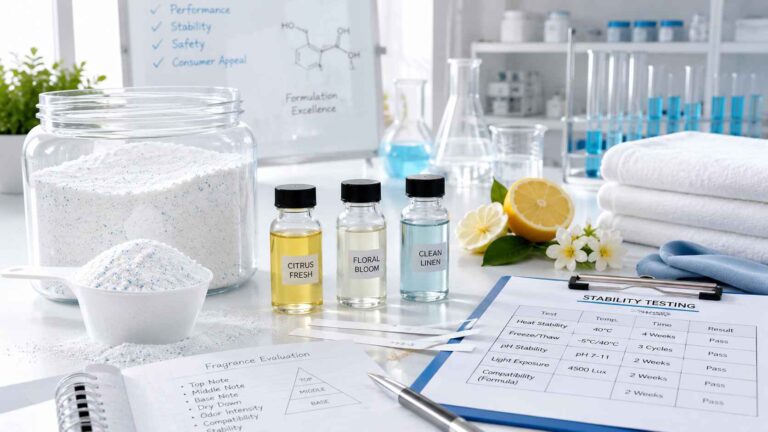
Stability Testing for Fragrance Oils in Personal Care, Home Care and Air Care
Now we arrive at the critical jump: from creative accord to stable formula. This is the less sexy part of the process, but if you miss it you pay later with complaints, returns, or even recalls.
Accelerated Stability, Freeze–Thaw and Transport Testing
Stability work usually mixes a few common methods:
Accelerated stability Products go into warm ovens or rooms for some weeks. You track color, scent, pH, viscosity and any separation. This simulates months or years on shelf.
Freeze–thaw cycles The batch moves between low temperature and room temperature several times. This copies winter shipping or bad storage. Any clouding, crystals, or odor loss shows up fast.
Light exposure Clear packs need this. You place samples under strong light or UV. Then you check for browning, fading, or burning notes.
Transport and room-temp checks Realistic storage. Pallets sit under normal conditions. You open them at different weeks and compare to your starting point.
For fragrance oils in skincare, hair, cleaning and air care, these tests aren’t “nice to have”. They’re needed if you want a formula that behaves the same in different seasons and countries.
Typical Stability Testing Durations in Fragrance Projects
To keep everyone aligned, you can share a simple table like this in project kick-offs:
Stage in Scent Timeline
What Happens
Typical Duration (Guide Only)
Main Risk if You Rush It
How I’Scent Supports
Brief & concept
Lock category, story, target rules, cost window
1–2 weeks
Wrong direction, too many re-briefs
Senior perfumers help sharpen the spec
Creative accords & first mods
Build and tweak key accords
2–4 weeks (often faster with library)
Not enough options, weak uniqueness
40,000+ formulas give a wide start
Application testing in base
Put fragrance into real formula
2–4 weeks
Smell OK on strip but bad in base
Tested oils for many scenes and uses
Accelerated stability & light
High temp, light, sometimes freeze–thaw
4–12 weeks
Off-odor, discoloration, phase split after launch
Internal QA and lab routine catch issues
Transport & real-time
Simulate shipping and storage
Several more weeks or months
Complaints after export, relabeling
ERP tracking and repeatable batches
Scale-up & first filling
Move to production and pack
Few weeks
Odor shift at scale, filling troubles
Fast 3–7 day production once locked
These numbers aren’t hard rules. But they stop the “we’ll do full stability in ten days” fantasy that still shows up in some meeting rooms.
Packaging Compatibility and Detergent Fragrance Performance
Cleaning Products, Surfactant Systems and Scent Longevity
Home care, laundry and some household scenes are quite aggressive for scent. Strong surfactants, bleaches, solvents and enzymes can attack top notes or certain naturals.
Typical headaches:
Bright citrus fades fast in heavy detergent
Vanilla-type notes turn the liquid brown in clear packs
Some musk or woody notes stick to plastic and never fully release
That’s why many formulators go for special detergent fragrance systems, like the ones on I’Scent’s detergent fragrance manufacturer page. Those oils are designed for:
High surfactant load and high water activity
Rinse profile on fabric
Warm and humid warehouses, long haul shipping
Packaging adds another layer. The fragrance has to stay friendly with pumps, seals, liners, bottle resin and label inks. Clear bottles look nice on shelf but give more light stress. Sometimes a tinted or opaque pack is just smarter.
I’Scent already tests many fragrance oils in real detergent and cleaning bases, not only in a neutral solvent. That cuts a lot of surprise later.
How I’Scent Compresses the Fragrance Development Timeline Without Cutting Corners
Fast Sampling, Low MOQ and Formula Matching
I’Scent isn’t only a raw material seller. They act as an OEM/ODM fragrance oil and perfume raw materials manufacturer with:
More than 20 experienced perfumers
Over 40,000 existing formulas
Fragrance copy service with up to 98% match rate
Samples ready in about 1–3 days for most projects
Production in about 3–7 days once formula is final
Low starting order, from 5 kg for many stock items
If you already have a best-selling scent and want to roll it into new formats, their matching and customizing can save huge time. Instead of guessing the accord, they analyse and rebuild it for your new base, whether you need a perfume oil manufacturer style bulk concentrate or a more tailor-made OEM/ODM fragrance solution.
So the “creative side” of the timeline moves faster without turning into a rush job.
Certified Quality and Full Traceability
On the stability and scale-up side, I’Scent works under IFRA, ISO, GMP and Halal systems. An advanced ERP platform tracks every batch of oil and raw material, so you can trace back from finished product to each input.
This helps you:
Keep batch-to-batch odor very close
Answer retailer or authority questions quickly
Sleep a bit better when your products travel worldwide
In simple words, they help make sure your creative accord stays that same accord in a million bottles, not only in the tiny first lab sample.
So, How Should You Plan Your Next Fragrance Project?
Let’s keep it simple and real:
Respect the timeline. From idea to stable formula, plan for concept, application tests and stability. Not only for “tasting session” with marketing.
Think by usage scene. Fine fragrance, skincare, hair care, laundry, home cleaning, air care — each one needs its own kind of oil. Use things like fine fragrance oil or Amber Wood EDP Base for EDP, and dedicated home-care or cosmetic oils for functional lines.
Build stability in from day one. Choose base, packaging and fragrance type together. Don’t treat stability as a last step.
Work with partners who already solved half of your problems. A big library, fast sampling, full certifications and solid ERP mean you don’t need to learn every hard lesson yourself.
Is it perfect every time? No, of course not, things still go wrong sometimes. But when you treat the fragrance development timeline as a proper process, and you lean on a supplier like I’Scent, your chances of landing on a stable, beautiful formula – on time – go way, way up.
Our team of 20+ senior perfumers leverages a vast library of 40,000+ formulas to deliver expert customization and scent replication with up to 98% accuracy. As premier perfume oil manufacturers, we bring your most complex fragrance concepts to life with precision.
Industry-Leading Speed
We empower your business with industry-leading speed. Samples are ready in just 1-3 days, mass production takes only 3-7 days, and our low 5kg MOQ allows you to test the market quickly and without risk, solidifying our role as agile fragrance oil suppliers.
Certified Quality & System Assurance
Our quality is built on trust and technology. We are fully certified with IFRA, ISO, GMP, and Halal, and our advanced ERP system guarantees complete traceability and batch-to-batch consistency, making us your reliable perfume raw materials supplier.