You can launch with “one beautiful smell.” Plenty of brands do. But the second you try to stretch that scent into shampoo, lotion, candle, room spray, and maybe a fine fragrance drop, things get messy fast.
Your “signature” starts drifting. The candle feels heavy. The body wash smells thin. The air care gets sharp. Customers don’t say “your formula changed.” They say “this doesn’t feel like you anymore.” Ouch.
So here’s my point: a brand signature scent isn’t one fixed formula. It’s a scalable scent system—a clear fragrance brief, a signature accord you can carry, and a portfolio plan that holds up across different bases, dosages, and compliance categories.
And yep, this is exactly the kind of work I’Scent does every day.
Brand signature scent
A real brand signature scent has two jobs:
Recognition: people smell it and instantly connect it to you.
Repeatability: the scent stays “on brand” across products and batches.
If you only chase “smells nice,” you’ll end up with a fragrance that wins on a blotter strip but fails inside real product formulas. That’s the classic trap. It happens alot.
The goal isn’t “a pretty perfume.” The goal is olfactive branding you can scale.
Fragrance brief
Most fragrance briefs are too vague. “Fresh, clean, premium” is basically air.
A useful fragrance brief is simple, but it’s specific. It answers:
What should the customer feel in 3 seconds?
What notes are must-have and what notes are no-go?
Where will this scent live: shower, laundry, living room, hotel amenities, retail shelf?
What’s the product base: surfactant, wax, alcohol, detergent, lotion?
What’s the dosage window (your chemist will thank you)?
What compliance flags matter (IFRA category, allergen disclosure, restricted materials)?
When you lock this early, you cut down the “I like / I don’t like” loop. You also protect your timeline, because every revision round costs time and focus.
Signature accord
Here’s the part people skip: you don’t scale a signature scent by copying one formula everywhere.
You scale it by building a signature accord.
Think of it like your scent fingerprint. A backbone. A “this is us” chord that you can re-balance for different uses without losing identity. Examples (not formulas, just shapes):
clean musk + airy woods
tea-citrus lift + soft amber base
creamy floral heart + skin musk drydown
This is also where industry folks talk about brand DNA, olfactive logo, or scent equity. Same idea. You’re building something you can reuse, not a one-time hit.
Fragrance portfolio strategy
A fragrance portfolio shouldn’t feel like random flavors. It needs structure.
A practical setup looks like this:
Core signature lane One main identity scent. This is the scent that shows up across categories first.
Category-optimized lane Same identity, but engineered for performance: candle throw, soap stability, detergent bloom, etc.
Seasonal / limited lane Fast drops for trends, gifting, and testing new directions without risking the core.
This keeps your lineup tight. It also stops internal fights like “Which scent is the brand now?” (That question is a revenue killer, honestly.)
Multi-category fragrance application
Different product bases don’t “wear” fragrance the same way. So if you’re building from one fragrance to a full portfolio, you need to plan around performance KPIs, not vibes.
Below are the big format realities. If you’ve been burned before, you’ll recognize these pain points right away.
Personal care fragrance oil
In body wash, shampoo, and skincare, you’re fighting wet dilution and surfactant suppression. Delicate top notes can vanish. Some materials can also clash with the base odor.
What you usually need:
stronger structure in the heart/base
smart fixation so it lasts through rinse-off
stability that doesn’t discolor or separate
If personal care is your lane, you’ll want a supplier who understands those matrices. I’Scent supports that category here: Personal Care
Home care fragrance
Home care is where fragrance gets brutal: high pH, strong solvents, and aggressive cleaning actives can warp the scent profile.
Common issues:
“It smelled great in the bottle, but weird on drydown.”
haze/clouding in liquid formulas
scent shift after storage
Here’s the category page if home care is on your roadmap: Home Care
Air care fragrance
Air care is about diffusion. Not just “smell,” but how it fills space.
If it’s too loud, people call it chemical. If it’s too soft, they think it’s weak and won’t rebuy. You’re balancing:
This area needs extra care. Heat, realism, and compliance can get tricky. Also, the sensory bar is different. People can tell when a “strawberry” smells like candy vs fruit, and they’ll judge you hard.
If you want one platform that can stretch into multiple uses, fragrance oils often become the workhorse. You build the signature accord there, then adapt.
When brands scale, compliance becomes the quiet boss in the room.
If you sell globally, you need clean documentation flow and consistent formulas that match the right end-use categories. No one wants a last-minute reformulation because a material cap changed, or because an IFRA category limit got missed.
I’Scent highlights IFRA coverage plus ISO/GMP/Halal certifications and traceability controls. If you need an overview from their side, this page lines up with that keyword intent: IFRA-Compliant Fragrance Oil Supplier
Fragrance duplication service
Let’s be real: a lot of “signature scent” projects start with a benchmark.
Maybe you’re switching suppliers. Maybe you lost access to a material. Maybe you need to match an existing scent for a line extension and keep the brand consistent.
That’s where fragrance duplication becomes a business tool, not a creative gimmick.
I’Scent positions duplication as a core service with:
20+ senior perfumers
40,000+ formula library
up to 98% scent matching accuracy
That’s helpful because duplication often becomes step one, then you build variants for each use-case: rinse-off, leave-on, air care, candle, and so on. One match, many adaptations.
Batch-to-batch consistency
Customers have a crazy strong “smell memory.” If your Batch B smells even slightly off from Batch A, they’ll notice. They may not know why, but they’ll feel something is “off.” Thats how you lose trust.
To control this, you need:
traceable raw material lots
consistent blending methods
strong QC checkpoints
systems that reduce human error
I’Scent calls out an ERP system for full traceability and consistent batches. That’s not marketing fluff. It’s how you protect repeat purchase, especially when your portfolio grows.
If you want the supply chain angle (and why stability matters for your business ops), this page fits: Fragrance Oil Supply Chain
Lead time and MOQ
Portfolio building dies when sampling is slow. Because you can’t learn fast.
I’Scent states:
samples in 1–3 days
production in 3–7 days
low MOQ 5 kg for many items
custom scents often start around 25 kg
No cost math here. Just a simple truth: speed protects your launch calendar. It also lets you run more trials and pick the best-performing option, not the “best we had time for.”
I’Scent OEM/ODM fragrance oil & perfume raw materials manufacturer
If you’re building a signature scent and scaling into a portfolio, you don’t just need “a nice fragrance.” You need a partner who can run a full pipeline:
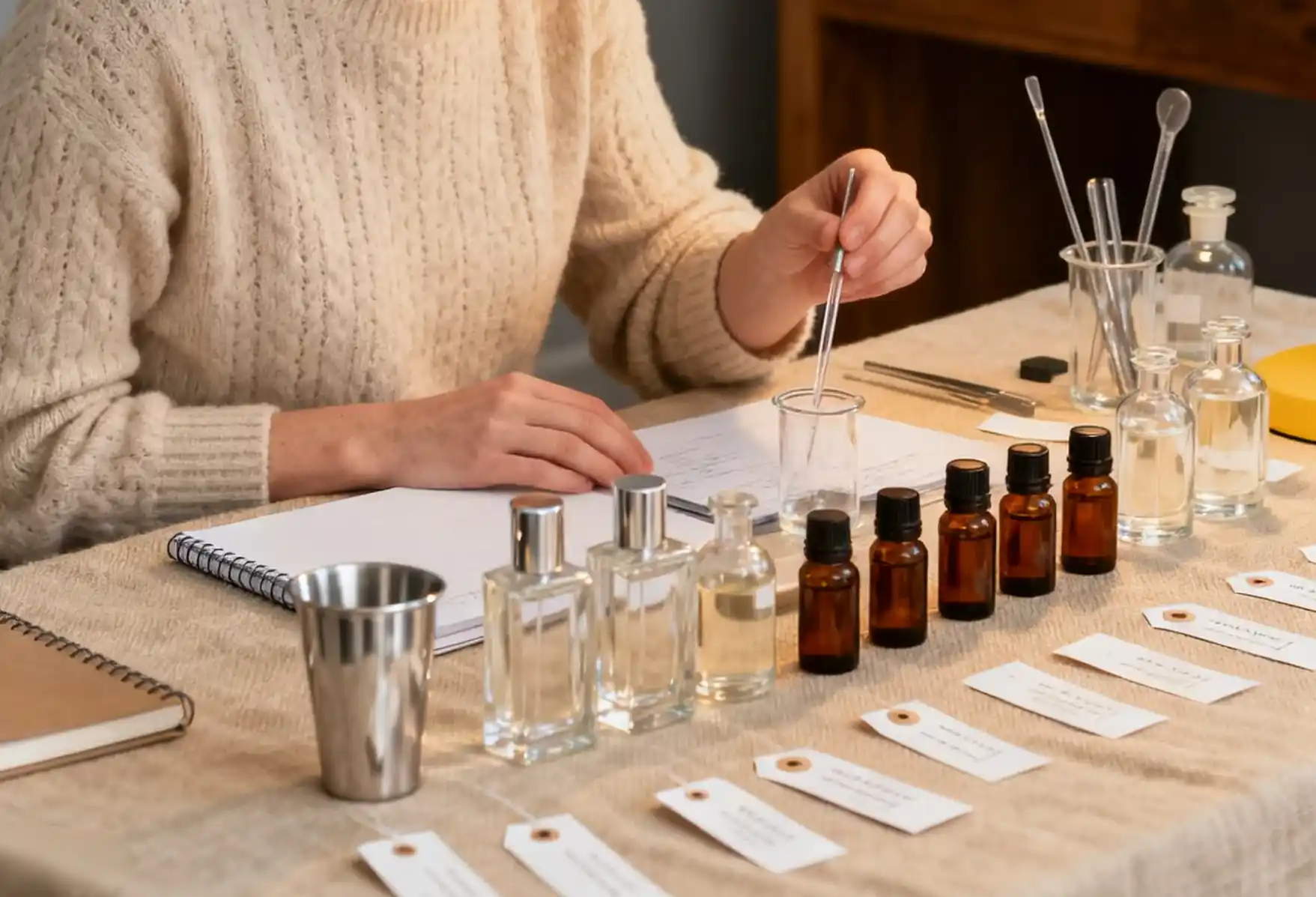
translate a fragrance brief into workable samples
build a signature accord that can travel across categories
handle duplication and custom development
support compliance docs and stability expectations
ship consistently, with traceability
That matches I’Scent’s positioning as an OEM/ODM Fragrance Oil & Perfume Raw Materials Manufacturer, active since 2005, supplying formulas worldwide.
Portfolio planning table
Here’s a clean way to plan your scent system without overthinking it.
What you’re building
What you should lock first
Common failure mode
Fix (industry talk)
What I’Scent brings
Core signature scent
brief + signature accord
“smells nice, not recognizable”
olfactive DNA + guardrails
perfumer team + big formula library
Shampoo / body wash
wet performance
top notes disappear
wet dilution tuning
personal care know-how
Candle / diffuser
throw + stability
weak hot throw / off-note
diffusion curve + burn behavior
category development
Room spray / air freshener
clean diffusion
too sharp or too soft
balance + halo control
air care experience
Global rollout
docs + consistency
reformulation surprises
IFRA-ready workflow
IFRA/ISO/GMP/Halal + traceability
Vendor switch / line extension
duplication
“close, but not it”
benchmark match + variants
up to 98% matching claim
Wrap-up: build a scent system, not a single formula
If you want “one fragrance to a full portfolio,” don’t treat scent like a one-time creative decision. Treat it like a scalable asset:
write a real fragrance brief
build a signature accord
plan a fragrance portfolio strategy
engineer for multi-category application
stay ready with IFRA compliance
protect trust with batch consistency
move fast with workable lead times and MOQs
If you’re doing this now, start by browsing the categories you actually want to win in—then build the signature in a way that can travel:
Our team of 20+ senior perfumers leverages a vast library of 40,000+ formulas to deliver expert customization and scent replication with up to 98% accuracy. As premier perfume oil manufacturers, we bring your most complex fragrance concepts to life with precision.
Industry-Leading Speed
We empower your business with industry-leading speed. Samples are ready in just 1-3 days, mass production takes only 3-7 days, and our low 5kg MOQ allows you to test the market quickly and without risk, solidifying our role as agile fragrance oil suppliers.
Certified Quality & System Assurance
Our quality is built on trust and technology. We are fully certified with IFRA, ISO, GMP, and Halal, and our advanced ERP system guarantees complete traceability and batch-to-batch consistency, making us your reliable perfume raw materials supplier.